



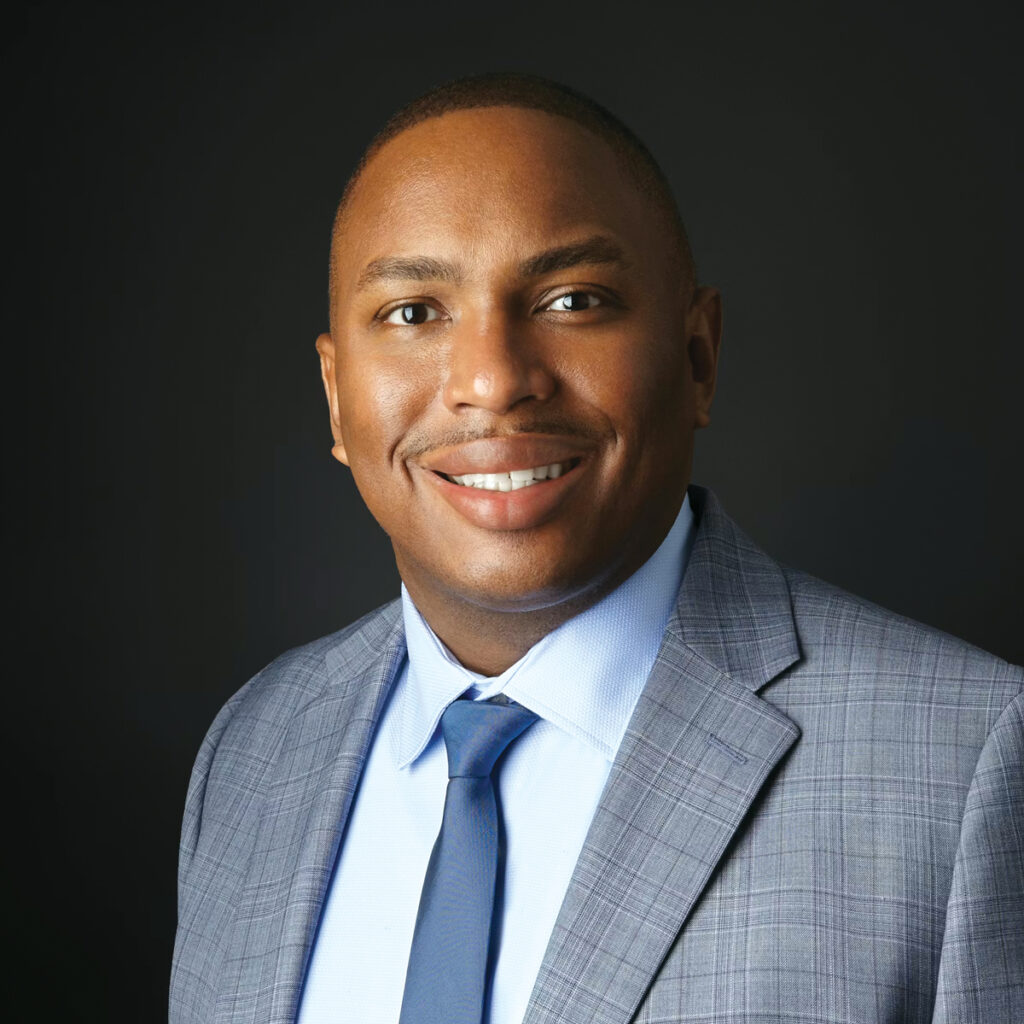
Vernon M. Taylor helped establish JFKIAT’s corporate People Operations department and built it from the ground up, implementing new policies and providing employees with a wide range of resources and benefits. The department was founded on the belief that people are JFKIAT’s greatest asset.
Taylor serves as Chair of JFKIAT’s DEIB and 4GOOD Committees and is a Bronze Stevie Award winner in the 2024 International Business Awards. He was also recognized as a 2024 Queens Power List Honoree and named a 2025 Queens Power List Icon, reflecting his impact as a leader shaping both the aviation industry and the Queens community.
Before joining JFKIAT, Taylor served as the Director of Human Resources at Open Loop New York, a subsidiary of RATP Group. From automobiles to buses to planes, Taylor has excelled at transforming the culture and building impactful People Operations departments within the transportation sector. Taylor earned a Bachelor’s degree in Business Administration with a focus in Management from Berkeley College and a Master’s Degree in Organizational Change Management from Milano The New School for Management & Urban Policy; additionally, he is a Society for Human Resource Management (SHRM) Certified Professional (SHRM-CP).
1 Tell us about your background. How did you begin your career in Human Resources, and what led you to your position as Director of People Operations at JFKIAT?
Vernon M. Taylor: My career in Human Resources began with an internship at Time Warner, guided by my mentor, Robert Perkins, who currently serves as Senior Vice President and Chief Global Diversity and Inclusion Officer at Mondelēz International. That experience gave me a strong foundation in how people strategy shapes organizational culture and business performance. I was drawn early on to roles focused on building and transforming workplace cultures, which led me into the transportation sector – an environment where complexity, scale, and operational demands require strong, intentional people strategies. Over time, I have gained experience across multiple modes of transportation, from automobiles to buses and now aviation.
2 In light of JFKIAT’s ongoing transformation, what is your role in contributing to the culture and workforce strategy at one of Queens’ largest employment hubs?
Vernon M. Taylor: At JFKIAT, my role is to build and scale the workforce behind Terminal 4’s $1.5 billion transformation. Over the past four years, we’ve been preparing for the future of air travel – driving operational excellence, innovation, and a best-in-class customer experience – while I’ve worked behind the scenes as the architect of the workforce enabling it.
As Director of People Operations and a member of the executive team, I focus not only on attracting top talent, but on shaping a culture that can perform in a high-demand, fast-moving environment. That includes strengthening employee voice, embedding equity into how we hire, develop, and compensate talent, and investing in training, upskilling, and leadership development – so our workforce can evolve with the business and sustain performance at scale.
3 As the Director of People Operations what are some of the initiatives designed to elevate talent, expand development opportunities, and strengthen the employee experience across the organization during this time of significant growth at Kennedy Airport?
Vernon M. Taylor: As Director of People Operations, my focus has been on building the talent, systems, and culture needed to support Terminal 4’s growth during a period of major transformation. On the talent side, that has included strengthening recruitment and onboarding, expanding the internship pipeline, launching the organization’s first secondment program, and putting succession plans in place for leadership and mission-critical roles so we are developing talent for both today and the future. As part of that effort, we have begun integrating AI-focused initiatives, including developing responsible use guidelines, and introducing company-wide training and upskilling opportunities to ensure employees can effectively and thoughtfully leverage emerging technologies in their roles. I am a firm believer that AI + HI = ROI.
We have also invested heavily in the employee experience. That includes implementing a modern HR management system to improve onboarding, document management, self-service, performance management, recruiting, and benefits administration, as well as conducting a comprehensive compensation study that reinforced a competitive pay structure and a broader retention strategy.
Just as important, we have worked to strengthen culture and accountability by standardizing job descriptions and compensation benchmarks, introducing workforce diversity and equity metrics, increasing employee engagement survey participation above 90 percent, and creating programs centered on recognition, civility, inclusion, and professional growth.
Together, these initiatives are designed to ensure JFKIAT is not only attracting and retaining top talent, but also building a more resilient, inclusive, and high-performing workforce as Kennedy Airport continues to grow.
4 What is the ‘T4 State of Mind’ and how is it designed to unify the passenger experience within Terminal 4 so that service feels consistent, regardless of which airline or vendor a traveler interacts with?
Vernon M. Taylor: As part of the T4 North Star – an aligned strategic vision across the T4 community and stakeholders to reimagine the future of the terminal experience and bring T4’s transformation to life – JFKIAT is fostering a terminal-wide culture where pride, community, and innovation unite under the “T4 State of Mind.” The T4 State of Mind is JFKIAT’s hospitality training and engagement program for all terminal employees to refine and invigorate the T4 culture, regardless of the airline or vendor they work with.
The established T4 State of Mind fosters a Culture of Caring, reinforcing for all employees that they can make a difference, no matter how impactful their function is to the passenger experience. We are working with our partners to adopt a continuous improvement mindset, fostering collaborative planning and community-driven solutions to enhance the overall terminal experience by solving key pain points sourced from a robust omnichannel Voice of the Customer program.
Our belief in strengthening our community highlights JFKIAT’s collaborative nature and connection to the local area. Driven by this mission, we are creating an inclusive environment where passengers, staff, and partners come together to enhance the travel experience and strengthen our ties to the city we serve.
As the operator of the busiest air terminal at JFK Airport, we are committed to cultivating a culture of service to provide passengers with incredible journeys from curb to gate. Each day, our employees go above and beyond to ensure our passengers have positive experiences.
5 How does your work and leadership extend beyond Terminal 4 and into the Queens community, and what are some of the partnerships formed during your nine-year tenure at JFKIAT?
Vernon M. Taylor: My work extends beyond Terminal 4 by positioning community investment and economic access as core drivers of workforce strategy – both locally in Queens and across the national aviation landscape. At JFKIAT, I’ve led efforts through our 4GOOD program to direct more than $1 million into local nonprofits, educational institutions, and workforce development initiatives, creating scalable pathways into aviation careers and strengthening long-term talent pipelines.
We’ve also expanded access at scale through initiatives like our annual Juneteenth celebration and community job fair – developed with partners including the Council for Airport Opportunity, the Office of Second Chance, and AMAC – connecting hundreds of residents to employment opportunities across the JFK ecosystem.
Nationally, my work with the Airport Minority Advisory Council has focused on advancing policies that expand participation for small and diverse businesses and modernize workforce development. As a regional lead during AMAC’s Economic Opportunity & Policy Forum in Washington, D.C., I’ve engaged directly with Congressional leaders on how infrastructure investment can drive inclusive economic growth.
At scale, this is about redefining how infrastructure organizations think about talent and access. The next era of aviation will not be defined solely by capital investment, but by how effectively we expand opportunity. That is how we build a more competitive, resilient, and future-ready industry.
Bonus Questions:
The results of your many initiatives have drawn recognition, as JFKIAT has been named a ‘Best Place to Work’ by Crain’s New York Business for six consecutive years. How did you feel the first time that was announced, and in the five years thereafter?
Vernon M. Taylor: The first time we received that recognition was incredibly meaningful – it felt like a genuine reflection of the care, intention, and hard work we had put into building both a strong organization and a supportive environment for our people. It validated that we were moving in the right direction – not just as an employer, but as a company committed to long-term success.
What has made each year since even more significant is the responsibility that comes with it. For me, it’s not about being on a list – it’s about what it represents. I care deeply about this organization and the people who make it run every day, and that recognition reinforces our commitment to keep raising the bar. It pushes us to continue listening, evolving, and investing in our workforce so we can sustain both a high-performing business and a culture where people genuinely want to be.
With your background transforming workplace cultures, what unique employment challenges does an international hub like JFK Terminal 4 present?
Vernon M. Taylor: An international hub like JFK Terminal 4 operates in constant motion – balancing labor constraints, regulatory complexity, global travel fluctuations, and rising customer expectations, all at once. The challenge is building a workforce that can perform with precision while adapting in real time.
My focus has been on what we can control: creating a culture that is resilient, inclusive, and built for performance. That means investing in leadership, training, and succession, while ensuring employees feel supported and connected to the mission. At this scale, culture isn’t separate from operations, it’s what sustains consistency, drives performance, and enables us to deliver a world-class experience every day.
How do you measure the success and impact of your DEIB strategies on day-to-day employee morale and operational success at Terminal 4?
Vernon M. Taylor: measure the success of our DEIB strategy in two ways: how employees experience the workplace every day, and how the organization performs as a result.
On the people-side, we look closely at engagement data, participation rates, retention, employee feedback, and whether people feel seen, supported, and able to grow. At JFKIAT, engagement survey participation has remained above 90 percent, which tells us employees are invested and willing to share what they need.
On the operational side, I look at whether DEIB is showing up in stronger decision-making, leadership continuity, compensation governance, and workforce accountability. We’ve embedded equity metrics into reporting, formalized diversity governance, and aligned inclusion with talent development and workforce planning. For me, DEIB is successful when it is not treated as a standalone initiative, but as part of how we build trust, strengthen culture, and sustain high performance across Terminal 4.
How would you describe the core mission of the 4GOOD program versus the DEIB program, and how does it aim to serve the broader community?
Vernon M. Taylor: JFKIAT’s 4GOOD Program focuses on strengthening community connections, enhancing stakeholder engagement, and ensuring fairness and equity, while advancing corporate social responsibility. It is a commitment to giving back to and protecting the people and places within the JFKIAT community, with an ongoing commitment to fostering an inclusive, equitable, and sustainable community where everyone belongs.
The program is not a universal concept like DEIB, which is more of a framework or philosophy used in workplaces to build inclusive environments – 4GOOD is an initiative within the organization. It aims to serve the broader community by often collaborating and supporting local non-profits, charities, and educational institutions, organizing volunteer opportunities, facilitating financial contributions and charitable donations, and supporting environmental initiatives.
How can current employees and new hires actively get involved with the 4GOOD initiatives, and what impact does volunteerism have on team building?
Vernon M. Taylor: Employees and new hires can get involved in 4GOOD initiatives in a number of ways. We regularly communicate our efforts internally, ensuring our staff are aware of the opportunities and unique ways they can participate. From organized annual volunteer events and community partnerships to joining internal campaigns and team-led service efforts throughout the year, we are always looking to involve our entire workforce. We strive to make it easy to engage by offering a variety of opportunities that align with different interests and schedules, so everyone can find a way to contribute.
Volunteerism plays a powerful role in team building, particularly at JFKIAT. It brings people together outside of their day-to-day roles, strengthens connections across departments and throughout our airport and Queens community, and reinforces a shared sense of purpose. When employees give back together, it not only supports the communities we serve, but also helps build a more collaborative, engaged, and mission-driven workplace.
What specific resources or ‘career pathing’ programs has JFKIAT implemented to help entry-level terminal staff transition into long-term leadership roles within the transportation sector?
Vernon M. Taylor: JFKIAT has developed a structured career pathing initiative designed to move frontline terminal employees into long-term leadership roles within aviation. The program focuses on two distinct tracks – Operations and Safety and Security – providing employees with a clear and intentional pathway from entry-level roles to supervisory and managerial positions within their respective departments.
In the Operations track, employees advance through roles that build expertise in terminal and airside operations, preparing them for increasing responsibility in managing day-to-day airport activity. In the Safety and Security track, employees begin as Security Operations Center (SOC) Operators, where they monitor systems, coordinate responses, and support critical safety and security functions. From there, they advance directly into Safety and Security Supervisor roles, developing the leadership and oversight required to manage safety and security operations in a complex terminal environment.
The program builds on employees’ existing experience while introducing targeted training in leadership, decision-making, and operational management. A defining feature is its emphasis on hands-on development. Selected supervisors receive specialized training that enables them to step into Airside and/or Terminal Manager roles on an as-needed basis, giving them the opportunity to lead in real-time operational settings.
This acting-manager experience is central to the initiative, allowing participants to apply their training in live scenarios, strengthen decision-making under pressure, and demonstrate readiness for permanent advancement.
By combining structured progression with practical leadership experience, JFKIAT is strengthening its internal talent pipeline while equipping employees with the skills needed to build sustainable, long-term careers in aviation.