

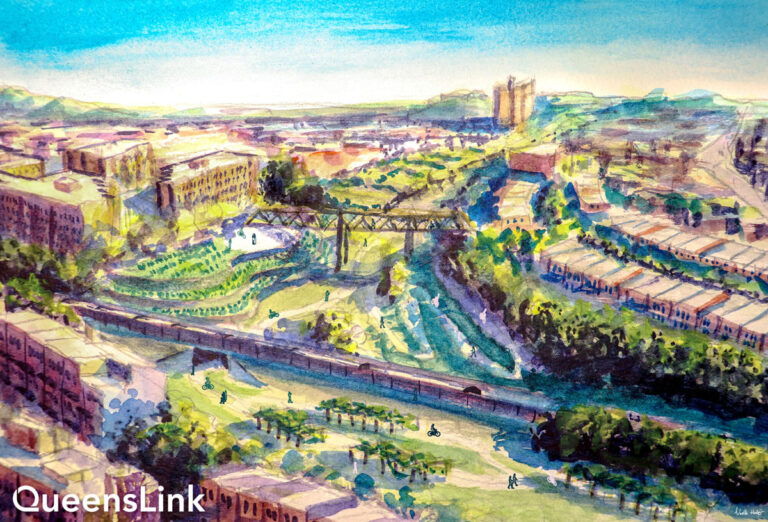
The QueensLink and QueensWay initiatives are competing blueprints for the transformation of the 3.5-mile Rockaway Beach Branch, an abandoned Long Island Rail Road line and landscape running through central and southern Queens. While both proposals aim to reclaim this derelict rail line and space- untouched since 1962-their conflicting visions offer drastically different outcomes for the borough’s infrastructure and community life.
The debate revolves around a disused, abandoned municipal rail corridor stretching from Rego Park to the Rockaways. New York City officials are now weighing two competing visions: QueensLink, which proposes a multi-modal approach by layering a new subway extension beneath parkland to improve transit access, and QueensWay, which seeks to transform the entire right-of-way into a dedicated bike and pedestrian trail without any rail service.
The QueensLink ‘Rails and Trails’ vision
According to the QueensLink advocacy group and the NYC DOT, the QueensLink grassroots, community-driven initiative envisions transforming the existing rail corridor into a vital north-south subway artery by extending the M line. By weaving green spaces directly into the transit infrastructure, the project aims to bridge the gap in Queens’ transit deserts.
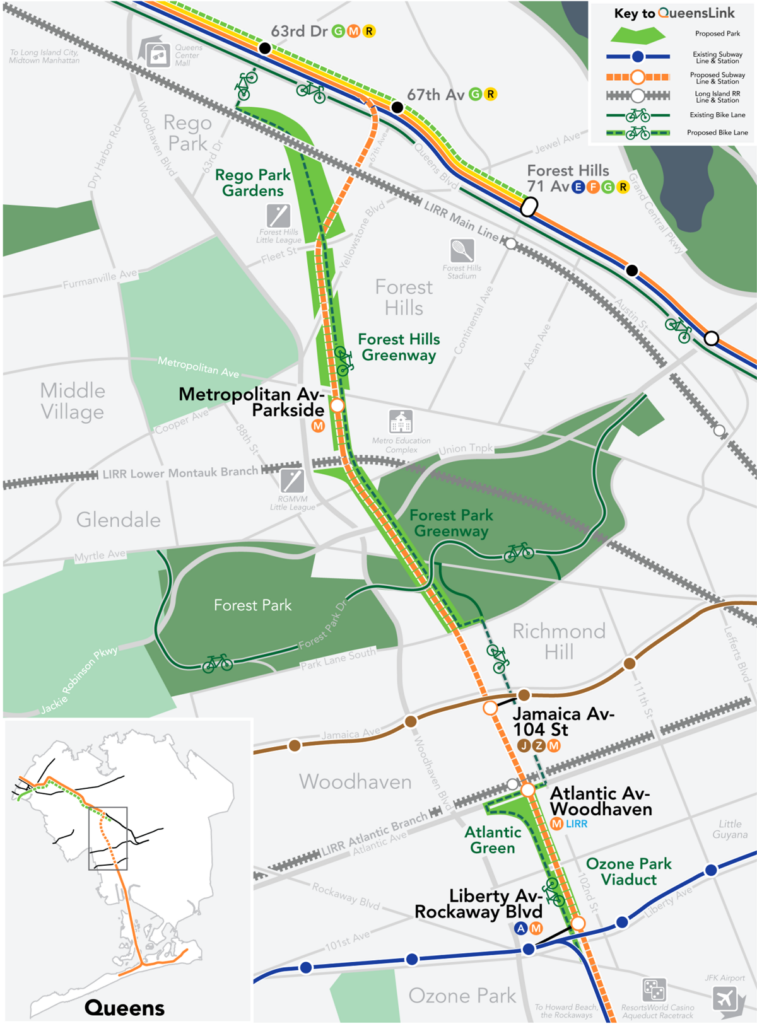
This dual-purpose approach is designed to offer a direct route for residents in central and southern Queens to Midtown Manhattan, reducing reliance on slow, heavily used bus routes like the Q52 and Q53. By creating a new connection for the M train to the J, Z, and A lines, it enhances mobility for underserved communities. Proponents argue that by offering a viable public transit alternative, QueensLink could remove up to 4.7 million car trips from the road annually, reducing CO2 emissions by approximately 7,200 tons per year. It is estimated to bring $4.9 billion in time savings and an $8.9 billion economic impact. By using existing city-owned right-of-way and leaving space for a 33-acre greenway alongside the train, the project will reduce the need for expensive land acquisition. The plan would also facilitate easier access to JFK International Airport in Jamaica by directly connecting the M train to the A train at Howard Beach.
The QueensWay “Rails-to-Trails” vision
According to the ‘Friends of the QueensWay ‘ in partnership with the Trust for Public Land, the QueensWay project is a community-driven plan to convert a 3.5-mile stretch of the defunct Rockaway Beach Branch of the LIRR into a 47-acre public park. Often compared to the High Line in Manhattan, this plan will repurpose old infrastructure to create an elevated linear park focused on green space, pedestrian trails, and bicycle paths connecting Rego Park to Ozone Park. It aims to improve air quality, boost local businesses, and provide safe, accessible green space for the nearly 250,000 New Yorkers living in the nearby neighborhoods. Proponents emphasize environmental remediation of the abandoned area, increased local property values and the creation of a “community hub” that links neighborhoods rather than bisecting them with a train.
As of April 2026, the projects have entered a new political era, and the 3.5-mile abandoned Rockaway Beach Branch line faces a strained standoff between the two proposals. The main challenges are severe funding disputes, political shifts, and conflicting priorities regarding the need for public transit versus green space only.
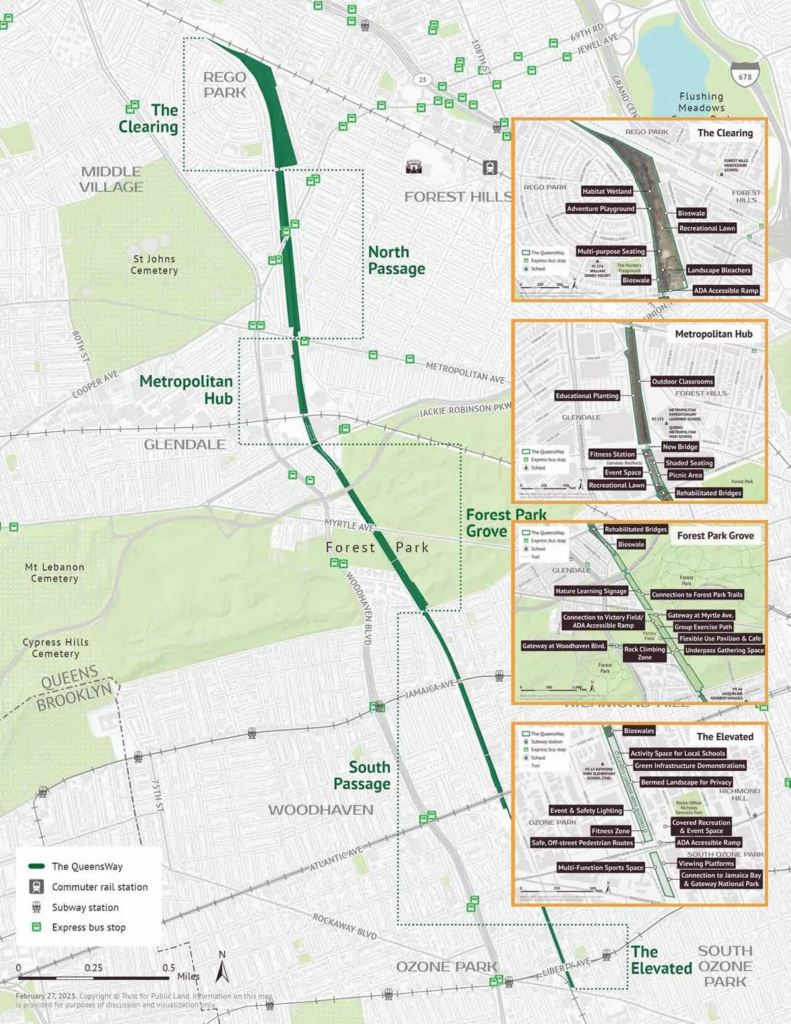
The proposal to build both accessible transit and a park (QueensLink) is viewed as physically complex and costly by city officials, who currently favor the ‘park first’ (QueensWay) approach. The core challenge is deciding between restoring train service for underserved communities connecting central Queens to the Rockaways or creating recreational green space in a dense, park-sparse area.
QueensLink advocates are calling on the Mamdani administration to pause current ‘park-only’ funding and conduct comprehensive studies. They argue that the current park design would make future rail implementation impossible without destroying the park’s infrastructure, and they want to ensure the corridor remains viable for transit. And while the QueensWay aims for construction to begin in 2027–2028, the uncertainty of funding and political support could delay both projects further.
1 Comment
With QueensLink, you’ll get both the park and train. QueensWay will provide only a park.
Other cities that have tried the park first don’t end up adding the train afterwards due to public opposition to paving over greenery.
The High Line comparisons to QueensWay are why the project shouldn’t go forward. The High Line is overrated and has accelerated the gentrification of its surrounding neighborhoods. Working and middle class residents who live near the proposed QueensWay shouldn’t want that there.