

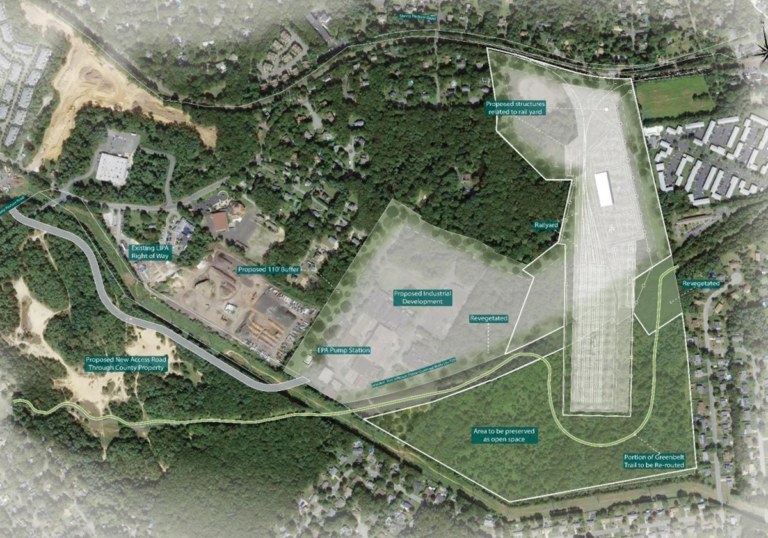
On June 10, 2026, the Metropolitan Transportation Authority (MTA) canceled its plans to purchase 40 acres of the former Lawrence Aviation Industries Superfund site in Port Jefferson Station. The land transfer was originally intended to build a Long Island Rail Road (LIRR) train yard as a critical first step toward modernizing and electrifying the diesel-powered Port Jefferson branch. To support the upgrade, the Suffolk County Landbank Corp. had initially agreed to transfer the 40-acre parcel of land to the MTA for a nominal $10 fee.
Lawrence Aviation Industries was once a lucrative business based in Port Jefferson Station in the Town of Brookhaven on Long Island. For over 40 years, they ran a 126-acre complex making titanium components for military aircraft, most notably the U.S. Navy’s legendary Grumman F-14.
On the outside, it looked like a booming Cold War defense success story, driving local employment and contributing to national security. Still, behind the scenes, decades of industrial production left a devastating environmental legacy. From 1959 until the facility shut down in 2003, toxic solvents, heavy metals, and raw acid were improperly handled and dumped into the ground, heavily contaminating the soil, groundwater, surface water, sediment, and groundwater that moved beyond the perimeter of the LAI property.
An onslaught of intense legal battles, federal interventions, and a prison term for the company’s owner followed the environmental misfortune. To address the crisis, the government designated the property a high-priority Superfund site and authorized a massive $48.1 million decontamination effort. Environmental response teams dismantled the dilapidated factory buildings, extracted over 17,000 tons of polluted soil, and purified millions of gallons of contaminated groundwater.
For years, community members, environmental advocates, and local leaders had championed transforming the vacant Superfund site into a modern MTA-Long Island Rail Road (LIRR) train yard as a vital first step toward removing diesel-powered trains from the tracks, reducing emissions, and improving commuter service.
A bureaucratic bottleneck between regional and state authorities ultimately derailed the MTA’s acquisition. The New York State Department of Transportation (NYSDOT) held onto a property easement originally set aside for a future roadway expansion. Because this created overlapping ownership claims, the MTA refused to close on the property until the conflicting land rights were completely resolved.
Following seven contract extensions, the cancellation drew heavy criticism from Suffolk County officials, commuter advocacy groups, local environmentalists, and stakeholders who have expressed deep frustration that administrative bickering between state entities has derailed decades-long efforts to modernize local rail infrastructure and improve commuter transit options for northern Suffolk County.
1 Comment
The electrification of the Port Jefferson Branch was part of the 1968-1969 MTA’s Plan for Action, but it was only completed as far as Huntington in 1970. Now 56 years later the commuters are still waiting for this very vital improvement as well. Now the NYSDOT & the MTA should get their act together, since ridership east of Huntington has been exploding in recent years as the line east of Huntington is getting more built-up rather quickly as well.