



“I saw the alchemy of perspective reduce my world, and all my other life, to grains in a cup. I learned to watch, to put my trust in other hands than mine. And I learned to wander. I learned what every dreaming child needs to know – that no horizon is so far that you cannot get above it or beyond it.”
– Beryl Markham – West With the Night
One can imagine that from the first moment humankind gazed skyward, came the yearning to soar with the birds above. Mythic figures and legends were created by early civilizations around flight. The story of one such legend in Greek mythology is a cautionary tale in which Icarus, the son of Daedalus used wings made of wax to escape from the island of Crete. In his desire to ascend beyond human confines Icarus flew too close to the sun and with melted wings he fell from the sky and into the sea, drowning.

During the 5th Century the Chinese discovered that kites could become airborne and used in several capacities such as religious ceremonies. As they became more sophisticated, kites were used to test distance and weather conditions becoming the forerunners of balloons and gliders. But it wasn’t until the late 1400s that Renaissance artist and inventor, Leonardo da Vinci drew detailed plans of a human powered flight machine called an ornithopter, a wing flapping device that was patterned after birds and meant to fly. It was this design that would ensue over the next four centuries.
Before the development of flying machines, a more rudimentary innovation came in the form of the hot air balloon, invented by the French Montgolfier brothers and in 1783 the first manned flight took place in a balloon that allowed its pilots to view the world from a bird’s perspective. A little over 100 years later, German born Otto Lilienthal was the first person to make documented, successful flights with gliders, influencing two brothers managing a bicycle business in Dayton, Ohio, Wilbur and Orville Wright. Adopting Lilienthal’s experimentation and research into aerodynamics as a precursor to their own research, the Wright Brothers ultimately invented the first powered, heavier than air aircraft that successfully accomplished the first recorded, sustained and controlled flight at Kitty Hawk, North Carolina in 1903.
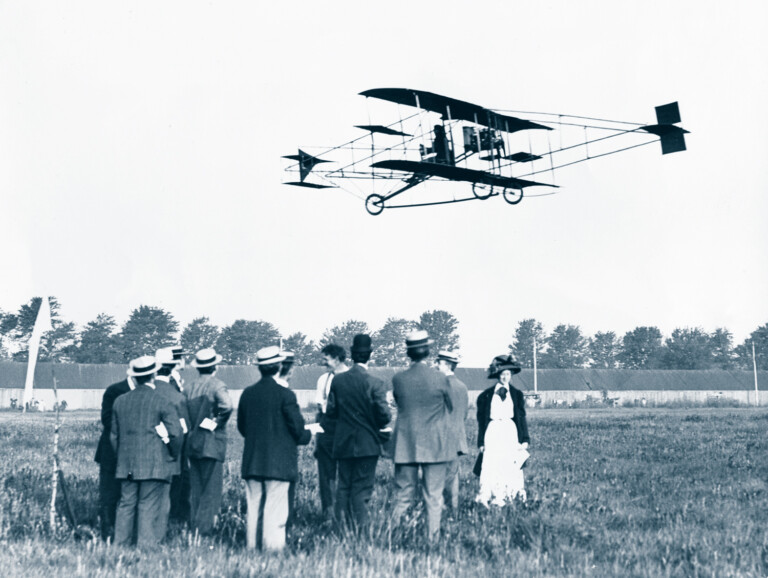
A few years later New York State, and particularly Long Island, became an epicenter of aviation pioneering when bicycle and motorcycle racer, Glenn Curtiss of Hammondsport, NY transitioned from motorbikes to airplanes with aviation developments centered at first in the Finger Lakes. In 1908 Curtiss made his first flight in ‘White Wing’, a design of the Aerial Experiment Association (AEA), led by Alexander Graham Bell. ‘White Wing’ was the first aircraft in the America to be controlled by ailerons, rather than wing-warping used by the Wrights. Months later, Curtiss utilized the knowledge he gained from previous flights to refine AEA aircraft design and built the ‘June Bug’ , a biplane that he piloted on July, 4, 1908 across Pleasant Valley, NY for a distance of over one kilometer and won the first stage of the Scientific American Trophy and $25,000. This flight was the first pre-announced, officially recognized and publicly-observed flight in the United States.

By 1909, Glenn Curtiss arrived at the Hempstead Plains of Nassau County, Long Island, a vast expanse of native grassland and flat, wide open landscape that made it the perfect airfield. Located on the western edge of the Atlantic, and in close proximity to the largest American city, the Hempstead Plains provided the best platform for aviators to begin or conclude experimental flights. Here Curtiss flew his “Golden Flyer” biplane a total of 15 miles winning the second stage of the Scientific American Trophy. This first flight was a launchpad for a multitude of notable flights, along the Hempstead Plains, across the continent, the Atlantic and around the globe.
In 1910 one of the most significant aviation events took place with the International Aviation Meet at Belmont Park, L.I. Here leading aviators of the day came from all over the world to exhibit, race and set speed and altitude records in their latest flying machines. The premier event was a race from Belmont, around the Statue of Liberty and back again. With a crowd of over some 100,000 cheering spectators, daring American aviator, John Moisant won the race accompanied by his cat ‘Mademoiselle Fifi’.

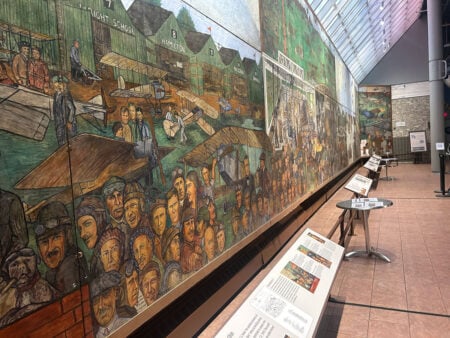
With several airfields now operating on the Hempstead Plains, Long Islanders began constructing their own aircraft. Flight schools opened, and though restricted, women began to fly. Blanche Stuart Scott was the first and only woman to receive flight instruction from Glenn Curtiss and to take a hop into the air on September 2, 1910. On September 16 of that same year Bessica Raiche made the first accredited solo flight by a woman in an airplane that she and husband built at their home in Mineola. By 1911 journalist Harriet Quimby enrolled in a five-week flying course at the Moisant School, operated by John and Alfred Moisant, and Quimby became the first licensed female pilot in the United States. During World War I, the Hempstead Plains was a major center for training army aviators at Hazelhurst and Mitchel Field, including former NYC mayor, John Purroy Mitchel who was killed after a training mission in Louisiana on July 6, 1918 after who Mitchel Field was named. Weeks later, Quentin Roosevelt, the youngest son of Theodore, was killed in aerial combat outside of Chamery, France on July 14th, thereafter the naming of Roosevelt Field in Quentin’s honor.

After 1918, aviation entered its ‘Golden Age’ and Long Island was the hotbed of its activity and major growth in the field lasting through 1939. With over 70 airfields eventually dotting the Island from Floyd Bennett Field and Curtiss Fields, to Port Washington, and east to Westhampton, some of the most transformative, historic and entertaining flights took place on Long Island including pilot Bessie Coleman’s first appearance at an American airshow honoring veterans of the all-black 369th Infantry Regiment held at Curtiss Field in 1922, Charles Lindbergh’s trans-Atlantic solo from Roosevelt Field to Paris in the ‘Spirit of St. Louis’ in 1927, James Doolittle’s revolutionary ‘blind flight’, flown solely by use of instruments and radio at Mitchel Field in 1929 and a daring stunt flight by Long Islander, Elinor Smith, who became the first and only pilot to fly under all four East River Bridges and who went on to break altitude and endurance records.
The list of notable flyers is exhaustive… Bert Acosta, Richard Byrd, Jackie Cochran, Clarence Chamberlin, Amelia Earhart , Alexander de Seversky, Viola Gentry, Frank Hawks, Howard Hughes, Ruth Law, Wiley Post, Cal Rodgers, Igor Sikorsky, Roscoe Turner, Alford Williams and others too numerous to list and many others.
Through the Great Depression and into World War II, the Jet Age and into Space, the legacy of flight on Long Island, later coined as the Cradle of Aviation, brought humankind’s yearning to fly above and beyond the horizon and even beyond our wildest dreams.
In memory of Giacinta Bradley Koontz

1 Comment
Pingback: March 2022 Publisher’s Message - Publisher's Message