


It was one of the first carriers to be established after passage of the 1978 Airline Deregulation Act (ACA), but its history would be repeated countless times after it. Both its name and service concept were reflected by its advertisement: “PEOPLExpress: Fly Smart!”
Establishment
Brainchild of Don Burr, who served as CEO of Texas International Airlines and was inspired by Sir Freddie Laker’s low-fare, transatlantic, DC-10 “Skytrain” service to London-Gatwick, it became his opportunity to put his own imprint on a deregulation carrier.
“People Express, the innovative airline that served the eastern part of the United States with Boeing 737s, was launched when two men took their idea for a new, low-cost airline to Citicorp Venture Capital (in January of 1980) and asked for a hearing,”: according to Alexander T. Wells and John G. Wensveen in Air Transportation: A Management Perspective (Wadsworth Publishing Company, 1994, p. 512).
Devoid of aircraft, routes, and FAA and CAB approvals, it was little more than a name, but that name made a greater statement about its purpose than may at first have been apparent: “People Express” stylized as the single-word “PEOPLExpress.” The Germans had created the “people’s car,” or “Volkswagen,” that “every man” could afford, and Burr sought to extend this concept to the sky.
Citicorp was apparently impressed enough with it to invest $200,000 in it two months later and by November of that year, management was able to raise $27 million by selling equity in the public market. Now everyone could afford to fly.
“The no-frills concept took flying to the masses, when the main consideration was price,” according to Harry Lawrence in Aviation and the Role of Government (Kendall/Hunt Publishing Company, 2004, p. 192). “The effects of deregulation, good and bad, were beginning to be defined.”
Initial Operations
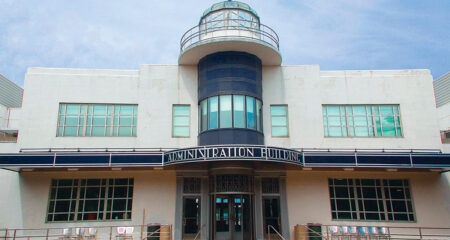
People Express was, above all else, about cost. Its operations were based in Newark International’s dormant, low-rent North Terminal, once the airport’s only facility, and its aircraft, which were subjected to 15-minute turnaround times to increase daily utilization to between 10 and 11 hours, nosed into jetbridge-unequipped positions in its East and West Arcades.
There were no ticket counters. Instead, passengers proceeded to the proper gate, checked any luggage for a $3.00 fee, and received a plastic, numbered, returnable boarding pass, which subdivided boarding groups into 20. There were no assigned seats and actual ticketing was done after takeoff, with a simplistic, unrestricted fare structure, such as $23.00 one-way to Buffalo on weekdays and $35.00 on weekends or $69.00 and $99.00, respectively, to Houston. The carrier stressed its fares by advertising, “All these places for People Express prices.”
An extension of its “every man” passenger philosophy was its “everyone” employee one. There was no hierarchy, no presidents, and no secretaries. One worker was almost indistinguishable from another. Pilots and flight attendants wore the same uniform. Extensive cross-training ensured high productivity. But there was another reason for this indistinguishability.
“People Express was founded on the principle that employees should have a financial stake in the company,” according to Encyclopedia.com’s People Express Airlines article. “The logic behind this is that if all workers were owners, this commitment would make them more productive.”
The result, needless to say, were lower labor costs and higher output. But the carrier’s corporate, almost-cult culture was reflected in its employee-passenger interaction.
“Morale was high, and most employees joined in the upbeat, new-age philosophy that infused the company, attending pep rallies in the company auditorium…,” according to Lawrence (op. cit., p. 198).
The carrier also stressed this aspect by advertising, “PEOPLExpress: Where attitude is as important as altitude.”
Like Southwest Airlines, it initially touched down in overpriced, underserved cities where there was little competition, employing a miniscule fleet of three former Lufthansa Boeing 737-100s configured for 118 six-abreast, single-class passengers.
Inaugurating service on April 30, 1981 to Buffalo, Columbus, and Norfolk, it became an instant success, not only attracting passengers from competing carriers, but from rail and bus lines, and by December, it offered 42 weekday departures to Baltimore, Boston, Buffalo, Burlington, Columbus, Jacksonville, Norfolk, Sarasota, Syracuse, and West Palm Beach.

Expansion
Once unleashed, People Express’s momentum was unarrestable. Additional aircraft acquisitions and route system expansion were attempts to satiate passenger demand.
In the January-February 1982 period, for instance, it carried 288,000 passengers and recorded a 56.3-percent load factor. In the year-later period, these figures had increased to 675,000 and 73.8-percent.
A byproduct was another deregulation-associated reality. Whenever a low-fare carrier inaugurated service at an airport, it attracted passengers, revenues, and often other-airline service, breathing new life into the facility. In 1981, People Express accounted for 16 percent of Newark’s’ traffic. By the following year, it had increased to 24 percent, or almost a quarter of its throughput. In January of that year, it carried its one millionth passenger.
By October of 1983, its mostly East Coast route system encompassed 18 cities. It also touched down in its first southwestern one, Houston, at this time.
“We don’t think it’s enough to offer low prices to just one city,” it stressed.
Its expansion continued. Perhaps fulfilling his long-bred desire, Burr followed his Laker inspiration, leasing a single Braniff International Boeing 747-200B and inaugurating the carrier’s first transatlantic service to London-Gatwick on May 26, 1983, relying on its Newark hub for domestic feed.
Another significant aircraft acquisition entailed the March 1983 purchase of 20 higher-capacity, former Braniff 727-200s for $4.2 million each to supplement its 737-100 and -200 workhorses.
Air Transport World presented it with its tenth annual award for Market Development in 1983, partly stating that People Express had “established itself as the standard for low-cost, low-fare service.”
It was clearly flying high. But was it?
Deregulation Descent
As would later play out in deregulation skies, once low-fare carriers began to encroach on majors’ territory, as People Express did with tis penetration of other-carrier hubs like Atlanta, Chicago, and Los Angeles, incumbents defensively responded, lowering fares to below-cost levels to retain or, in the same cases, regain market share.
“The major destabilizing element that has affected (labor relations) collective bargaining during deregulation has been intense competition from numerous new-entrant carriers that immediately began to bite into the market share of the major airlines,” according to Wells and Wensveen (op. cit., p. 482). People Express was certainly one of the early ones.
After seven consecutively profitable quarters, it posted its first operating loss, of $14.2 million, in the final 1984 one, as it suffered from overcapacity and the threat of employee unionization. The value of its stock declined by 50 percent.
But, as would be repeatedly demonstrated, deregulation inherently entailed two forces: stimulus-and-response and survival-of-the-fittest.
While upstart carrier’s’ low fares provided the stimulus, incumbent ones provided the response in the form of their own lowered ones. And when upstart carriers could no longer compete on price alone, they themselves responded with traditional, full-service airline elements.
In People Express’s case, it introduced ticketing-by-mail, assigned seating, a free baggage allowance, dual-class cabins, complementary on-board snack service, an inflight magazine, a frequent flier program (Travel Reward), a small package service (People Express Pak), and relocation to Newark’s modern Terminal C.
In its quest for growth, it acquired Frontier Airlines in the fourth quarter of 1985 for $300 million, provisioning it with a 737-200 and MD-80 fleet and a western hub.
People Express grew into New York’s second-largest carrier in terms of departures and took its Newark hub with it. Before it established its presence there, the airport handled 11 million annual passengers. By 1986, that total had tripled.
But its appetite could not be satisfied with its pocketbook. Saddled with costs incurred by its need to resemble and therefore compete with major airlines, and serving as the tourniquet to stem the financial hemorrhage of its Frontier Airlines acquisition, it ran out of cash and was forced to file for Chapter 11 bankruptcy protection on August 28, 1986.
Without choice, it had to accept Texas Air’s $125 million takeover offer, leaving it to lose its identity as it folded into Continental on February 1, 1987, the day it ceased to exist.
“Flying smart” initially worked for its passengers, but not ultimately for the airline which flew them, as it over expanded and posed too much of a competitive threat to the established carriers.