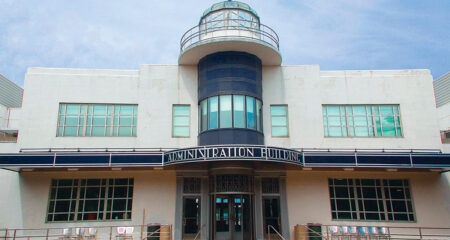

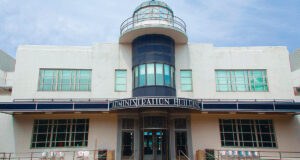



The short, stubby control tower indicated that this was a controlled airfield and that it provided takeoff and landing clearances. The long, white Passenger Terminal failed to produce a single, suitcase-carrying traveler, but that the sizeable parking lot in front of it was about half-full meant that there was some activity there. Oddly, in this day and age, there was no charge to use it. A few tailwheel airplanes, affectionately known as “tail draggers,” were parked in the distance, but the pair of Piper pistons were parked on the ramp outside of the terminal. Is this where airliners used to park? This was the Hudson Valley Regional Airport, located south of Poughkeepsie.
A Cessna 172 Skyhawk, subjected to its run-up, filled the air with its almost ear-splitting grind. But when its pilot was satisfied that its systems were fully functioning, it taxied parallel to Runway 33, which was interspersed by the otherwise green-velvet patches of grass, and executed its takeoff in the direction of the billowing windsock on this sweltering July day, leaving silence.
Silence says nothing except, perhaps, to communicate that what is, is not always what was. Where did the airline service go? Possibly an even more important question is: Where did the original airport go?
Red Oaks Mill Airport
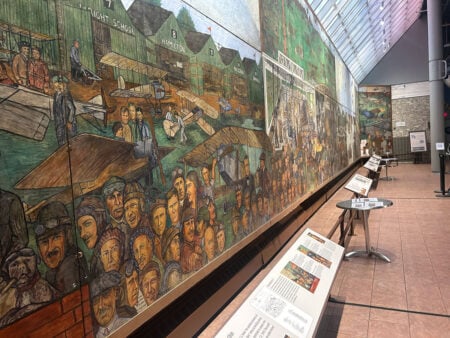
Airports of a century ago were not the mega-complexes from which wide-bodied airliners accommodating 300 to 500 passengers gathered before or after their continent-slinging journeys. Any flat parcel of land, devoid of trees, was sufficient for the rudimentary fabric-covered and wire-braced biplanes to touch down, generating public interest and hoping to exchange revenue for rides in an aerial profession known as “barnstorming.” In many ways, the Hudson Valley Regional Airport got its start this way, but not exactly at this location and not by its present name. That name was the Red Oaks Mill Airport.
Located at the intersection of Route 376 and Spackenkill and Vassar roads, it was typical of the post-World War I airfields, whose plowed paths served as runways and sported nary a structure, except, perhaps for a hangar. The one here, on property originally owned by Fred Cleveland, measured 80 by 100 feet, and the 1,500-foot runways were oriented toward the west and the southeast. Trees in its northeastern corner precluded takeoffs in that direction.
“Because the Red Oaks Mill Airport was too small to handle the increasing size of airplanes, the US Commerce Department opened another airport in 1932 just south of New Hackensack to serve as an emergency landing field halfway between New York City and Albany,” according to Anthony M. Musso in his “Red Oaks Mill Airport” article in the Poughkeepsie Journal.
New Hackensack Field was another stepping stone toward the Hudson Valley Regional Airport.

Hudson Valley Regional Airport
Initially known as New Hackensack Field after the nearby hamlet and constructed by the U.S. Department of Commerce in the 1930s for the purposes of providing pilot training to the US Army Air Force, it was used by the Military Academy and served as a training field that supplemented nearby Stewart Airbase.
According to the Bureau of Air Commerce’s January 1, 1937 “Description of Airports and Landing Fields in the United States,” it was an “intermediate field” that “adjoins the city on the west, the Wappinger River to the west, and was 5.5 miles southeast of Poughkeepsie.” Its “two landing strips” consisted of a 2,110-foot north-south one and a 2,700-foot east-west one. Its aeronautical facilities included a 24-inch rotating beacon with green course lights that flashed the characteristic “7” or (dash dot dot).
Midway through the world war conflict, on June 17, 1942, President Franklin D. Roosevelt drove from his Hyde Park home to meet British Prime Minister Winston Churchill there. He had flown from Naval Air Station Anacostia to the New Hackensack facility.
As would occur with numerous other originally military fields, it was turned over for civilian use—in this case, to Dutchess County for a token $1.00 after the war by the War Assets Administration, provided that it would remain open as part of the Surplus Property Act of 1944.
Originally known as the Dutchess County Airport and intended for general aviation operations, it is described by Dutchess.org as “a county-owned, public-use airport located on State Route 376 in the Town of Wappinger, Dutchess County, New York, (located) four miles south of the Central Business District of Poughkeepsie. It is sometimes called Poughkeepsie Airport, which gave it the three-letter code or ‘POU.’ The airport provides corporate and general aviation transportation services.”
By the beginning of the next decade, its general aviation purpose would evolve into a commercial one.
Airline Service
Dutchess County Airport fielded its inaugural commercial service when Colonial Airlines incorporated it as a stop on its puddle-jumper route to Canada.
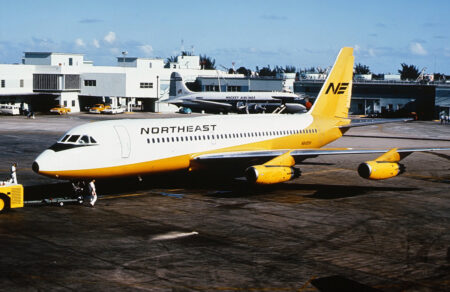
Founded in 1928 as Canadian Colonial Airlines to operate Foreign Air Mail Route No. 1 (FAM-1), it began operations between New York and Montreal on October 1 of that year, but a subsequent ownership and name change to, simply, Colonial, restructured it and profiled it for expansion.
“On August 10, 1995, the company was awarded a route from Washington to Montreal and Ottawa, and in May 1946, one to Bermuda, scheduled flights beginning on August 1, 1947,” according to R. E. G. Davies in Airlines of the United States since 1914 (Smithsonian Press, 1998, p. 312). “In spite of these concessions, however, Colonial, like its near neighbor, Northeast, had to struggle hard to remain in business. The network was not big enough to permit efficient integration of the fleet and deployment of effort.”
Nevertheless, according to its April 1, 1956 timetable, in which it advertised “Colonial Airlines: 1930-1955. Silver anniversary of safety,” it offered an 11:50 departure from Poughkeepsie, which made intermediate stops in Albany, Troy, Schenectady, Rutland (Vermont), Burlington (Vermont), Massena, and Montreal, before terminating in Ottawa at 15:45. The aircraft used was a 21-passenger Douglas DC-3, but a 44-seat “Douglas 4 Engine Skycruiser,” identified by a dot in its schedule, was deployed to Bermuda.
After acquisition attempts by Eastern and National, the former achieved the CAB merger approval and ceased to exist on June 1, 1956, after a quarter-century of fatality-free flying.
Dutchess County Airport’s scheduled service purpose took on new meaning when Command Airways established its headquarters there.
Founded by Kingsley G. Morse, who served as its sole CEO throughout its history as Mid-Hudson Airlines, it subsequently adopted its latter name. Morse, who strongly supported the Poughkeepsie facility as its base over one in Newburgh, was singularly responsible for its presence there.
According to its July 1, 1973 flight schedule, in which it advertised, “Command Airways…because time counts,” it “served Binghamton, Boston, Burlington, New York City via Kennedy and La Guardia, Pittsfield, Poughkeepsie, and White Plaines with a total of 55 daily flights.”
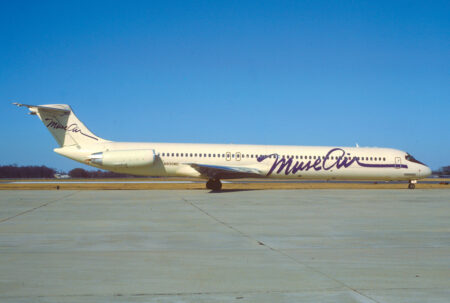
Winning Air Transport World’s 1985 Commercial/Regional Airline of the Year Award, it was purchased by AMR Corporation for $24 million three years later on September 30, at which time its Poughkeepsie presence had been reduced to five departures to the three New York airports of JFK, La Guardia, and White Plains, but these were operated with larger, 46-passenger ATR-42 aircraft.
Another Dutchess County Airport operator was Manassas, Virginia-based Colgan Air, which itself had been founded by Charles J. Colgan as a fixed-base operator in 1965.
In 1977, it linked Poughkeepsie with Washington-National three times per day.
Another carrier that served the Mid-Hudson Valley airfield was Air North—in this case, with two daily departures to White Plains and two to Burlington, Vermont—with the stretched, 37-passenger Gulfstream G-159C Commuter.
“We’ve got a lot going for you as Air North continues to spread its wings,” it stated in its April 26, 1981, system timetable. “Settle back and relax in the comfort of our wide-bodied aircraft. Read, work, snooze, or enjoy your choice of beverages served by friendly flight attendants. Rest assured that veteran pilots are at the controls.”
Aside from Burlington, Boston, and Washington, it served 13 destinations in New York State.
But during the next two decades, the facility’s annual enplanements decreased from 33,000 in 1989 to just over 6,600 in 1993. CommutAir, operating as the Continental Connection to Burlington, departed the Poughkeepsie airport for the last time on August 12, 2001, taking it full cycle to its scheduled airline origins since the sector had been part of Colonial’s route system.
The current 16,700-square-foot Passenger Terminal, which opened in September of 1980, served this purpose for two decades, and the two Piper pistons on its ramp occupied the space the regional turboprop aircraft once did. Airline service from the 640-acre Hudson Valley Regional Airport, which adopted its current name in 2017, was no more.
There are two reasons why it is not likely that it will re-serve its original airline passenger purpose. First and foremost, IBM’s financial loss necessitated downsizing, decreased area jobs by some 20,000, and prompted its relocation to White Plains’ Westchester County Airport. Secondly, Newburgh’s Stewart International Airport’s increase in low-fare service to U.S. leisure destinations and to Europe, located only 14 miles away on the Hudson River’s west side, diluted a market that cannot support two scheduled airline facilities within such a small catchment area.