


Fighting airport congestion, joining long security queues, and being packed into cattle cars with wings, today’s airline passengers must sometimes wonder how the privileged few fly: private sanctuaries removed from the terminal turmoil, a corporate jet that awaits only feet away from it, and living room luxury once on board. A few may not have needed to imagine such an experience, even if they do not count themselves among the rich and famous if they once flew on a carrier that blurred the boundaries between the airline and private jet—MGM Grand Air.
Founder and Foundation
If that name evokes images of the MGM Grand Hotel and Casino in Las Vegas, it is no coincidence. That facility served as the inspiration for it, the brainchild of Kirk Kerkorian. Hotels and airlines do not necessarily share a commonality, but with his aviation background, he sought to connect the two.

A pilot himself, he was contracted to fly de Havilland Canada-built Mosquitos across the Atlantic for the Royal Air Force Ferry Command during World War II and, after it, purchased surplus airplanes, restoring and selling them. But the hotel and air service combination inched toward reality when he acquired charter carrier Trans International in 1947 to funnel gamblers to Las Vegas, and two years later, he bought the Metro-Goldwyn-Mayer Studios. That famous MGM name soon adorned the hotel and casino, then the world’s largest, with some 2,000 rooms.
The movie studio, hotel, and casino were now tied together, but what was needed was an airline that could fly passengers to them. Although he had sold Trans International to Transamerica Corporation and was a major shareholder of Western Airlines, he elected to create his own instead, which grew from a deregulation-facilitated concept.
Airline Concept
Aerial elegance for those of Hollywood fame served as the initial inspiration—a private jet of airliner size that featured comfort, gourmet cuisine, and inflight gambling. Toward that end, Regent Air, in which Kerkorian had a financial stake, provided early transcontinental experience between Los Angeles and Newark with opulently-outfitted Boeing 727-100s, but it proved unsuccessful. It operated on a charter basis, was not adequately promoted, and used a far-removed terminal at Newark International. Infight gambling was ultimately ruled illegal.
Although Kerkorian divested himself of Regent Air, he took the concept with him, believing it could be successful with the right elements. Those included scheduled airline status, listing in all five major airline computer reservation systems to permit travel agent bookings, first-class-comparable fares, service to JFK in New York to facilitate international fight connections, and a more recognizable name. That name, of course, was MGM Grand Air.
Kerkorian acquired Regent Air’s three 727-100s for $10 million, retaining their interior appointments, but had them retrofitted with long-range fuel tanks for an additional $1 million to provide the needed nonstop transcontinental capability and spent an additional $1 million to refurbish the Imperial Terminal at Los Angeles International Airport. The airline-turned-private jet was thus ready for takeoff.

Service
Service began in September of 1987 with two daily roundtrips between Los Angeles and New York. Pilots, idle after layoffs from Continental, joined the corporate jet carrier, and five flight attendants served the 32 passengers in the cabin, a total that was 100 short of the aircraft’s certified maximum capacity.
Celebrities, Hollywood stars, entertainment executives, designers, and royalty constituted the targeted clientele, and Tom Cruise, Robert De Niro, and Julia Roberts were frequently on board.
“The customer looks upon our service as if it were his own private corporate jet and, as such, enjoys and expects the stress-free, hassle-free environment,” its promotional video toted. It claimed that it offered true first-class service and “everything else should be called second class.” It labeled its flights “the MGM Grand Air experience.”
And an experience it was. Passenger check-in in the Imperial Terminal in Los Angeles entailed sitting on leather chairs at a rosewood concierge desk, and the plush, private club atmosphere was enhanced by couches, coffee tables, and bars. Separate conference rooms were available for use at no additional charge.
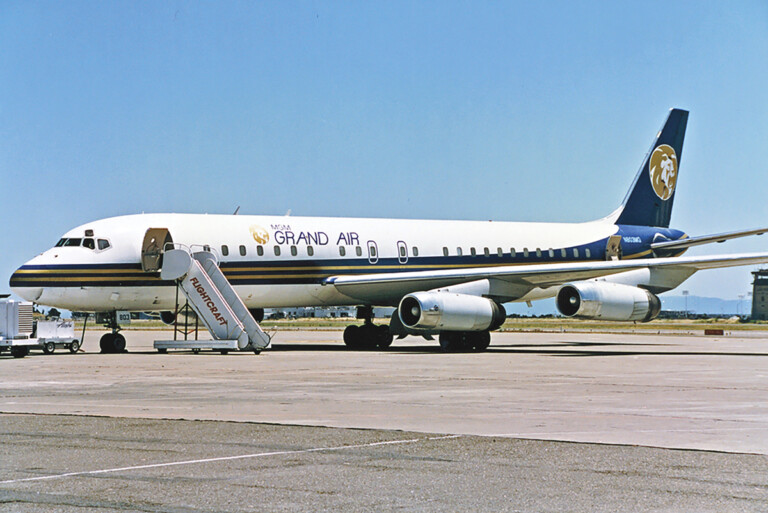
Like those of Hollywood fame, the passengers walked the red carpet—literally—to the aircraft parked only feet away, which sported the gold MGM lion emblem on its vertical tail.
Internally, it appeared nothing short of a corporate jet: individual swivel seats, velvet window curtains, plush carpeting, dining room tables, a bar, four-place compartments that served as both private dining and conference rooms, bed-convertible seats, and lavatories adorned with smoked glass, Italian marble, and gold fixtures.
Dinner, preceded by the distribution of menus and hot towels, progressed through warm nuts and cocktails served on formally set tables with Royal Worcester china; hors d’oeuvres, such as shrimp and lobster puffs, pate, and caviar; a salad course with hot rolls formed the basket; beef, poultry, and seafood entrees with accompaniments like potatoes au-gratin and a selection of wines; and pastries and coffee. The final course, presented at the bar and inviting social interaction, consisted of assorted cheeses, fruits, biscuits, sparkling wines, and liqueurs.

Entertainment entailed several audio channels and films viewed through a Sony video system; both were considered state-of-the-art some four decades ago.
Although MGM Grand Air offered comfort, convenience, and cuisine, it failed to generate a profit, having needed to fill 27 seats on every flight just to break even, and in some sectors, flight attendants outnumbered passengers.
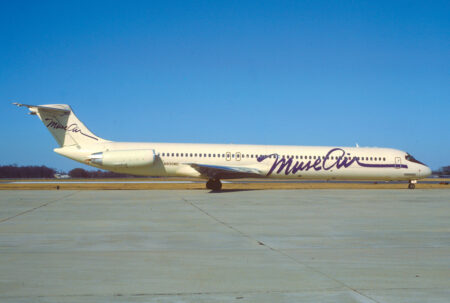
In order to attract a wider passenger base, it replaced its three 727-100s with an equal number of DC-8-62s, configuring them with 35 Grand Class First and 40 Grand Class Coach seats, the latter in a four-abreast arrangement and offered at lower fares. In its April 5, 1992 timetable, it advised, “All scheduled transcontinental service operates with spacious DC-8 Super 62s.” It still offered two daily roundtrips, departing at 08:40 and 15:30 from Los Angeles and at 10:30 and 18:40 from New York. It also briefly linked the former with Orange County, operating a de Havilland Canada DHC-6-100 Twin Otter on this commuter route.
Demise
While its concept was unique, it lacked the clout of the major airlines. Higher fares, the absence of a frequent flyer program, and a route system that could be reduced to a pair of destinations all resulted in its inability to turn a profit, leaving it little choice but to discontinue service in 1992 and sell its assets to Champion Air, which itself specialized in flying sports teams and their fans.
“(Selling the airline) enables us to focus all of our efforts on the operation and expansion of our core hotel and gaming business,” Robert Maxey, MGM Grand Air’s Chief Executive Officer, commented at the time.
Sandra Bernhard, actress and hostess of “Sandyland” on Sirius XM Radio, summed up the experience best.
“It wasn’t like any other plane I’d flown in,” she said. “The thing had more rooms than a mansion. And everybody was flying it—models and celebrities—so you’d always be running into people. There’ll never be anything like it again.”