


Internal need sometimes leads to external purpose. Midwest Express Airlines, a unique, post-deregulation carrier, successfully demonstrated this concept.
From Corporate to Commercial Aviation
Tracing its roots to the 1969 establishment of K-C Aviation, a subsidiary of Kimberly-Clark’s flight department, which had maintained a small fleet of aircraft and serviced those of its corporate clients, it took initial, internal form when the need to transport employees from the company’s Neenah, Wisconsin, headquarters to the locations of its mills, arose. They were not always conveniently situated.
If, for example, its staff had to travel from Appleton, WI., to Atlanta, Ga., they would have had to fly Air Wisconsin to Chicago-O’Hare, transfer to an Eastern or Delta flight to Atlanta, and then complete their journey by road. Although their destination was closer to Fulton County, its general aviation airport was not commercially served It entailed a six-hour trip, but the solution was K-C Aviation’s 1981 creation of a company shuttle operated by a 12-passenger Hawker Siddeley HS.125 business jet that enabled them to land in Fulton County itself, as well as cities such as Chicago and Memphis.
So popular was the shuttle, that the business jet was replaced with a larger DC-9-14 two years later, in April. It solved one problem, but created another—namely, excess capacity. In order to fill the additional seats, K-C Aviation elected to open the service to the public, in effect establishing a scheduled airline.

Midwest Express Airlines
Although employee need to fly from Appleton would have limited its attraction to scheduled passengers, it elected to establish Milwaukee’s General Mitchell Field as its operational base instead, an underserved midwestern airport where Northwest Airlines had created its own small hub. However, as a less congested, hassle-free alternative to Chicago-O’Hare, it was still able to serve the southern Wisconsin and northern Illinois catchment areas. That it had just completed a major renovation was a plus.
Unlike other deregulation upstarts, such as Midway Airlines and PEOPLExpress, it elected to attract higher-yield corporate clients with superior service and comfort.
“Although relatively small, Midwest (Express) Airlines was an industry leader, finding profits where other airlines struggled, and leading the nation in customer service and satisfaction,” according to the “Midwest Airlines” entry in Encyclopedia.com.
Inaugurating scheduled service on June 11, 1984, with a trio of 60-seat, all-first-class-configured DC-9-14s to Boston and Dallas/Ft. Worth from Milwaukee and to Newark from Appleton, it quickly fulfilled its “best care in the air” slogan by offering passengers four-abreast, leather-upholstered seats; entrees such as prosciutto-wrapped pork, Beef Wellington, and lobster served on china with an assortment of fine wines; and freshly baked chocolate chip cookies.
The following year, Consumer Reports rated the fledgling carrier as number one in comfort and would consistently do so in the near future.
Avoiding major airline competition, offering a simplified fare structure that equaled most carriers’’ regular coach fares, eliminating connecting flights, typically scheduling two daily round trips to a given destination to facilitate same-day roundtrip travel, and catering to business passengers whose usual lack of checked baggage enabled more lower-deck cargo and mail to be carried, Midwest Express embarked on a very slow, but steady expansion course. It described its attributes as follows.
“Midwest Express is dedicated to the comfort and efficiency of the business traveler. All flights to and from our Milwaukee hub are nonstop to save time and eliminate layovers or plane changes. All of our seats are extra-wide and two across for comfort. Our meals are outstanding. Our staff is genuinely friendly and courteous. And, our fares are coach—always. Fly Midwest Express. Business travel is hard enough, so we make flying easy.”

By mid-1986, it operated four DC-9-14s sequentially registered N300ME through N600ME over four main routes to Atlanta, Boston, Dallas/Ft. Worth, and Washington-National from Milwaukee and two intra-state ones to Appleton and Madison. It inaugurated service to New York-LaGuardia the following year.
During its first year of operations, it accounted for less than one percent of Milwaukee’s traffic. Four years later, that number had climbed to almost 10 percent. In 1989, it became the airport’s third-largest carrier.
Expansion
Aside from its nine DC-9-14s/15s, Midwest Express also eventually acquired 16 stretched, 84-seat DC-9-30s and more than a dozen MD-81s, -82s, and -88s, enabling it to cater to both increased demand and serve longer routes, such as those to Florida and the West Coast.
While it satisfied demand, its high-quality service also satisfied desires. Echoing an obstacle-into-opportunity philosophy, Timothy Hoeksema, former K-C Aviation pilot, and long-standing Midwest Express president, once said, “When you have an industry with dissatisfied customers, you have a business opportunity.”
And the carrier’s structure, service, and niche had clearly seized it. But the only void it still needed to fill was the lack of feeder service on commuter routes to and from its Milwaukee hub on appropriately-sized turboprop aircraft.
Toward that end, it contracted Skyway Airlines, a division of the Mesa Air Group, to serve them with 19-passenger Beech 1900s as of 1989 under the “Midwest Express Connection” designation. It extended the major carrier’s reach to destinations such as Green Bay, La Crosse, and Stevens Point in Wisconsin; Flint in Michigan., and Des Moines in Iowa.
Seeking to continue serving small, underrepresented airports yet expand beyond its single Milwaukee hub, it opened a second one in Omaha in 1995. Not entirely successful, it was replaced by one in Kansas City, once the stronghold of Eastern and Braniff.
Nevertheless, the carrier, whose new owner became Midwest Air Group after Kimberly-Clark relinquished control and two initial public offers (IPO) were made in 1995 and 1996, was successful.
It had been consistently profitable since 1988. In 1993, now the 24th largest US airline and controlling some 30 percent of the traffic in Milwaukee, it recorded $165 million in revenue. The following year, it exceeded $200 million. In February of 1998, its stock reached an all-time high. And by the end of the decade, it had become the nation’s 17th largest carrier.
The Last Decade
As the next decade dawned—and it would ultimately prove to be Midwest Express’s last—it underwent significant changes, sometimes to navigate turbulent skies. Although it had employed a protracted expansion strategy, by the summer of 2001 it served 27 cities.
There may be strength in numbers, according to the adage, but small, in its case, offered strengths of its own, because it refrained, for the most part, from engaging in head-to-head competition with the major carriers, for which it posed little threat. Its strengths were thus its superior service, small niche, and business traveler attraction.
Yet it sought to avoid regional carrier associations by eliminating the “express” part of its name, re-designating itself, simply, Midwest Airlines. Similarly, its commuter affiliate adopted the “Midwest Connect” title.
Revenues, it was later to conclude, could be increased if it reconfigured its aircraft in a dual-class “Signature” and “Saver” arrangement, enabling it to additionally attract the budget-conscious flier, as of 2002. While it retained the extra legroom and the chocolate chip cookie bake, it offered purchasable on-board food service in the latter class, whose seating increased to five-abreast on its MD-80s.
“The moment you walk onto one of our Signature Service jets, you know Midwest is different,” it advertised.“Wide leather seats, superior service, chocolate chip cookies baked on board, and competitive fares have helped us earn our reputation as ‘the best care in the air.’ We’ve added new dimensions with our budget-conscious Saver Service, featuring low fares and extra legroom to some of your favorite vacation destinations. Add our Midwest Connect regional service, and there’s something for both business and leisure travelers alike.”
After Northwest filed for bankruptcy and scaled back its already-small Milwaukee hub in 2005, it gave Midwest new growth opportunities there, enabling it to claim the largest airline spot.
A Zagat Air Travel Survey named it the Best Domestic Airline that year—the fifth consecutive time that it had done so.
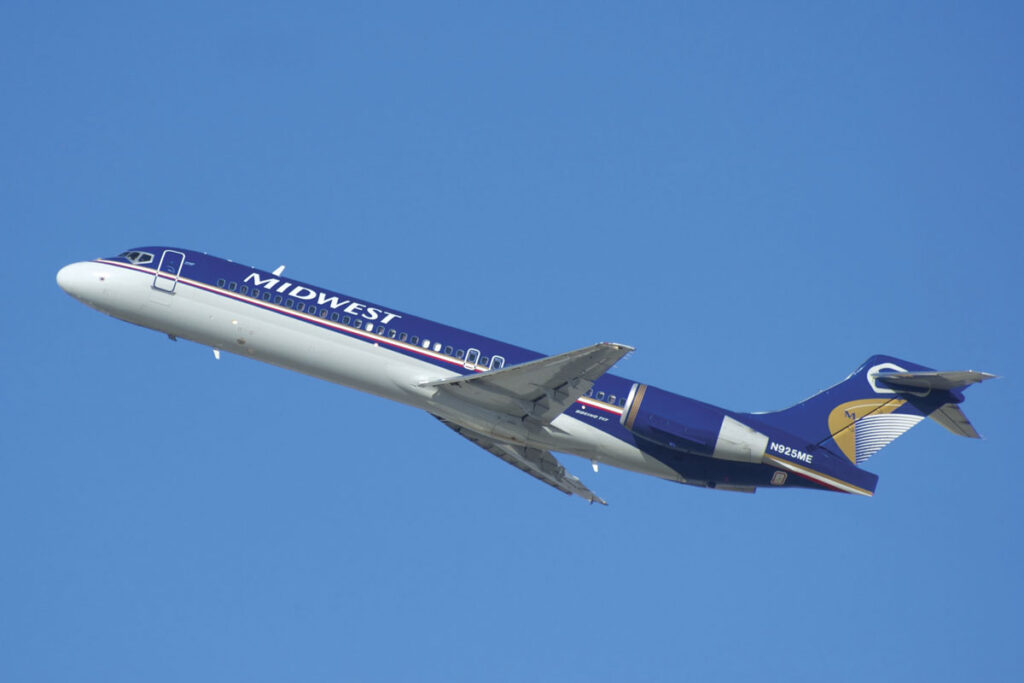
The following year, it completed its fleet transition from the first-generation of DC-9s to the Boeing 717-200, which itself had begun as the McDonnell-Douglas MD-95. Its 25 aircraft initially featured an 88-seat, single-class configuration, but were later outfitted with 40 Signature- and 54 Saver-class ones.
The year 2008 proved the turning point for the once-illustrious, sterling-service carrier. Trans Pacific Capital (TPG), a private equity group, acquired Midwest for $450 million and its remaining MD-80s were removed from service because rising fuel prices had rendered them uneconomical.
Yet a second ownership change occurred only a year later, on June 23, this time when Republic Airways Holdings acquired the airline for a fraction of the price, or $31 million, transforming Midwest into one of its wholly owned subsidiaries. Frontier Airlines was the other one.
Reduced to a shadow of its former self, it was left with an operation undertaken by Frontier with five 136-passenger Airbus A319-100s and Republic with 15 76-seat Embraer E-170s and ten 99-seat E-190s.
Midwest itself operated its last 717-200 with its own flight crews to Milwaukee on November 2, 2009 and by September of the following year, it was absorbed into the Frontier brand, taking its long-familiar “YX” two-letter code with it.
Its spirit of quality had alas succumbed to the ubiquitous, low-cost, post-deregulation model.