




Lower-demand, shorter-range routes inappropriate for larger-capacity aircraft dictated the types that could be operated during the first few decades of the jet age: a high-capacity jet itself or a low-capacity turboprop. Why, it can only be wondered, were the two concepts not combined for regional operations?
Regional Jet Evolution
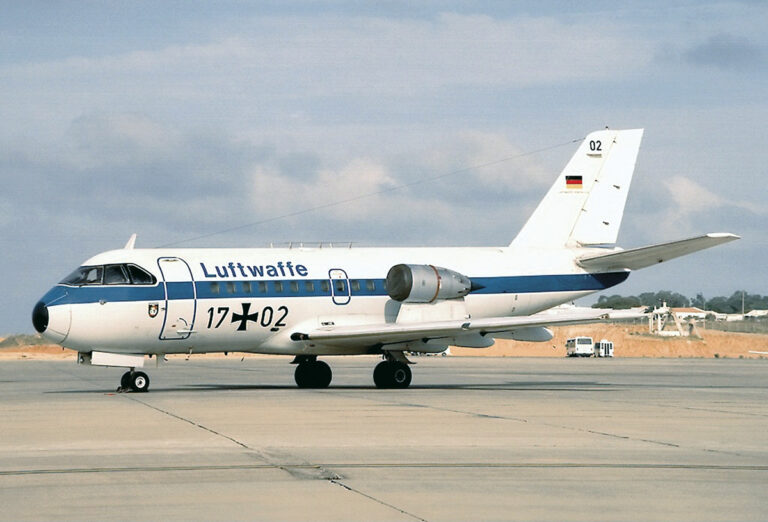
At the dawn of the 1970s, the Vereinigte Flugtechnische Werke of Germany designed the 44-seat VFW-614, whose above-wing mounted engines shielded low-altitude ground noise and permitted access to service panels without ladders or other support equipment. Only 16 aircraft were ever ordered by Air Alsace, Cimber Air, and TAT, as well as by the German Luftwaffe, principally because its operational economics were excessive on such low-density, short-range routes, indicating the obstacle to such an aircraft—namely, unsuitable engines. However, this changed in the 1990s with General Electric’s CF34 turbofan, and Canadair was the first to employ it on what would become the CRJ100.
As the first of a new breed of “mini-jetliners,” it was the result of one of three design origin options available to manufacturers.
- Create a new clean-sheet design.
- Adapt and convert an existing turboprop airliner to a regional jet.
- Transform an existing business jet to a regional jet, thus crossing the line between the general and commercial aviation sectors.
“Canadair (later Bombardier) took a bold step, if not a gamble, that a fuselage stretch of its existing Challenger business jet, which already offered four-abreast seating and comfort, powered with new-generation CF34-3A1 turbofans, would produce an ideal regional jet, spark a revolution, and succeed when attempts with immature powerplants failed,” according to Ramon Lopez in his “Regional Jets Find a Home” article in Flight International (May 7-13, 1997).
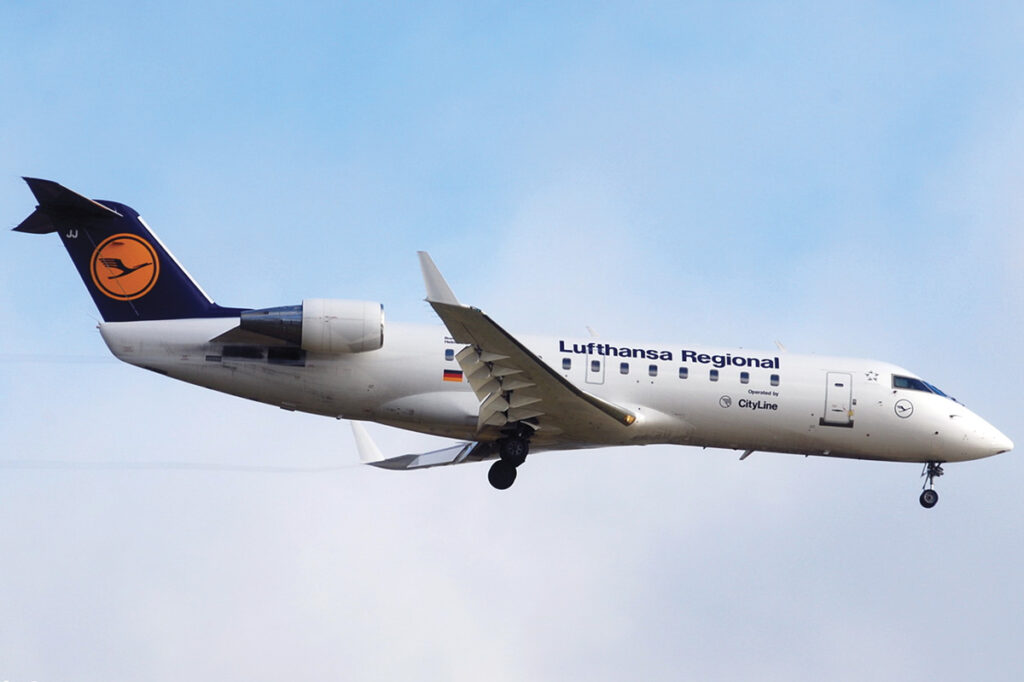
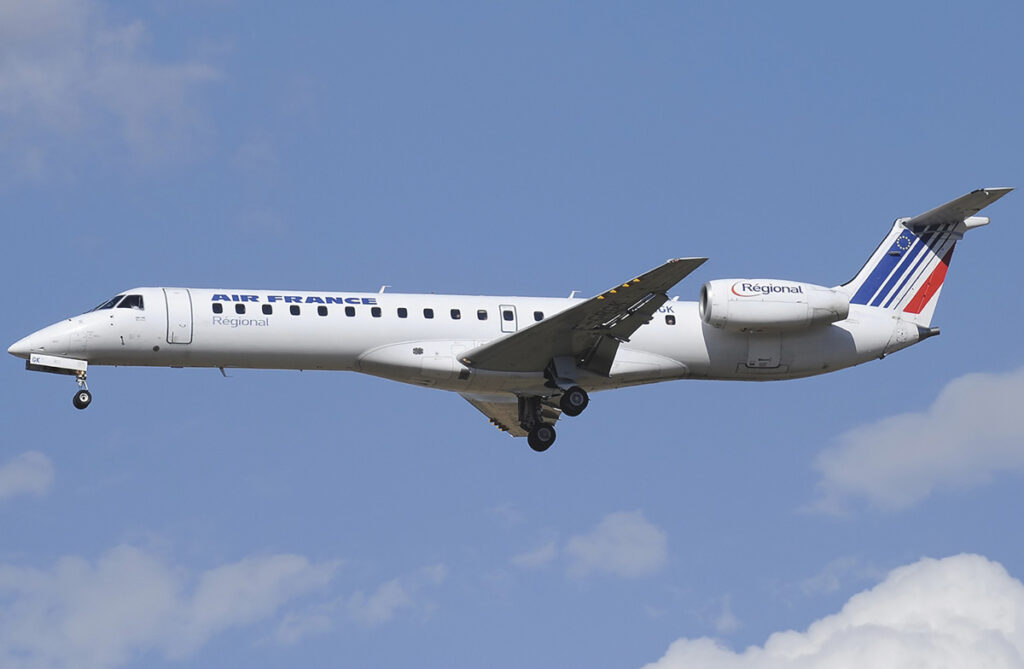
Embraer, the second manufacturer to design such an aircraft, basically adapted the second strategy for doing so—namely, it stretched the three-abreast fuselage of its existing EMB-120 Brasilia to accommodate 50 passengers, replaced its Pratt and Whitney of Canada PW118 turboprops with Rolls Royce AE 3007 turbofans that were aft fuselage-mounted and introduced a swept wing. The result, the CRJ100’s competitor was the ERJ-145.
“When it was launched into service in 1996, the ERJ-145 represented the convergence of multiple, state-of-the-art aviation technical advances,” according to Jeffrey L. Rodengen in The History of Embraer (Write Stuff Enterprises, 2009, p. 146).
“The company pinned its hopes for success on the ERJ-145, and it would not be disappointed,” he also wrote (p. 148). “The aircraft would go on to triumph in the regional jet market, despite facing stiff competition from rivals such as Bombardier.”
Continental Express became the North American launch customer for the type when it placed a 25-firm order valued at $375 million.
Dornier, the third manufacturer to offer this new breed of aircraft, directly adapted its Do-328 commuter aircraft by replacing its Pratt and Whitney of Canada PW119B turboprops with Pratt and Whitney of Canada PW306B jets and produced the Do-328JET.
Regional Jet Revolution
Comair was the US launch customer for the Canadair Regional Jet and its operation of it dramatically changed the carrier’s structure and demonstrated its ability to redimension the airline industry.
From its very first flight from Cincinnati to Toronto on June 1, 1993, it became apparent that it not only introduced a new aircraft type, but a new concept. Aside from its mainline-jet comparable comfort and, in some cases, range, its greatest advantage was its speed.
“The CRJ capitalized on the increased competition between major airlines at the federal level, the range limitations of turboprops, a public preference for turbofan aircraft, and the lower cost of developing an airliner based on an existing business jet, rather than investing hundreds of millions of dollars on a clean-sheet design,” according to Kenneth I. Swartz in his article, “30 Years Marked since Maiden Flight of Canadair Jet” (Skies Mag).
By the first quarter of 2000, 169 CRJ100s and its improved-performance successor, the CRJ200, were operated by Air Wisconsin, Atlantic Southeast Airlines, Comair itself, the Mesa Air Group, and SkyWest on codeshare flights for America West, Delta, United, and US Airways.
During the same period, 149 ERJ-145s and its smaller, 37-seat ERJ-135 were flown by American Eagle, Business Express, Chautauqua, Continental Express, and Trans States Airlines for American, Continental, Delta, TWA, and US Airways.
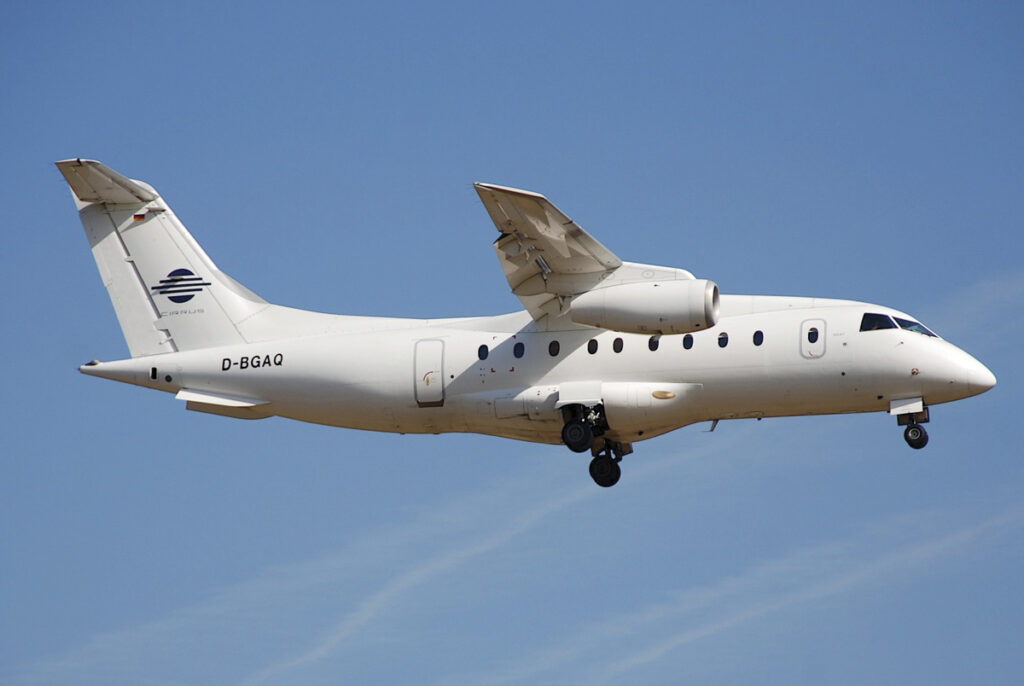
And while the Do-328JET was still in its flight test program, 50 had already been ordered by ACJet and Atlantic Coast for Delta and United code share services at this time.
By April, orders for the Bombardier, Embraer, and Dornier regional jets respectively totaled 831, 612, and 206.
Although the concept and economic reality of regional jets had to be proven, experience more than surpassed any early doubts. Despite their higher operating costs, this new breed of mini-airliners combined the best elements of turboprop aircraft and mainline jets, stimulating growth and, indirectly, higher revenue. They also significantly extended major carrier reach from their hubs when operated by a codeshare carrier.
“A spur for this expansion is the availability of the turbofan-powered regional jets,” according to James Ott in his “Regionals Building at Nation’s Hubs” article (Aviation Week and Space Technology, May 18, 1998). “These aircraft allow the regionals to extend their reach to destinations one thousand miles more from hubs. This new capability is bringing about big-scale route rationalizations between the regionals and their affiliate major carriers.”
Passenger ignorance and avoidance of propeller aircraft, despite the fact that turboprops still employ core jet engines, and therefore attraction to turbofan ones, also played a significant role in regional jet acceptance.
“There is significant evidence that today’s regional jets, despite having similar cabin cross sections and inflight service (as turboprops), engender a significant market share premium, especially on medium- and long-range itineraries,” Doug Abbey points out in “The New Jet Set” article in Airline Business (May 1997).
“One truth is undisputed,” he further emphasizes. “The marketplace has embraced small jet service to such an extent that carriers that lack them in their fleet mix will be at a distinct competitive disadvantage.”
Their value, in fact, can be illustrated by US regional airline changes experienced during the first nine months of 2002. Regional jet service on 127 new routes was announced, and an increasing number of them constituted point-to-point, hub-bypassing ones. Of these, more than half consisted of nonstop city pair service that never previously existed. More than half entailed segments of at least 500 miles, and seven, or 5.5 percent, were at least 1,000 in length. Of these, 19 percent entailed turboprop replacements, and 13 percent were larger regional jet substitutions for previous smaller ones.
Because of the comparable comfort, speed, range, and powerplant, the line between the major and regional airlines began to blur, enabling passengers to exclusively fly transcontinentally on such aircraft, albeit with two or more stops. And, as had occurred during the 1980s when deregulation eliminated restrictions and local service carriers such as Frontier, Ozark, Piedmont, and Republic were no longer encumbered from evolving into major ones with first-generation twinjets, the same took place with the likes of American Eagle, Atlantic Southeast, Horizon Air, Comair, and Mesa with regional jets.
“The CRJ represents a major shift in commercial aviation–probably the biggest change since the advent of commercial jets,” Charles Curran, Comair’s Senior Vice President of Marketing, synopsized.
The new breed of mini-jets dramatically transformed regional flying in numerous ways.
- They served hub and hub-bypassing routes too distant for slower regional turboprops or too thin for larger mainline jets—and did so more economically.
- They supplemented or replaced either or both.
- They provided service in markets in which it had never previously been offered.
- They maintained frequencies on routes where there was insufficient demand, particularly during off-peak times.
- They enabled carriers to gauge and develop demand until either a larger regional jet or a mainline one could be substituted.
- They provided mainline aircraft-comparable jet service standards, offering passengers a more seamless major-to-regional carrier transitional experience.
- They redefined and redimensioned route systems.
- They redefined the regional airline industry.
- They blurred the lines between regional and mainline jets and between major and regional airlines, elevating their image as jet operators.
- And they enabled the regional jet market to become the fastest growing one as major carriers shifted their low-density routes to commuter airlines.
“Simply put, regional jets have been successful because they offer the traveler more choices,” Debbie McElevoy, former Regional Airline Association president, summed up their contribution. “The new-generation 32- to 50-passenger aircraft provide expeditious, nonstop flights to small- and medium-size cities directly from hubs, many times in markets that had never had such service, owing to range or flight time constraints.”



1 Comment
“The Regional Jet Revolution is an exciting shift in aviation, making air travel more accessible and efficient for shorter routes. Looking forward to seeing how this changes the industry!”