


Both birds and airplanes attain lift with wings. But one of the former species has none at all and is therefore flightless. When airlines fail, they, too, join the grounded pack. This, in essence, was the concept that gave rise, and ultimate fall, to KIWI International.
Flightless Bird
Like a string of dominoes, once-mighty carriers whose failures were initially never conceivable suffered that very fate. One of them, of course, was Eastern, which ironically adopted “The Wings of Man” campaign to lure passengers, yet its own were eventually severed.
While some, harnessing the forces of deregulation, attempted a comeback, others tied together their remnants and retook to the sky under new names. And while their purposes varied, Eastern’s version was practical–that is, employment—specifically for the pilots, flight attendants, managers, and others after its bankruptcy caused its demise.
Banding together to pose solutions to their situation, mostly Newark-based pilots identified themselves as “kiwis”—that is, flightless birds who sought to regain wings and, with them, a paycheck.
More formally designated the “Kiwi Acquisition Group,” those in search of work initially considered purchasing the Pan Am Shuttle for $100 million, but the offer was rejected in favor of Delta’s.
If they could not find a carrier to employ them or acquire an existing one, they ultimately elected to start their own. Some 40 pilots, in fact, each threw $50,000 into the pot and selected the KIWI name to reflect the situation which gave its rise.
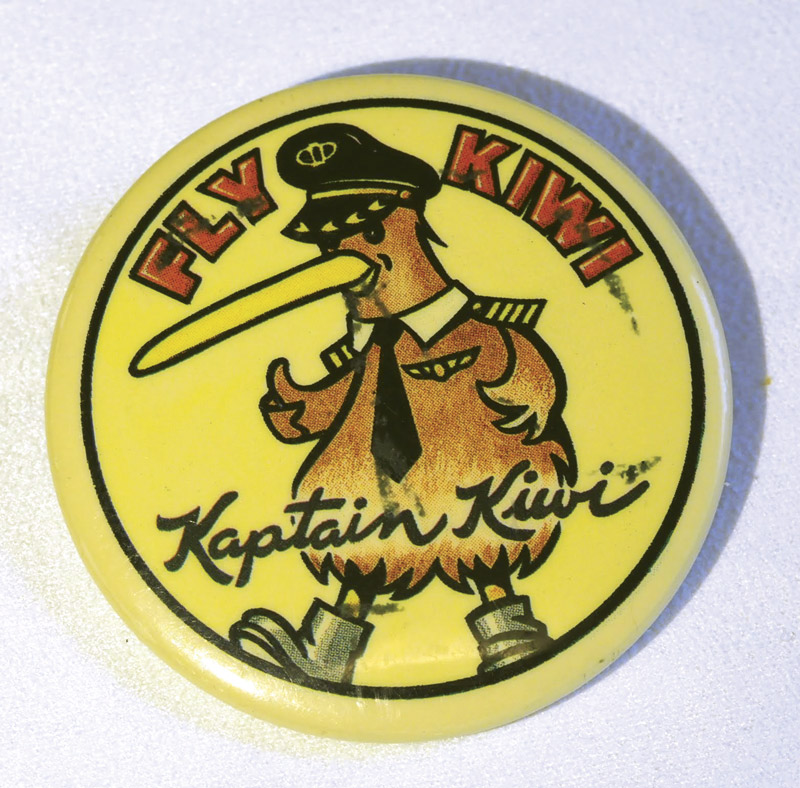
“Regarding our name, one may, at first, think of a tin of shoe polish,” it advertised. “Naw. How about a fuzzy piece of fruit with wings? Not exactly. Our KIWI identifies most with the flightless bird native to New Zealand and, while you now know where we got the name, you still may not know why.
“The owners of KIWI started with a dream. Most of us who now call ourselves KIWIS were previously employed by carriers that were grounded and no longer exist. We lost our wings and subsequently realized that our situation was similar to the plight of the Kiwi bird. What would be a more appropriate name for an airline that gave back the power of flight to so many people?”
Winged Bird
As an employee-owned carrier, the resultant KIWI International Air Lines gave out-of-work professionals the opportunity to be a part of something and not simply work for something.
“We dared to believe that experienced and knowledgeable employees, good service, quality food, and reasonable prices would make us successful,” they claimed.
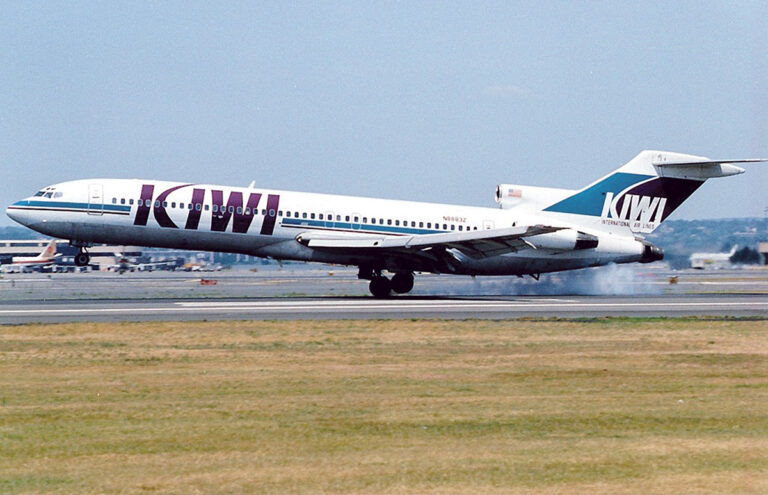
Inaugurating service from a Newark hub with a pair of former Lufthansa Boeing 727-200s in a six-abreast, 36-inch-pitch, single-class configurations on September 21, 1992 to Atlanta, Chicago-Midway, and Orlando, it structured itself with several unique aspects. These, combined into what it dubbed “Kiwi Class,” included low fares, the elimination of minimum-stay and advance-purchase requirements, seat selection and boarding pass issuances, increased leg room, award-winning food service, and a 20-year employee foundation.
The following year, it added San Juan and Tampa to its route system, offering two daily roundtrips to each of its destinations.
An early interline agreement with Virgin Atlantic provided transatlantic connections in Newark and Richard Branson, the carrier’s owner, promoted KIWI by stating that it was his “favorite airline.” Conde Nast Traveler named it the “best airline in America.”
Seeking to incorporate the service elements that other carries had begun to shed, it advertised that inflight meals were “something to be enjoyed and not paid extra for.”
“As you can see from our beverage menu, all of our liquor choices are top-shelf quality—a cut above the ordinary. For us, it is business as unusual.”
It even invented its own beverage—California Quake.
“At KIWI International Air Lines, we are dedicated to providing you with the finest products available,” it stated. “For example, our new soft drink, California Quake, is made with real fruit and pure sparkling water. It contains no artificial sweeteners, preservatives, additives, color, or caffeine, and is low in sodium.”
Like many deregulation carriers, the once-flightless bird sought to carve a nonthreatening niche in the sky by avoiding competition, adopting a simplified fare structure, eliminating price wars, and minimizing market share encroachment into the major carriers’ turf with a small route system and only a handful of daily frequencies to the cities it served.
Throughout its history, they included, at various times, Atlanta, Boston, Chicago, Las Vegas, Miami, Newark, Orlando, Tampa, and West Palm Beach in the US, and Aguadilla, Aruba, Bermuda, San Juan, and St. Maarten in the Atlantic and the Caribbean.
Clipped Wings
KIWI’s success was founded upon employee ownership and its ability to plug the service concept gaps other carries had increasingly created. But, behind most theories, there were several realities that worked in its disfavor. The first of them was the human one.
Robert Iverson, its first chairman, CEO, and president, mismanaged the company and appointed his old crony pilots, who may have had flying skills, but lacked leadership ones.
“One of the stupidest things I ever did was call everybody owners,” he once said in a New York Times interview. And he himself had never managed as much as a baggage carousel.
The carrier’s second obstacle occurred when the FAA grounded its fleet because of pilot training irregularities, resulting in significant revenue loss.
“By 1994, the carrier was struggling financially, reporting a loss of $14 million,” according to Lee Cross in his article, “KIWI International Launches Flights” (Airways, September 21, 2024). “Several of the airline’s top management members were ousted in an attempt to turn around its fortunes.”
Yet a third factor in its misfortune entailed the now-familiar David-versus-Goliath one: the incumbent carries lowered their fares to retain market share on routes in which they competed, and KIWI proved no match for their size and the destination opportunities their frequent flyer programs offered.
Despite KIWI’s own late attempt to introduce such a loyalty program, its fate had been sealed. New owners and investors, route realignments, and sporadic service starts and discontinuations all led to its initial 1996 Chapter 11 bankruptcy filing and $17.8 million loss two years later.
Flightless Bird Again
KIWI’s lofty vision ultimately collided with airline industry reality in deregulated skies, clipping its wings and once again rendering it just as flightless as the bird which had served as its inspiration and given it its initial rise.