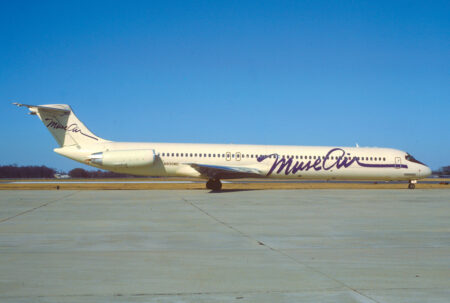



Deregulation, which enabled new-generation airlines to challenge the incumbent ones, resulted in two fundamental types: The low-fare, single-class, limited-amenity ones that attracted budget travelers and the unrestricted coach-fare ones that offered first-class-equivalent service in select business markets and thus became opponents of the major airlines. Air 1 and Legend Airlines, a first-class pair, belong to the latter category.
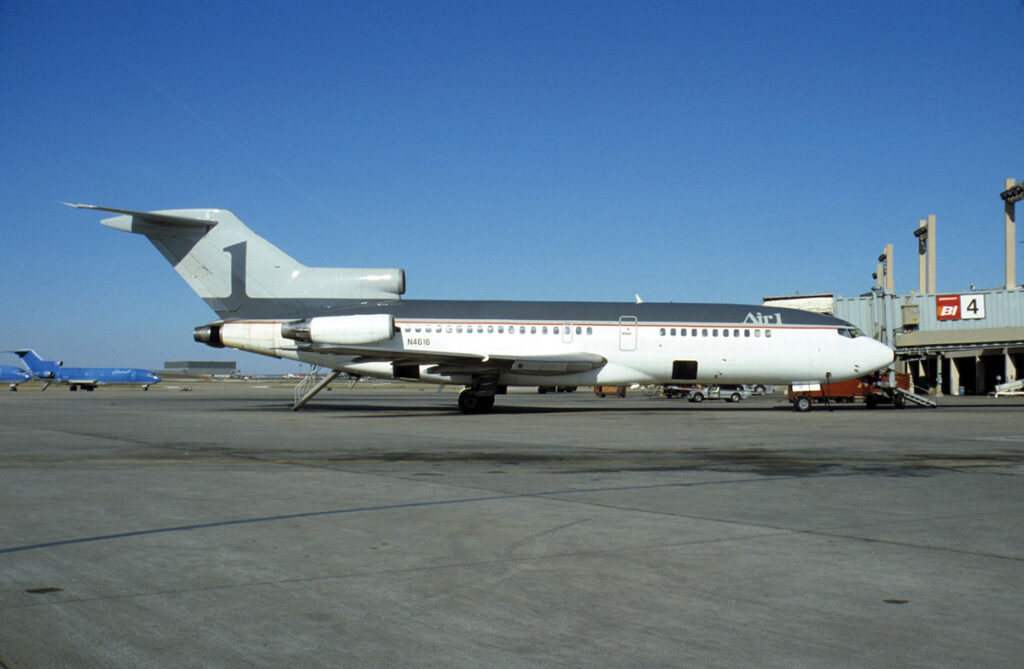
Air 1
Like the pieces of a puzzle, which, when assembled, produce an airline’s profile, Air 1 put together the following.
The members of its management team, consisting of former Apollo astronaut and current Houston businessman Eugene A. Cernan as chairman of the board and previous traffic manager for Ozark Airlines Paul J. Rodgers as president and CEO, were significantly experienced.
Because of the strong business market in centrally-located St. Louis, it chose that city as its operational hub, although it was aware that it would challenge TWA’s own, and fortress, one there in doing so.
Its fleet, comprised of seven Boeing 727-100s acquired on lease-purchase agreements from Pan Am and Piedmont, had the range to fly to either coast, and were outfitted with 80 leather-upholstered seats in a four-abreast arrangement—or one-third fewer than their certified 119-passenger maximum.
“Since deregulation, the major airlines have been squeezing down the size of seats and squeezing the businessman who has to fly,” according to James C. Johnston, Air 1’s Senior Vice President, as reported in Tim Bryant’s “Air 1 Caters to Business” article (UPI Archives, April 6, 1983).
Because it was estimated that 60 percent of businessmen were unable to take advantage of lower-fare advance-purchase, minimum-stay requirements, Air 1 elected to offer only a single fare structure—an unrestricted coach one those passengers were already forced to pay.
And because of the carrier’s business-oriented nature, flights were only operated on weekdays and on Saturday mornings.
Tantamount to its lure was its first-class equivalent service. Pull-down tray tables were covered with white linens and set with china, silverware, and stemware. Hot towels preceded upscale, restaurant-reminiscent entrees, such as filet mignon, and were served with wine. Seatbacks were equipped with inflight telephones, then an innovation. And business-related publications, such as the Wall Street Journal, were stocked on board.
Civil Aeronautics Board (CAB)-certified in November of 1981, the St. Louis-based, TWA-contender inaugurated service 18 months later, on April 1, offering between three and five weekday departures to Dallas/Ft. Worth, Kansas City, Newark, and Washington-National. Houston and Los Angeles were later added and, in an attempt to attract leisure passengers, it advertised, “Air 1 offers ‘Pleasure Class’ for your vacation travel” on the cover of its April 15, 1984 timetable.
Its service was superior. Its size, pitted against TWA, was inferior, and the typical David-versus-Goliath battle played out until the money ran out.
“Established 1982, the intent was to capture traffic from TWA in St. Louis by offering…all first-class service with 727s,” according to “The Top Airline Start-Up Failures since Deregulation” article. (Boyd Group International). “Not a lot of interest. Air 1 predictably wallowed deeper and deeper into the financial Red Sea (and ultimately drowned).”
Legend Airlines
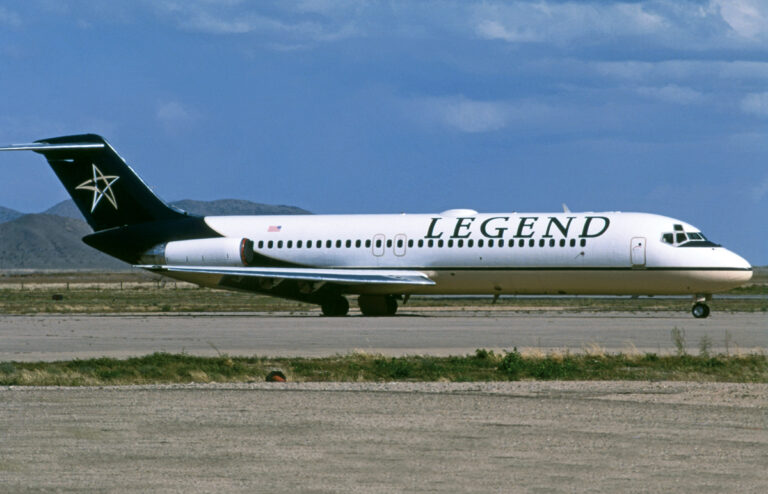
Grouped into a pair with Air 1, Legend Airlines also tried to challenge a megacarrier—in this case, American and, to a degree, Southwest—with superior service—at a secondary, underutilized airport to boot. But it was even shorter-lived and most of its story played out in the courtroom instead of the sky.
Brainchild of T. Allan McArtor, a former FAA administrator, US Air Force pilot, and Federal Express executive who became the airline’s president and CEO, it employed a first-class formula similar to Air 1’s.
Seeking to cater to the business market and employ the unrestricted coach fare in exchange for superior service strategy, it had a separate, $20 million terminal styled after an executive lounge built on Lemmon Avenue in Dallas, enabling business travelers to make the one-minute sprint from curb to gate and therefore save time.
Like the perfect seven fleet size of Air 1, Legend equally acquired seven DC-9-30s, reconfiguring them with 56 leather-covered seats, or fewer than half the type’s 115 maximum.
Once on board, passengers were treated to the latest technology—AT&T Airfones, live inflight television, and computer-charging ports—and quintessential first-class cuisine created by Dallas area chefs, served with wines and trailed by boxes of chocolate truffles.
The minuscule route system was created for the business-bound: New York-La Guardia and Washington-Dulles on the east coast and Las Vegas and Los Angeles on the west from a Dallas hub. But the airport was Love Field, not Dallas-Ft. Worth International, and its ability to serve those destinations from it only resulted from its lengthy and costly litigation.
The Wright Amendment
Protection can often be dual-sided, and on its other side is restriction. This, in essence, is what Legend tried to circumvent when it elected to fly from Love Field.
Although it had been the city’s major airport, traffic growth during the 1960’s left it capacity-constrained and the interim solution to co-use Southwest International Airport in Fort Worth, Texas, only diluted operations. What was needed was a much larger, integrated facility, which took form as the Dallas/Ft. Worth International Airport when it opened in 1974, and all airlines subsequently transferred to it.
Nevertheless, now-dormant Love Field seemed like an opportunity waiting to happen and Southwest, founded to attract the masses with peanut fares and operate from high-priced, underutilized airports, did. In order to “protect” the new facility from defecting or new carriers, Jim Wright, a US House of Representatives member serving the Fort Worth area, became instrumental in passing the so-called “Wright Amendment.” It stipulated three restrictions.
Only airliner-sized service could be legally offered from Dallas Love Field to other points in Texas and those in Arkansas, Louisiana, New Mexico, and Oklahoma.
Connecting flights could not be offered to or through any other destination beyond these states.
Any service beyond them could only be operated with aircraft seating a maximum of 56 passengers.
Using what Legend believed was the amendment’s loophole, it deliberately configured its DC-9-30s with the 56-seat limitation. However, the Department of Transportation (DOT) ruled that the restriction referred to “designed capacity” and not the operator’s choice to reduce it to meet it. It was not until October 7, 1997, that the Shelby Amendment rescinded this and expanded Love Field’s reach by another three states.
Legend ultimately became airborne on April 5, 2000, operating the airport’s first long-range service since 1974, but it was short in duration. Unable to pay its fuel bills, it literally ran out of gas and ceased flying only eight months later, on December 3.
“(It) seems like only yesterday that some of us were flying the friendliest of skies on the airline that offered first class service at discount prices…,” according to Robert Wilonsky in his article, “Legend Had It” (Dallas Observer, June 7, 2006). “It really was an amazing airline, a swift kick in the ball bearings to other carriers that treated customers like cattle and their luggage like lepers.”
While its high start-up costs and lengthy legal battles with the cities of Dallas and Fort Worth, the Dallas/Ft. Worth Airport Board, and American and Southwest left it financially drained; it was instrumental in challenging and changing the Wright Amendment, which was entirely repealed in 2014.
The First-Class Pair
Small and short-lived, Air 1 and Legend represented two more attempts to carve a super service niche in skies dominated by super-sized carriers.