

As the airlines crossed the bridge between the 1950s and 1960s decades, and the first long-range jets took form as the Boeing 707, the Douglas DC-8, and the Vickers VC10, the consensus was that the earlier piston-powered types would continue to serve the short and medium routes. But, as quickly gauged by passenger popularity, travelers sought the same jet speed and comfort on sectors of all lengths, leaving aircraft manufacturers to design economical, smaller-capacity airliners. Although producing them was logically viewed by the non-aviation public as just reducing the number of seats, the reality was that suitable pure-jet powerplants had yet to be conceived to facilitate profitable operations in this exclusively-propeller market.
The first to do so occurred not in the U.S., but in France, when Sud-Aviation introduced its 80-passenger Caravelle and essentially established the configuration for such aircraft. In the UK, the British Aircraft Corporation followed suit with its own offering, the BAC 1-11, and American Airlines ordered it.
Design Features
That aircraft traces its origins to the Hunting H.107, a 32- to 48-seat, four-abreast design powered by two Bristol Siddeley engines mounted in the then still-controversial rear-fuselage arrangement. But it left the wings aerodynamically clean to be able to develop their maximum lift.
When Hunting Aircraft was absorbed into the British Aircraft Corporation (BAC) in 1960, however, the design, exhibiting merit, was retained and redesignated BAC-107.
“When Luton-based Hunting Aircraft became part of the British Aircraft Corporation, the former Vickers-Armstrongs factory at Brooklands, Weybridge, was already working on the BAC VC7 project, a 140-seat development of their successful VC10,” according to BAE Systems. “Having identified the H.107 as ‘having merit’, BAC decided to merge the projects under the heading of BAC-107.”
Subsequent iterations resulted in its capacity increase—to 79 passengers in a five-abreast configuration; power by two 10,400 thrust-pound Rolls Royce Spey Mk 506-14 thrust reverser-equipped turbofans; a t-tail to avoid horizontal stabilizer engine exhaust interference; low, swept wings; an auxiliary power unit (APU) for autonomous engine starting and cabin conditioning; and provision for both forward, left, and aft, ventral, air stairs.
“The BAC One-Eleven is the first jetliner specifically designed for short-haul routes,” according to the British Aircraft Corporation’s BAC One-Eleven description booklet (100 Pall Mall, London). “As a result, it offers short-haul operators jet facilities at small-jet costs. It is a first-class airplane tailored to second-class airfields…”
In its final iteration as the BAC 1-11-200 and registered G-ASHG, it made its maiden flight from Hurn on August 20, 1963, and received its Air Registration Board (ARB) certification on April 6. Freddie Laker-managed British United Airways inaugurated the type into service between London-Gatwick and Genoa, Italy, three days later.
The upgraded BAC 1-11-300, powered by 11,400 thrust-pound Spey Mk 511-14 engines, was dimensionally identical, but introduced additional fuel capacity and therefore greater range. Kuwait Airways was the version’s launch customer, but subsequent reassessment of its short-range aircraft needs before it was even delivered left British Eagle to take delivery of the airframes intended for it and thus serve as its initial operator.
When the U.S. weight limit for operation of such aircraft was increased, the British Aircraft Corporation discontinued the variant after only nine had been built and replaced it with the BAC 1-11-400. This became American’s first short-haul jet.
American’s First Short-Haul Jet
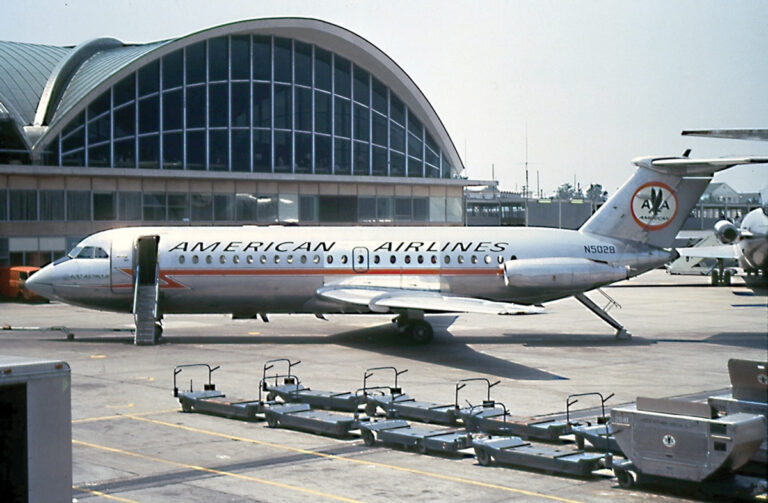
Because American considered the comparable Caravelle a little outdated, and because the BAC-1-11’s DC-9 and 737 US counterparts had not yet even flown, it selected the British twin for this market when it placed an initial 15-firm and 15-optioned order, enabling it to replace its piston-powered types on short-range routes that often touched down at limited-facility airports. Although it was a score for BAC by marking its U.S. market inroad with the 400 series, it had already succeeded in doing so with its baseline 200, with sales to Mohawk and Braniff. American was instrumental, however, in incorporating improvements in the version.
“Since first taking interest in the BAC-107 concept at the 1960 SBAC Farnborough Air Show, American Airlines had a great influence over the final series 400 design…,” according to Malcolm L. Hill in his book, BAC One-Eleven (Ian Allan, 1999, p. 53). “From mid-1961 onwards, American engineers were able to evaluate the developing detail design and projected maintenance costs and reliability.”
Among these recommendations, which were implemented to maintain commonality with its other jet aircraft, were both forward and aft air stairs to minimize turn-around times, and new wheels, brakes, and an antiskid system.
In its colorful, Dreyfus-designed cabin, which seated 69, drop-down oxygen masks were incorporated, public address speakers were installed in the overhead racks, and increased-capacity potable water tanks were used to avoid intermediate-station replenishing.
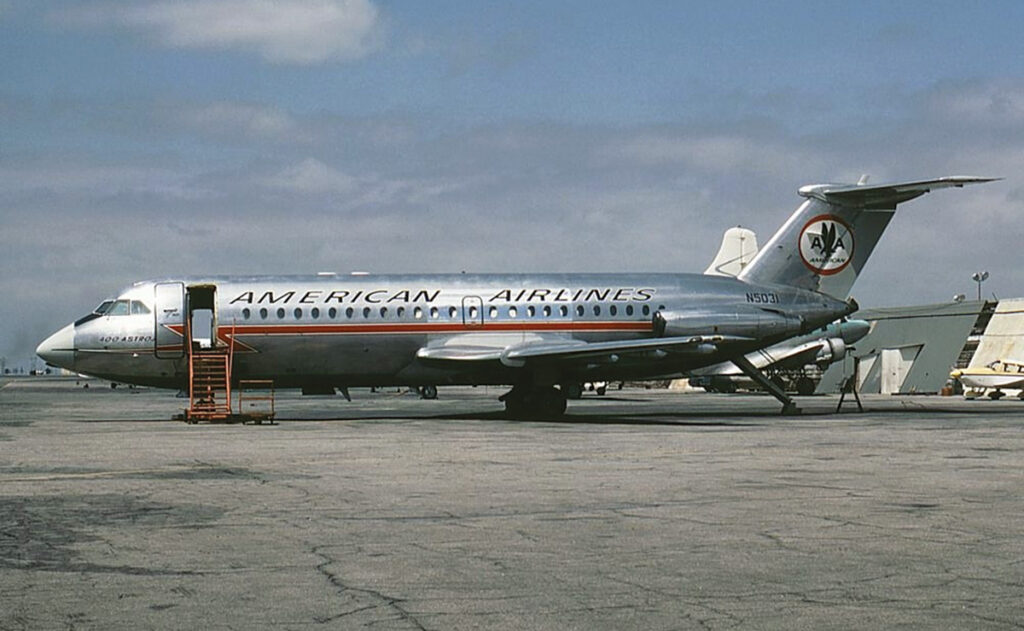
After conducting tis first sales tour, which encompassed cities in the U.S., Mexico, and Central America, aircraft G-ASYE was leased to American for three and a half weeks in December 1965 for crew training, enabling it to take delivery of its first dedicated BAC 1-11-400s, which it dubbed “Astrojets” on the 23rd.
The following March, it conducted route-proving and familiarization flights by operating to the 13 American-served destinations of Baltimore, Boston, Buffalo, Chicago, Cleveland, Detroit, Hartford, Newark, Philadelphia, Rochester, Syracuse, Toronto, and Washington-National.
Primarily based at New York-La Guardia, its eventual 30-strong fleet (once the 15 options had been taken up) served New York State and the northeast. Its inaugural flight occurred on March 6 from La Guardia to Toronto, and the type was generally operated on routes not exceeding 500 miles in length, although a Dallas-Louisville sector was one notable exception.
During their peak, the British twinjets operated some 230 daily sectors and served 21 destinations.
American used the type for its own air shuttle. Unable to compete with Eastern in capacity or frequency on the La Guardia-Boston route, and only carrying 9,000 monthly passengers on it, it elected to increase its market share with the type.
“Eventually, American responded to the threat of virtual elimination from the market by inaugurating, on February 12, 1967, its Jet Express service on the New York-Boston route,” according to R. E. G. Davies in Airlines of the United States since 1914 (Smithsonian Institution Press, 1998, pp 544-545). “Using BAC One-Elevens, this was, however, little different from a normal airline scheduled service with the usual frustrations of booking procedures and the need for advance reservations for the peak-hour services.”
To advertise the new operation, it advised on the cover of its February 12, 1967, timetable, “American Airlines will inaugurate Jet Express service between New York and Boston.”
While the effort increased its monthly passenger totals between the cities to 50,000, and it subsequently expanded the operation into Washington with 70-percent load factors, its own shuttle was not profitable and had no impact on Eastern’s version of it. As a result, it was discontinued after less than two years.
Service Withdrawal
American’s operation of the short-haul jet hardly represented longevity. By January of 1972, it had removed its last aircraft from service, or just under six years since the first had begun it.
“Unless one stretches both imagination and truth, the BAC 1-11 was far down American’s list of airplane popularity,” advises Robert J. Serling in Eagle: The Story of American Airlines (St. Martin’s/Marek, 1985, p. 362). “The crews referred to it as ‘Britain’s revenge for 1776.’ Its high landing speed made passengers nervous, the cabin was somewhat cramped, and the galley space was almost nonexistent.”
Nevertheless, it enabled the carrier to introduce jet service on routes for which its larger aircraft were inappropriate and both gauge and develop their markets. Although BAC offered a higher-capacity, stretched 500 version, American elected to replace the British twin with the Boeing 727-100 and, later, -200, which became its short-to-medium-range workhorse.
BAC_1-11_Series_401AK,_American_Airlines.jpg