


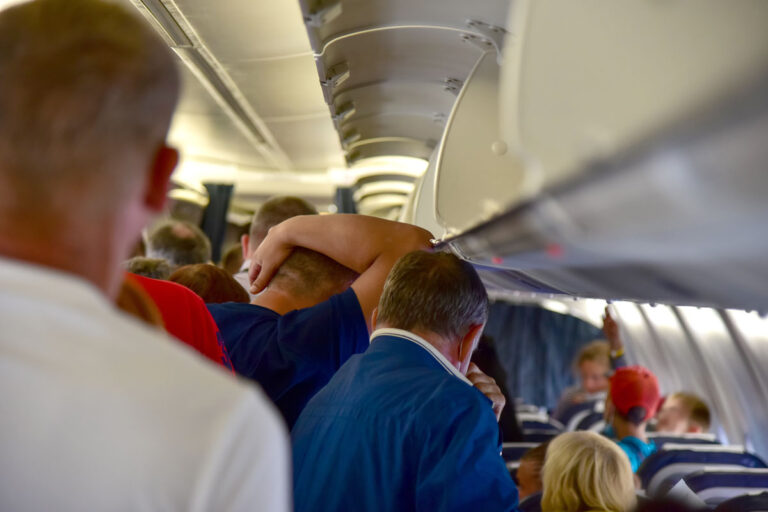
Even when told repeatedly not to, many people instinctively prioritize grabbing important items as a flight cabin fills with smoke or the alarm sounds. A U.S. Transportation Safety Board study in 2000 found that nearly 50% of passengers attempted to take carry‑on bags during evacuations, typically reaching for wallets, credit cards, passports, medication, or work materials. In a later survey, about 35% of respondents said they would take their luggage in an emergency even if explicitly warned not to. And according to a British report, 77% of passengers at least expect to try to take some belongings in an evacuation scenario.
These reactions are understandable—people want to safeguard what matters. But in an emergency, every second lost can cost lives.
The Impact: Simulations and Real Data
- A recent FAA‑sponsored review (Dec 2024) analyzed prior incidents and modeling studies. It consistently concluded that retrieving carry‑on baggage slows evacuation times, blocks exit routes, risks injuring others, and can damage emergency slides.
- An academic study using Boeing 777 evacuation simulations showed that even modest levels of baggage retrieval significantly delay overall evacuation time.
- Another modeling study using A380 simulations found that if 50% of passengers attempt to retrieve luggage, median evacuation times rise by around 38%, and worst cases exceed 140 seconds—far beyond the 90‑second certification standard.
- Safety analysis reports highlight that increased evacuation delay can correlate with exposure to smoke, fire, or structural collapse—turning a survivable event into a tragedy.
From Cabin Crew to Cockpit: Why You Need to Follow Instructions Immediately
As a former flight attendant, I witnessed firsthand how the briefing instructions—“Leave all carry‑on baggage behind” — were based on decades of hard-earned safety data. As a pilot today, I feel the weight of that responsibility even more.
When an evacuation is ordered, our goal is to get everyone off the aircraft in under 90 seconds, even though some real evacuations exceed that when passengers act against instructions. Bags jam aisles, slow down others behind you, and can disrupt slide deployment. They can also become projectiles or trip hazards—in one incident, passengers hitting slides caused minor injuries to others.
We are trained to evacuate under extreme pressure—and we count on passengers to follow instructions immediately. Your compliance can speed up the evacuation—and if you’re able, help others find the nearest exit or assist someone needing a hand.
Time Is of the Essence
Jet fuel can ignite quickly. Certification rules assume no luggage, no delay, and successful evacuation in tiny fractions of time. One real-world case: in 2016, in Dubai, an Emirates 777 crash‑landed, and the crew had to rush passengers down slides. Despite instructions, many opened overhead bins to grab luggage—but the evacuation still met the 90‑second standard only because the crew acted swiftly.
When a delay occurs — stop to lift a bag from above, block a cabin doorway, tugging at a zipper — it can add precious seconds. In modeling scenarios, with 0% bag retrieval, all evacuations finished within regulatory limits; but with 25–75% retrieval, a large fraction exceeded safe evacuation times, and the worst cases rose 64% slower than baggage-free evacuations.
So, Why Do People Still Do It?
- A deeply human desire to retain identity documents, medication, money, and electronics. Often it’s instinctive.
- Some keep small items already on their person—backpack at their feet—and may think it’s okay. Modeling shows that retrieving items stowed under your seat does impact, but less than overhead bins, as long as you don’t stop in the aisle.
- Many believe “there’s time”—but simulations and past accidents show how fast confusion and smoke can disorient people.
A Former Flight Attendant’s Advice, Now from the Pilot’s Seat
- As soon as the alarm is given, stand up if instructed, leave all carry‑on baggage. Even if the light luggage under your seat feels harmless, following instructions without delay is critical.
- Prioritize getting to exits, not opening bins or grabbing bags. If you’re in the aisle and see a crowd or someone stuck, move past them quickly if safe.
- Once off, if you can help—assist someone slower, point others to usable exits, listen to the crew or ground responders.
- Respect the training—for crew and for you. When we brief and we order evacuation, we are not wasting time. We act—and we expect you to, too.
Gratitude and Partnership
Thank you to all past passengers who followed crew instructions swiftly—you are the reason many evacuations ended without loss of life. To crew members, past and present, your training, calm leadership, and insistence that personal items be left behind save lives.
When passengers and crew work together—when trust and clear, prompt action form a partnership—you drastically raise the odds of everyone getting out safely.
In Summary
- Nearly half of passengers historically try to take bags during emergency evacuations, delaying exits and risking lives.
- Simulations consistently show how any luggage retrieval increases evacuation time—sometimes by over 30–60%—often pushing beyond the 90‑second benchmark.
- As a former flight attendant and now pilot, I urge you to follow crew instructions immediately, leave all carry‑on items behind, and help others when safe to do so.
- Time is precious—every second saved in a cabin full of smoke or shifting structure is a second closer to safety.
Thank you to passengers and crew alike—for being alert, responsive, and cooperative. When we all act together correctly, we preserve what matters most: lives.