




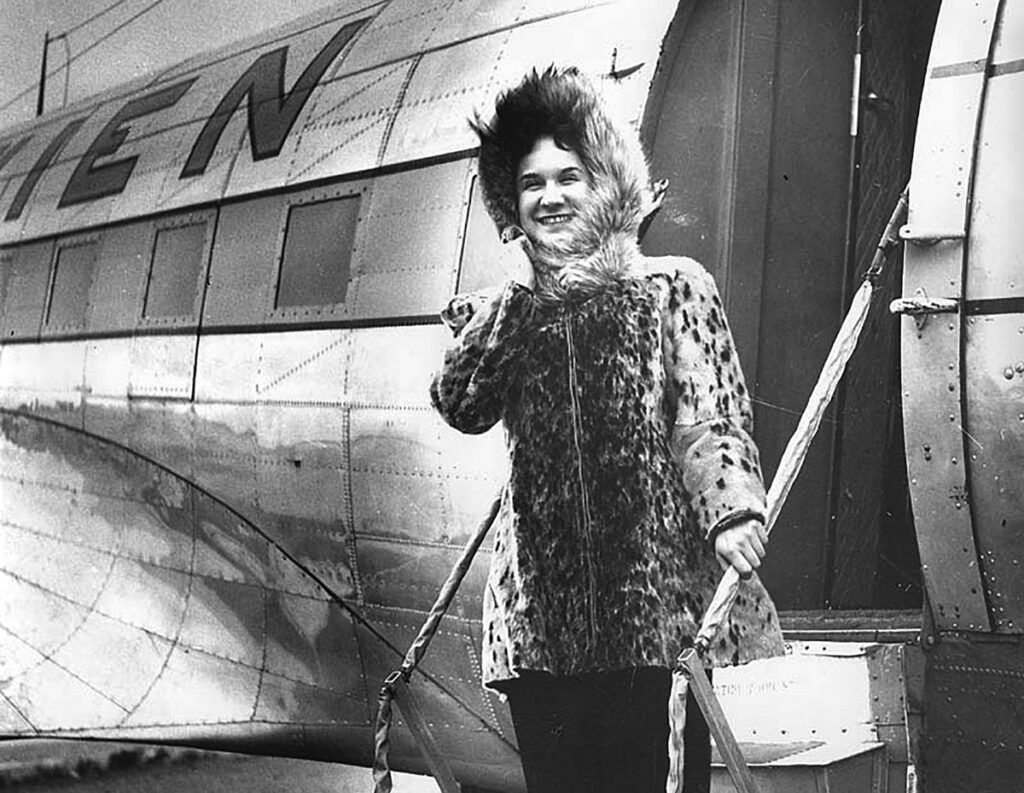
First to spread wings in the 49th state, Wien Air Alaska served as a passenger and supply lifeline to remote communities, operated in geographically and climatically challenging conditions, and ultimately extended its reach to the Lower-48. But it always bore the name of its founder as it negotiated mergers and expansions throughout its six-decade history.
The name that the airline bore was Noel Wien. Born, himself, in the Lower-48—specifically in Nebagamon, Wisconsin, in 1899—or just before the turn-of-the-century and four years before the Wright brothers even demonstrated that controlled, powered, and sustained flight was even possible—he was drawn to aviation and achieved early experience when he doubled as a performer in the Federated Fliers Flying Circus.
Early Wien Airline Companies
As, perhaps, a catalyst, this experience led to the autonomous Wien Airways of Alaska in 1927 when Noel and brother Ralph acquired a Standard aircraft and supplemented it with a Stinson Detroiter, inaugurating service to the northwest communities of Candle, Deering, Kotzebue, and Point Hope.
Noel became its president and Ralph its vice president. The life of the fledgling company, however, was brief, as was that of Noel’s brother. The former was sold to Avco in 1929, which combined the Bennett-Rodebaugh Company and Anchorage Air Transport to form Alaska Airways. The latter died on October 12, 1930, when the Bellanca he was flying crashed.
Although Noel briefly flew for the new airline company, he restarted his own—and second one—in 1932. Instrumental in it was Northern Air Transport, a carrier from which it acquired early routes and equipment. The routes themselves were granted by the US Post Office for special contract mail service by steamer, automobile, and even dog team.
Expansion and Acquisition
These so-called “Star Route contracts,” initially awarded for point-to-point service for a four-year period, had to be granted multiple times if a route entailed one or more stops. Because payments were based upon surface, dog-sled transportation in the winter and river boat means in the summer, bids had to be very low before they could even be considered.
In late 1933, rebidding became available for the period beginning July 1 of the following year, and three air carriers did so, including Pacific Alaska, Woodley Airways, and Northern Air Transport, which would merge with Wien in 1936. It was ultimately awarded route rights north and east of Fairbanks.
The new destinations, coupled with the merger, enabled Wien to slowly expand. By the beginning of the next decade, Noel once again bowed out of the airline industry, forced to sell his shares to brother Sigurd to pay for his wife’s medical bills, but would later return as a pilot and vice president.
Nevertheless, the airline acquisition that would characterize Wien’s history continued: it took over Ferguson Airways on June 25, 1949, Byers Airways on July 8, 1956, and Northern Consolidated, in 1966.
The latter, an amalgamation of Roy Peterson Flying Service, Northern Airways, Walatka Air Service, and Northern Air Service that occurred on May 8, 1947, offered service in a southwesterly direction from Anchorage and Fairbanks with “28 passenger combination DC-3s and four eight-passenger combination twin-engine Cessna T-50 Bushmasters with wheels, skis, or floats,” according to its June-July 1955 timetable.
Major DC-3 routes from Anchorage included those to Aniak, Bethel, McGrath, and Nulato. Five years later, it had upgraded to the Fairchild F.27 propjet and was able to advertise that it “served Western Alaska from Anchorage, Bethel, and Fairbanks.”
As the US, license-built counterpart to the Fokker F.27 Friendship—the Dutch-designed, high-wing, twin-turboprop regional airliner intended to replace the ubiquitous DC-3 with greater speed and pressurized comfort—it first flew in prototype form with 1,540-shp Rolls-Royce Dart engines on November 24, 1955.
Featuring a forward, left, upward-opening cargo door and a strengthened cabin floor, the F-27B entered service with Northern Consolidated in November of 1958, offering passenger and cargo transport to all of its destinations.
The Wien merger prompted another name change—in this case, to Wien Consolidated Airlines in 1968, enabling it to introduce a blue and gold color scheme to match Alaska’s state colors. Sigurd became chairman of it. Roy Peterson of Roy Peterson Flying Service and Northern Consolidated became its president, and brothers Noel and Fritz served as board members.
Because Alaska Airlines had failed to provide adequate service between Anchorage and Fairbanks, the Civil Aeronautics Board (CAB) granted Wien Consolidated this coveted, intra-state trunk route. It subdivided its operations into geographical groups, each of which listed the flights and stops within it, such as “Nome Bush,” “Fort Yukon Bush,” “Fairbanks Bush,” “Fairbanks-Koyukuk River Area,” “Fort Yukon Service,” “Fairbanks-Whitehorse-Juneau,” “Fairbanks-Yukon River Area,” “Nome-St. Lawrence Island,” “North Coast Area,” “Kotzebue Bush,” and “Bettles Bush.”
Wien Consolidated elevated its image when it transitioned to the jet age with the combi version of the Boeing 737-200C, emphasizing its achievement by advertising, “The biggest little airline in the world” and “Alaska’s first airline with America’s newest jet–the 737.” It deployed it on the Anchorage-Fairbanks, Anchorage-King Salmon-Fairbanks-Barrow, and Fairbanks-Galena-Nome-Fairbanks stretches.
Wien Air Alaska
On August 1, 1973, Wien refreshed its image by adopting the “Wien Air Alaska” name, introducing a primarily blue aircraft livery, and appointing Roy Peterson as its chairman, president, and CEO. The 737 became the mainstay of its jet fleet and was gravel kit-equipped for operation from unprepared surfaces. A forward, left, cargo door facilitated combination passenger and freight payload services.
In its June 1 to July 31, 1974 timetable, it billed itself as “Alaska’s first airline” and emphasized its expanding reach by stating, “From the Land of the Midnight Sun to old Russian Alaska, Wien Air Alaska offers seven of the most exciting tours (to Point Barrow, Prudhoe Bay, Nome and Kotzebue, Fort Yukon, Katima, Kodiak, and Russian Alaska and Bethel with a tundra excursion). These visits will take you to the real Alaska. You meet fascinating people, see unique places, and have the most unusual experiences.”
It denoted 737-200C equipment as, simply, “JET,” and Fairchild F-27 and FH-227 turboprop aircraft as “F7.” It also uniquely highlighted the geographical nature of certain routes, such as those between Anchorage and Barrow, with the notation “Cross the Arctic Circle.”

Three years later, it exclusively operated 737-200s on Anchorage sectors to Aniak, Barrow, Bethel, Dillingham, Fairbanks, Galena, Homer, King Salmon, Kodiak, Kotzebue (with another “Cross the Arctic Circle” notation), McGrath, Nome, Prudhoe, Bay, St. Mary’s, Unalakleet, and Whitehorse, Yukon, Canada.
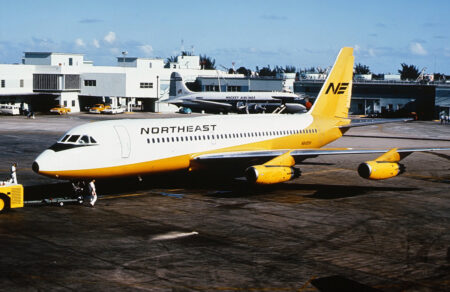
Although it had yet to connect Alaska with the Lower-48 states on its own, it listed 15 daily frequencies between Anchorage and Seattle operated by Alaska Airlines, Northwest Orient, and Western.
That autonomous service was subsequently listed in its June 15, 1979, timetable, in which it indicated that it offered one- or nonstop flights from Anchorage, Juneau, Kenai, Ketchikan, and Kodiak to Seattle, and to Chicago in cooperation with Northwest Orient.
Wien Air Alaska facilitated route expansion with a second pure-jet type—namely, the original, short-body Boeing 727-100, five of which it operated from May of 1981 to September of 1982, and two of which it leased from Continental Airlines in 1984, appearing in a hybrid color scheme.
It also leased four stretched 727-200s—three from Ansett Australian Airlines and one from Aerolineas Argentinas—between December 1983 and November 1984.
By mid-1982, Wien Air Alaska operated six daily 737 and 727 flights on its Anchorage to Seattle air bridge, gateway to the Pacific Northwest and intermediate stop on an increasingly expanding southwest route system, which now encompassed Portland, Boise, Salt Lake City, Phoenix, and Denver.
Expansion Into Bankruptcy
Expansion, with its aircraft, employee, and airport facility investment, is always a bet between monetary output and profitable return. In the case of Wien Air Alaska, it lost it.
In 1983, the carrier was sold to Jim J. Flood, its president, and a name change to, simply, Wien Airlines to deemphasize its Alaska-exclusive route system, was selected to reflect its Lower-48 expansion, now covering Albuquerque, Boise, Denver, Phoenix, Portland, Reno, Salt Lake City, San Francisco, and Seattle, and primarily served by its higher-capacity 727-200s.
But the overexpansion and liquidation for personal profit led to its bankruptcy declaration on November 28, 1984, and its complete service discontinuation almost a year later, on October 25.
“Wien Air Alaska was bought by a corporate raider on a leveraged buyout and was liquidated for about twice what the stock was selling for,” Merrill Wien, Noel Wien’s son, claimed at the time. “The Airline Deregulation Act of 1978 made this possible.”
“After nearly 60 years of serving Alaska passengers and freight clients and undergoing several name changes, Wien Air Alaska folded in 1985,” according to Jennifer Houdek in her article, “Noel Wien: Alaskan Aviation Trailblazer” (LitSite Alaska). “But the name Wien had (forever) become synonymous with commercial aviation in the Far North.”



4 Comments
Great article , our family worked for Wien ‘s from the 50’s to the 70’s our home was a local gathering place for many Wien employees in Fairbanks during that time.
My dad, Bernard Sherwood worked for Wien in Fairbanks and in Anchorage for decades. When I was just a kid, he used to take me to the old Wien hanger in Fairbanks sometimes and show me the planes and the work he did. Robin (Sherwood) Smith.
As a 30-year airline veteran myself, I am always delighted that my articles about various carriers bring back wonderful memories for the employees and their families. Working for airlines, I have always said, is more than a job or a career: It is a unique way of life!
Wein had a long and rich Alaska history. My first flight was on a Wein DC-3 in 1954, a few days after my birth.