

A cadre of professionals with airline experience, the desire to establish a hub with a significant number of origin-and-destination passengers, a short-range, twinjet fleet, and a name strongly suggestive of the city it was based in, combined to create Presidential Airways. Its hub was Washington-Dulles International Airport, where it offered numerous capital connections.
Concept
Hailing from nearby McLean, Virginia, 37-year-old Harold (Hap) Pareti was the brainchild of the carrier, which constituted his second one. His first, $1 billion per year PEOPLExpress, was initially a resounding success. After he resigned from it, having achieved president and CEO status, he decided to repeat his formula. Why another, it may be asked?
“I came to the conclusion that I had to do this,” he once stated. “My life wasn’t going to be complete without trying to start something from scratch.”
Motivation always serves as a draw, but for Pareti, money was not behind it.
“It’s not the money at all that gets me going,” he said in Iris Krasnow’s “Presidential Airways: High Risk, Big Bucks” report (UPI, October 13, 1985). “I just like to restructure things—create. To me, the satisfaction of this deal is coming here every day and seeing the excitement in the eyes of the new flight attendants, pilots, and customer service personnel.”
Airlines, like buildings, are only as strong as the foundation upon which they stand. In this case, that foundation consisted of an experienced, motivated management team, comprised of Senior Vice President Geoffrey Crowley and Donald Hoydu, formerly with Texas International and PEOPLExpress; Vice President James Proia; Director of Airport Services Karen Kenny; Director of Training Larry Elliott; and Director of Reservations and Telecommunications Stephen Means.
Service Inauguration
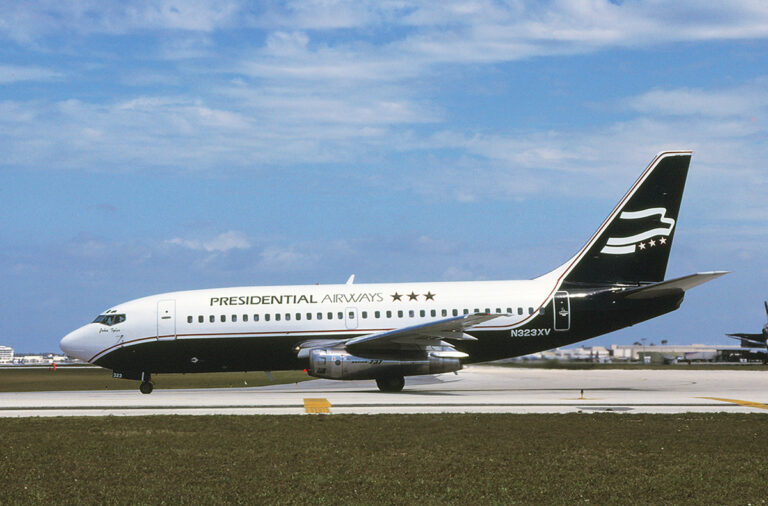
Presidential Airways inaugurated service from a Washington-Dulles hub to Boston, Cincinnati, Hartford, Indianapolis, and Miami with an initial fleet of four Boeing 737-200s, very much the way PEOPLExpress had from Newark, on October 10, 1985.
“Washington’s masses of pinstriped inhabitants will be sitting slick in the airline’s upscale jets,” Krasnow’s article continues (ibid). “Presidential’s four white Boeing 737-200s are stamped with silver stars and midnight-blue eagle profiles. Interiors are colonial blue, gray, and wine.”
Unlike Pareti’s PEOPLExpress rendition, which featured a no-frills, buy-on-board product, Presidential combined curbside baggage check-in, reserved seating, and complimentary beverage and snack service amenities with fares that were between 33- and 67-percent lower than those of the established carriers.
Washington associations were, wherever possible, used. Introductory fares to new destinations, for instance, reflected the founding year of the country, at $17.76. In-flight snacks, provided by Marriott Corporation, were inspired by past U.S. presidents’ preferences, such as a Jefferson Po’boy, Ronny’s ranch sandwich, and Truman’s blueberry muffins.
“Our theory is basically to put a few more dollars into the fare, but give people all the amenities,” Senior Vice President Crowley explained the airline’s strategy.
Expanding into the first phase of what Pareti dubbed “Washington’s airline,” Presidential, taking delivery of additional 737s, soon served Boston, Cincinnati, Cleveland, Hartford, Indianapolis, Miami, Orlando, and West Palm Beach from its Washington-Dulles hub, destinations not necessarily reachable nonstop from nearby Washington-National.
It introduced “The World According to Presidential” in its July 3, 1986, timetable. “Welcome to the world of superb Presidential treatment, both on the ground and in the air,” it stated. “Service that has our competition beat. Welcome to more than 90 flights every day. Flights designed to meet your busy schedule. Welcome to everyday low fares that make the business of doing business even more rewarding. And going off to have fun is ever so much more enjoyable. Welcome to the kind of airline you always wished you could fly. We’re glad you’re here.”
Now flying to 16 destinations, it has since inaugurated service to Allentown, Atlanta, Daytona Beach, Detroit, Fort Lauderdale, Melbourne, Montreal, New York-La Guardia, Portland (Maine), Sarasota, and Savannah/Hilton Head. A star on its route map marked Washington, which it called “Home Town.”
“It isn’t easy being a small airline in 1986, but Presidential Airways, marking its first anniversary, believes it will not only survive, but will prosper,” according to David Vesey’s “First Year Tough, but it Intends to Survive” article (UPI, October 9, 1986). “That could be a tall order in an industry in which big, rich airlines have been devouring weaker carriers, a threat Presidential knows only too well.”
Although the $13.3 million it lost during the first half of the year was hardly novel with upstart carriers, and the ten-gate concourse it constructed at Dulles drained its coffers, its major challenges were combating the Dulles hubs established by New York Air and United, whose brand recognitions were higher than Presidential’s.
New Strategies
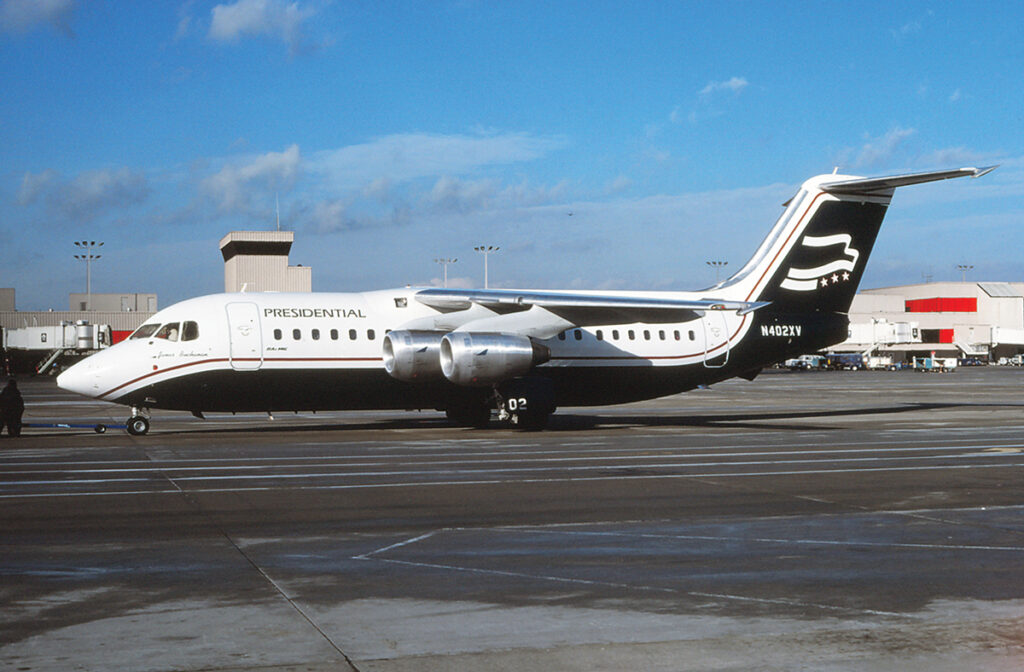
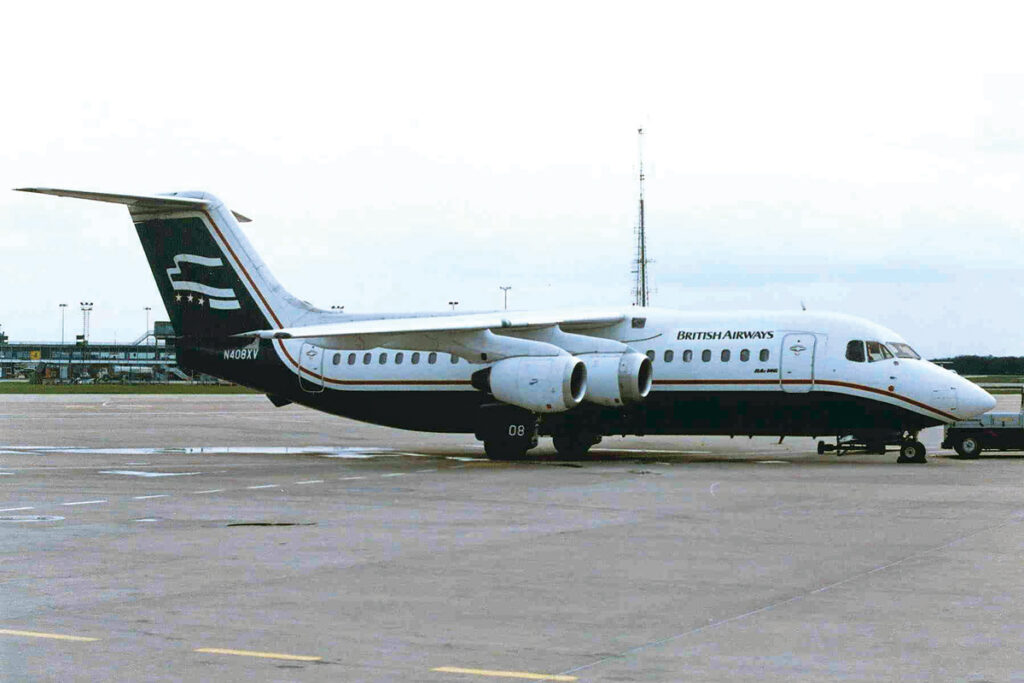
Part of its offensive strategy entailed developing markets in which its two competitors saw no profitable potential. The other was to introduce smaller-capacity aircraft that required lower breakeven load factors. That aircraft was the British Aerospace BAe-146-200 regional jet of the UK.
As perhaps the ultimate design response for a feeder or regional aircraft, it progressed through numerous iterations, including those of the high-wing, twin-turboprop DH.123 proposed by de Havilland and a low-wing one with aft-mounted engines, until it arrived at the HS.146 of Hawker Siddeley with Avco Lycoming ALF-502 high-bypass-ratio turbofans. Because they did not generate the required thrust for the envisioned aircraft, only the use of four pylon-mounted to the high wing’s underside could ensure the needed performance and range.
Sporting a t-tail and an aft petal, fuselage-forming airbrake for steep approaches, it ultimately featured that very high-mounted wing, without leading edge devices, and the four turbofans. While its cabin was wide enough for six-abreast seating, most carriers chose five. When British Aerospace took over the program from Hawker Siddeley, it was re-designated the BAe-146.
Presidential announced a $100 million order for five such aircraft in June of 1986 for delivery by the end of the year, with seven more slated for 1987.
“Presidential was looking for the best small jet that could provide the frequency, economics, and capacity for the routes that we will be considering for our expansion program,” Pareti explained.
Although the quad-engine regional jets provided short-field, low-capacity service, they were still too large for small community feed, prompting Presidential to acquire Colgan Air in 1986.
Founded by Charles J. Colgan 21 years earlier as a fixed base operator offering aircraft fueling and maintenance services at Manassas Airport near Washington, it began airline operations to Poughkeepsie under an IBM contract in 1970. Eventually purchasing a fleet of Beech 99s, Beech 1900Cs, and Shorts 330s, it progressively expanded its northeast regional route system, serving Binghamton and Poughkeepsie in New York, Asbury Park in New Jersey, Philadelphia in Pennsylvania, Dulles and National airports in Washington, and Hot Springs and Norfolk in Virginia by 1983.
Three years later, it began code-share service with New York Air as New York Air Connection. But after Continental purchased the Big Apple carrier and folded it into its own operation, Colgan Air was briefly branded Continental Express.
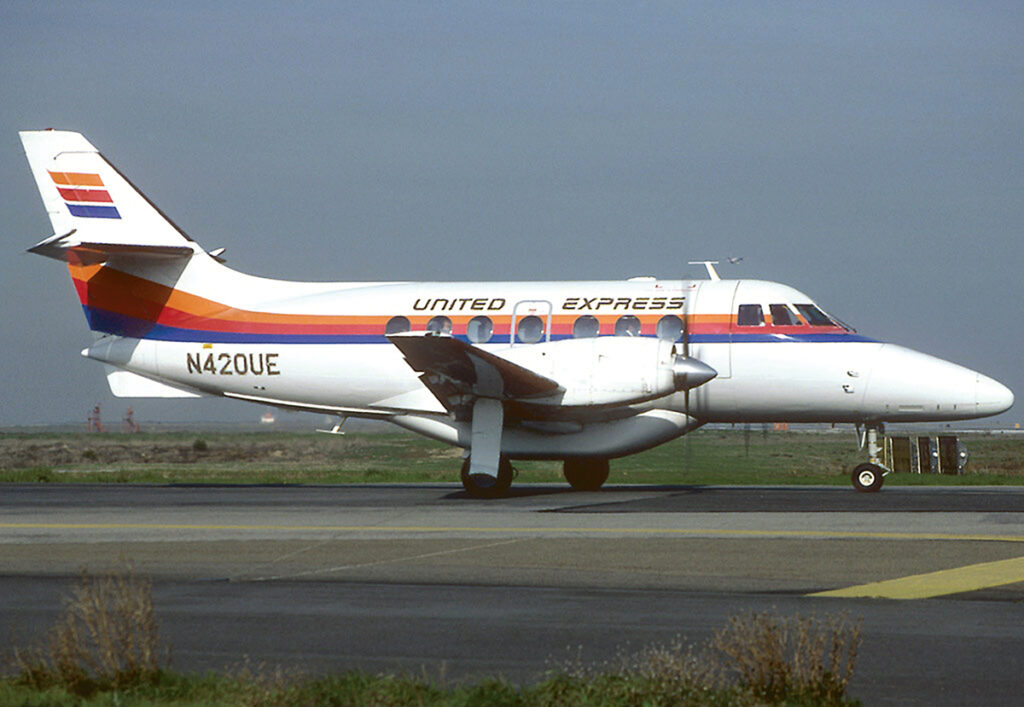
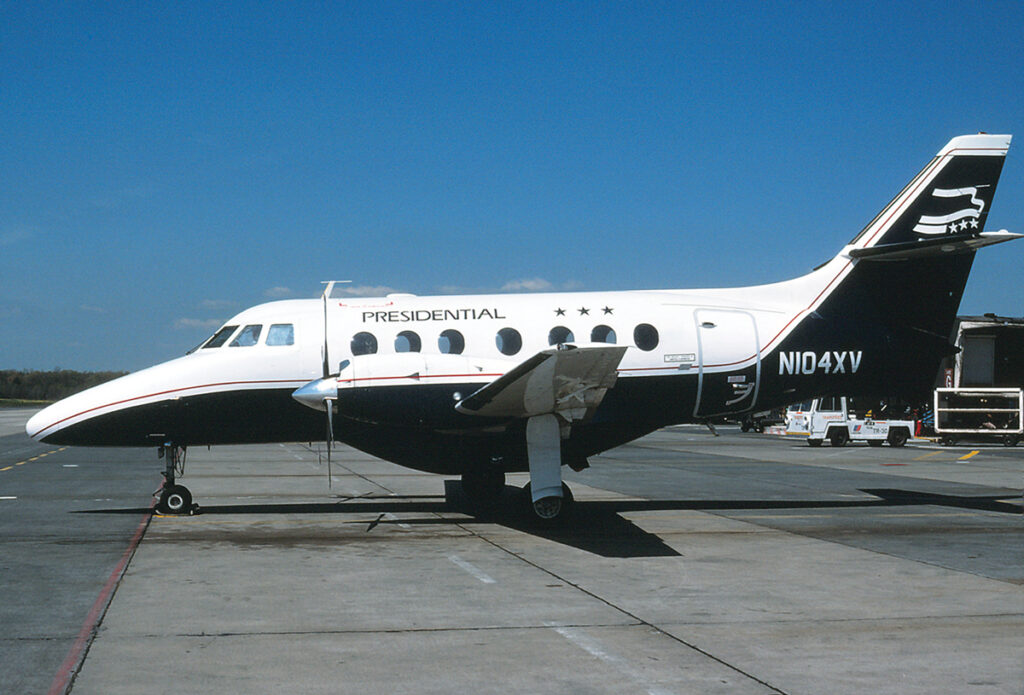
Unable to profitably compete with Continental and United at their Dulles hubs, Presidential relented to feeding them, first as Continental Jet Express as of January 1987, along with Colgan Air, which was renamed Continental Express, after its brief Presidential Express designation, primarily operating Jetstream 31s and 32s.
After a cooperation that lasted less than a year, the Continental alignment was dissolved, leaving Presidential, along with Colgan, to once again operate independently. But a second code-share agreement was quickly concluded in 1988 with United, and both carriers now operate under the United Express banner.
Bankruptcy
Ever in search of purpose and profit, however, Presidential Airways, having continually provided the all-important capital connections, whether independently or cooperatively as major carrier-aligned Express affiliates, was forced to file for Chapter 11 bankruptcy protection on October 26, 1989.
While the process was initially a gradual one, with a 15-percent workforce reduction and a decrease in the number of cities served from 24 to 16, it ultimately ceased flying altogether on December 5, its $60 million debt unsustainable and its ability to raise the necessary funding to keep it airborne elusive.
“It began to be a greater burden than we could handle,’ Pareti said. ‘It jeopardized ongoing operations.’
Throughout its brief, four-year history, it had operated 14 737-200s, nine BAe-146-200s, and Colgan Air’s turboprop regional aircraft, searching for a competition-devoid niche as it touched down in some 25 cities from Maine to Florida.