

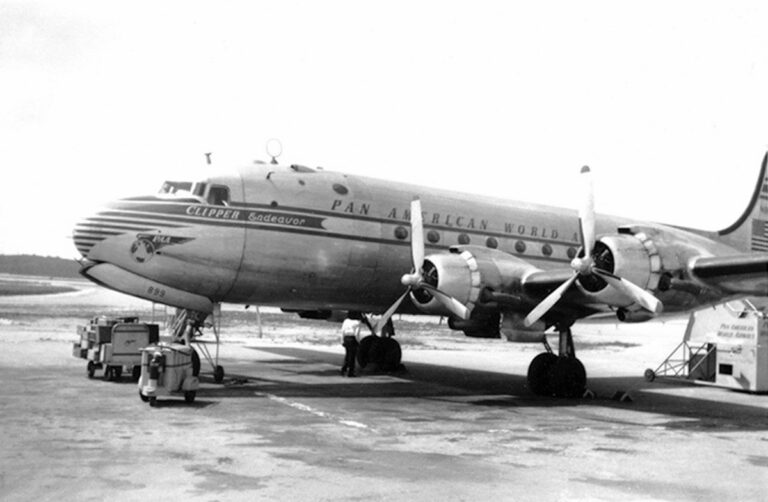
The historic 1952 crash forever changed aviation safety and led to mandatory preflight safety briefings given on every commercial flight.
The sun dawned over San Juan’s Isla Grande Airport on April 11, 1952, marking the arrival of what began as a beautiful Good Friday morning. On the tarmac, ground crews finished preparing Pan American World Airways’ Clipper Endeavor for its upcoming northbound journey. The Douglas DC-4 was slated for a standard 1,600-mile flight across the Atlantic to New York’s Idlewild Airport (now JFK International Airport). Having logged 20,835 hours in the air over seven reliable years, the veteran airliner was highly trusted by its crews. Tragically, this particular trip to New York would stand as the final chapter in the aircraft’s operational history.
At 12:11 pm, aircraft N88899 departed the runway and climbed northward under full takeoff power. The flight carried 64 passengers and five crew members under the command of Captain John C. Burn, a veteran pilot with more than a decade of transoceanic experience with Pan American Airways. Notably, Captain Burn was a survivor of a previous major aviation accident; he had served as First Officer aboard the Yankee Clipper when it tragically crashed into the Tagus River during its landing approach at Lisbon in February 1943.
Seconds after lifting off from Isla Grande, Pan Am’s Clipper Endeavor suffered a catastrophic power loss in its #3 engine. Captain John Burn immediately attempted to loop back for an emergency landing, but the crisis deepened when the #4 engine failed as well. With both powerplants on the right wing completely dead at a low altitude, the aircraft grew increasingly unmanageable. Captain Burn broadcast a Mayday signal and braced for an immediate ditching in the ocean.
Rough seas and strong winds made the water landing dangerous. When the DC-4 hit the water, its tail broke off, and the plane began to sink. The crew tried to calm the 64 panicked passengers on the plane, despite the quick action by Capt. Burn and his crew to launch life rafts, and do what they could to get the passengers into their life vests, most passengers stayed frozen in their seats out of fear and refused to leave the rapidly sinking Clipper. Of the 69 souls onboard, only 17 survived.
The legacy of the Clipper Endeavor’s final flight, known as ‘’La Tragedia del Viernes Santo” (“The Good Friday Tragedy”), prompted aviation authorities to mandate preflight safety briefings and emergency demonstrations on all commercial flights worldwide.
Lost Pan Am Airliner ‘Clipper Endeavor’ Found After 74-Years
On June 2, 20026, 74 years after its tragic crash, the Clipper Endeavor was located resting nearly 2,000 feet deep in the Atlantic Ocean, broken into two sections, but largely intact and well-preserved. The team that discovered the aircraft was led by the Air/Sea Heritage Foundation (ASHF) in partnership with Deep Sea Vision and Discovery Channel’s Expedition Unknown. The airliner’s identification was confirmed via high-resolution sonar and photographs showing the iconic Pan Am logo.
The Air/Sea Heritage Foundation is dedicated to the study, investigation, and preservation of relics, wrecks, sites, and stories related to aviation and maritime history. The foundation conducts or supports original field expeditions and archival research around the world, focused on illuminating our shared nautical and aeronautical past.
The search and discovery will air on an upcoming episode of Expedition Unknown later this year. The ASHF is collaborating with the government of Puerto Rico to protect the wreckage and build a lasting memorial.
A special thank you is extended to the Pan Am Historical Foundation for this historical information.