



From the cactus that characterizes Arizona rose a uniquely structured deregulation carrier which established its hub there in the early 1980s and became the quintessential symbol of the southwest — so much so, in fact, that that plant became its very call-sign, as in, “Cactus 155, you’re cleared for takeoff.”
That airline was America West.
It only plied the skies for a brief two decades. But it demonstrated quality, resilience, and a unique breed captured by its initial slogan of “Less fare, more care.”
Foundation
Incorporated in 1981 after obtaining funding from ten investors and a New York banking firm that underwrote a stock issue for a start-up carrier, it achieved financial lift in the form of $18.7 million after 3.5 million shares were sold at $7.50 each.
Deviating from the soon-standard deregulation formula, it was established to provide lower-fare, yet full-service flights from hub-lacking Phoenix Sky Harbor International Airport. It took to the air on August 1, 1983, when a triplet of leased Boeing 737-100s and -200s connected Arizona with Colorado Springs, Los Angeles, Kansas City, and Wichita.
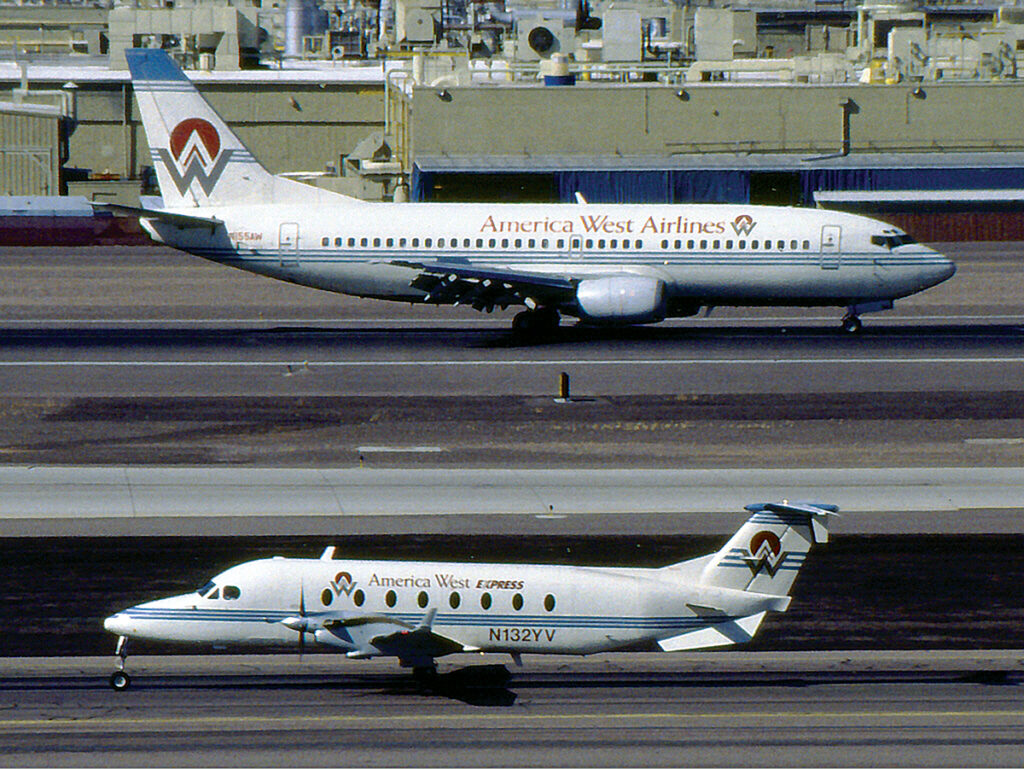
Its initial strategy entailed mostly short-range service to destinations west of the Mississippi to avoid competition with established airlines.
“The company’s strategy was to make Phoenix an east-west transfer point by routing travelers from its network of Midwestern cities through Sky Harbor Airport to California,” according to the “America West Holdings Corporation” entry in Company-Histories.com. “With business travelers as its target market, America West aimed to increase traffic on the routes it served through a combination of full-quality service, frequent flights, and low fares.”
Costs were always key to company success, and America West implemented a dual-fold solution to stem them.
Create a mandatory stock ownership plan for its exclusively nonunion employees, who were required to purchase shares equal to a fifth of their starting salary. Implement a non-hierarchical, cross-utilization work structure, similar to that of PEOPLExpress, so that each employee would be trained to perform multiple, productivity-increasing functions, such as customer service representatives wearing the hats of reservations, ticketing, and gate agents.
Still tiny, but innovative, America West used whatever it had to become airborne.
“We used to wash the aircraft at night with a garden hose…(and) only had tiny areas for dispatch, commissary, and maintenance,” advises Randy Lenton in the carrier’s August 1993 inflight magazine. “We had no hangars—and we did all of our maintenance on the ramp. We were growing, and the facilities weren’t growing fast enough to keep up.”
Indeed, its growth was accelerated. Two additional 737s facilitated service expansions to Omaha, Ontario, Las Vegas, Albuquerque, and San Diego by the end of the year for a fleet total of ten and destination count of a dozen. By the end of the following year, these figures respectively increased to 21 and 22, with its first profit realized that November.
Aircraft reach and capacity increases were made possible by its 1985 acquisition of CFM56-powered Boeing 737-300s, which were particularly suited to noise-sensitive California operations. Its statistics, both positive and promising, indicated doubled revenues of $241 million on an $11.4 million profit that year, and 122 daily departures were dispatched from Phoenix, giving it a one-third market share there. It operated a 32-strong fleet to 26 cities.
Expansion
Like any foundation, America West progressively built upon the one it initially laid. Serving some 30 destinations by 1986, including its first trans-border ones to Calgary and Edmonton in Canada, it broke ground on a maintenance hangar in Phoenix, inaugurated night flights from Las Vegas to increase daily aircraft utilization, began commuter-feed service from small communities, and expanded its route system—albeit at the expense of a meager $3 million profit, principally because of the fare wars it engaged in with southwest.
1987 saw the creation of a second hub in Las Vegas, but, more importantly, the acquisition of the six Boeing 757-200s slated for Republic Airlines, which were deemed redundant after its Northwest takeover. Offering a significant capacity increase, they enabled America West to implement long-range routes, specifically to New York-JFK and Baltimore, on July 1, now with first-class cabins.
Despite the elevating aspect of these strategies, it left it vulnerable to more major carrier competition and drained its profitability during the first half of the year.
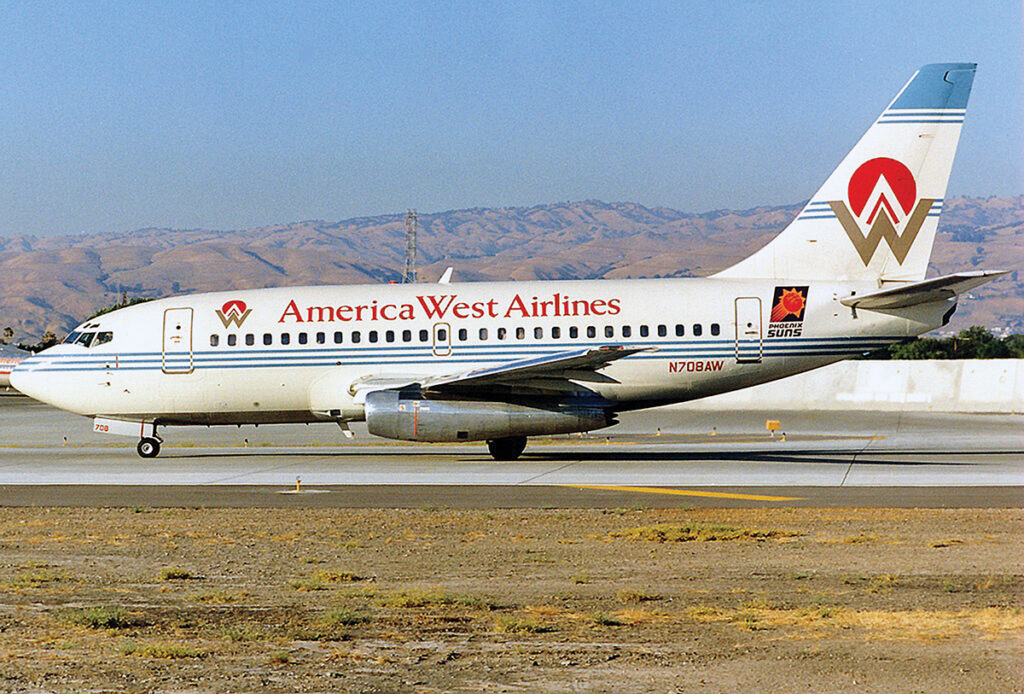
A cash infusion came with Ansett Worldwide’s 20 percent purchase of its stock.
Lower-density routes offered similar comfort levels when its 737-300s were reconfigured with first class seats and in-flight entertainment systems, and its little-known Free Flight Plan frequent flyer program was replaced with the more encompassing and successful FlightFUND one on June 10, 1987.
Positive views often depended upon perspective. A $45.7 million loss on $575 million in revenues was recorded by the end of the year on the one hand, but the airline had added service to ten new destinations that were now served by 23 aircraft on the other.
An airline analyst adopted the former approach when he opined in Business Week magazine, “They’re flying into oblivion. It’s only a matter of time.”
But it was during that “time” that a cost-cutting and debt-restructuring strategy returned it to profitability—to the tune of $9.4 million—in 1988.
Widebody Era
Seeking to offer longer-range, widebody flights with the eventual intention of serving Sydney so that its passengers could connect with Ansett Australia Airlines’ own flights, America West purchased two former KLM Royal Dutch Airlines Boeing 747-200Bs and inaugurated “Bird of Paradise” service from Phoenix to Honolulu on November 15, 1989, as a first step.
CEO Edward R. Beauvias once explained the rationale behind the strategy by stating, “You cannot just sit still and survive.”
However, it failed to secure approval to provide Tokyo service, the first of its planned Pacific Rim destinations, and its successfully achieved Honolulu-Nagoya route award only proved the opposite with the first departure carrying all of one passenger. Competition on the Hawaii route from Las Vegas and Phoenix was too fierce, and additional, but excessive-capacity 747s only served as stopgap equipment on transcontinental routes from its two hubs.
Unrealized Promise
Although America West became the only one of the more than 150 airlines launched during the post-deregulation start-up boom to be DOT-classified as a “major carrier” when its annual revenues eclipsed the $1 billion level, fuel costs, high interest payments, and competition caused it to rack up a $74.7 million loss by the end of 1990. The Gulf War, impacting travel, forced the new “major” to succumb to a “minor” stance.
Its resuscitative strategy entailed passenger-attracting fare reductions, the avoidance of Southwest Airlines’ competition on short-haul routes, the reduction or altogether elimination of unprofitable service, and the shedding of its commuter division. Despite these steps, it still ended the year with a $213.8 million loss.
Financial Recovery
America West’s remarkable recovery, which few predicted was even possible, entailed several strategic steps. These included the acquisition of 17 Airbus A320-200s originally intended for bankrupt Braniff II, the discontinuation of widebody flights, the service increase in the California corridor, and the creation of a third hub in Columbus, Ohio. The move was seen as offering a dual benefit–namely, the attraction of higher-yield business travelers from the area’s corporate headquarters concentration and the lack of Southwest Airlines competition.
“August 25, 1994, was emergence day for America West,” the “Unofficial History of America West” article states. “The airline left bankruptcy as a new company with reduced debt, a focused management, and a new hope.”
“Record profits in 1995 fueled further expansion around the Phoenix hub,” the “America West Holdings Corporation” article advises. “The airline added six routes from Acapulco to Anchorage. Company officials stated there was enough room for America West and Southwest Airlines to coexist in Arizona, which had one of the fastest-growing economies in the US.”
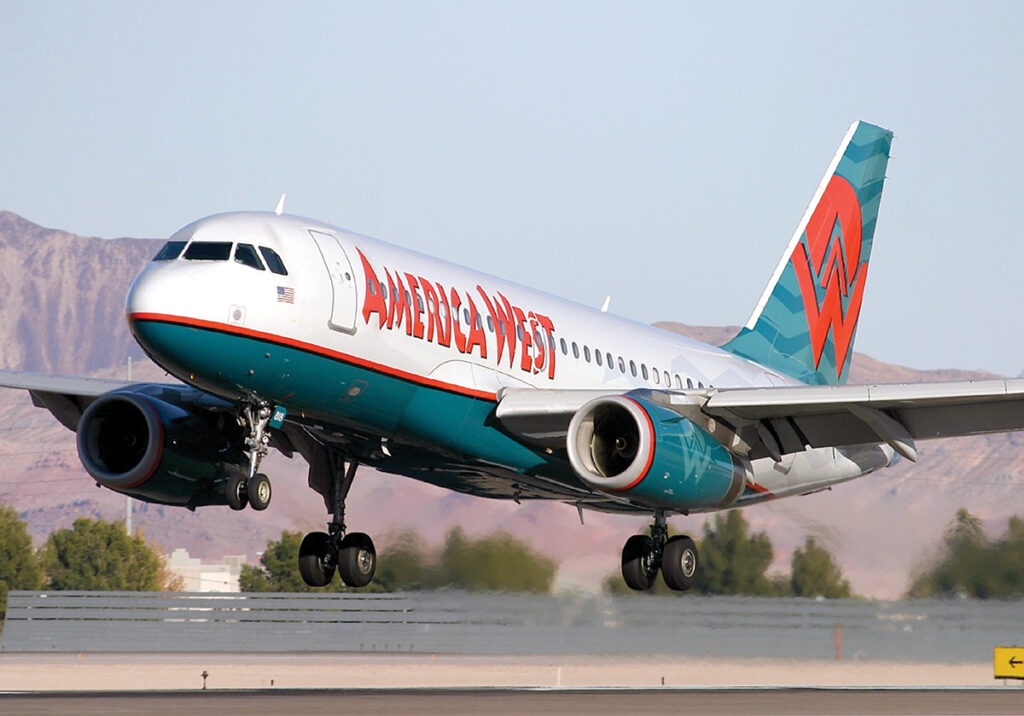
A new pearl white, orange, and turquoise aircraft livery was unveiled on January 18 of the following year, and a maintenance reliability program, whose tenet was “Getting the product right…together,” was implemented.
The existing, first-generation 737 fleet was hush-kitted and the Airbus order was revised to include 12 A319-100s and 24 A320-200s.
“America West was riding high as a company, capped by winning the J. D. Power Award for short-haul flights and ranking first in baggage handling among major airlines,” according to the “Unofficial History of America West” article.
By June of 1998, it operated 11 757-200s, 18 A320-200s, and 56 737-200s and -300s to 55 regional, domestic, and international destinations in 22 states, the District of Columbia, and Mexico with 153 daily departures from Phoenix, 75 from Las Vegas, and 30 from Columbus.
Final Flight Into the Next Century
Bridging the centuries, America West continued to implement strategy changes to remain competitive and maximize profits, but even proactivity could not predict or combat all conditions.
In October of 1999, for instance, it took delivery of its first Airbus A319-100, which introduced the new interior color schemes and light-blue slimline seats that would become the standard, after retrofitting, of its entire fleet.
But its strengths almost proved its demise, because US Airways, in financial decline and now in its second bankruptcy, saw America West as a healthy injection into its own failing condition, and a merger between the two was announced on May 18, 2005, ending the airline that rose from the cactus of Arizona and established its largest hub there.
“Like the Phoenix, the mythical bird that rose from its ashes, America West was reborn several times during its short, 22-year history,” the “Unofficial History of America West” article concludes. “…But (it) stayed the course to become the only post-deregulation major airline.”