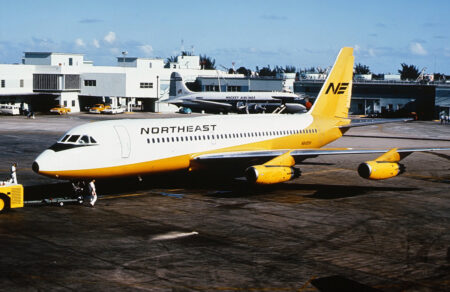



Restricted by Civil Aeronautics Board route and fare authorizations back in the early 1960s, and left with little choice but to operate Boeing 707s and Douglas DC-8s at the time, airlines had few options with which to compete with one another and attract passengers. American, however, sought to differentiate itself on the transcontinental route by offering higher speeds and therefore shorter flying times with a new aircraft, the Convair 990.
Design Origins
Although smaller and lagging behind Boeing’s 707 and Douglas’s DC-8, the aircraft, in its initial CV-880 form, featured the same overall configuration as the Boeing and Douglas contenders, with four wing pylon-mounted engines, a swept wing, and a conventional tail. But it differed in two fundamental ways: it introduced a narrower fuselage, which was only wide enough for five-abreast coach seating and therefore offered reduced drag, and 11,200 thrust-pound, cowling-encased, aft-fan General Electric CJ-805-3 engines.
While it appeared as if it would compete with these quad-engine jets, Convair believed that they offered too much capacity on some of the routes they served, leaving it to design what was then considered the first intermediate-range and capacity jetliner.
The intended aircraft was, to a significant degree, dictated by Trans World Airlines, which, controlled by Howard Hughes, determined its performance and specifications.
Yet Convair unknowingly placed its program on a course of failure. It could have seized the opportunity to design an aircraft for a segment that had no competition. Neither Boeing nor Douglas had available engineering talent or even production capacity to launch such a design at the time, and Convair’s own reputation would certainly have proven an advantage in light of its earlier, highly successful piston series of short-range airliners.
With a 23,150-pound payload capability, the Convair 880 had a 184,500-pound maximum takeoff weight and required a 5,200-foot runway. Rate-of-climb at this weight was 3,700 fpm. Its 615-mph cruising speed qualified it as the fastest commercial jet airliner at the time. The range with a first-class payload was 3,450 statute miles.
Service Entry
Despite obstacles that had plagued the Convair 880’s design definition, the aircraft that first took to the sky from San Diego’s Lindbergh Field on January 27, 1959, exuded speed. A narrow, drag-reducing fuselage extended from its pointed nose, its razor-thin wings were swept back, and its turbofans were housed in long, thin nacelles. It subsequently landed on Coronado Island’s North Island Naval Air Station after a successful maiden flight.
During its 14-month flight test program, the three examples that partook of it more than demonstrated their intended performance superiority: they achieved Mach 0.93 speeds, which exceeded its 0.89-maximum.
Although the type should theoretically have been inaugurated into service by TWA, its launch customer and, in many respects, its designer, the honor fell instead to Delta Air Lines. Hughes, source of both catalyst and conflict, was once again behind the obstacle.
Oblivious to TWA’s financial capability, he ordered 33 707s and 18 CV-990s, an advanced, higher-performance successor to the CV-880, despite the fact that he neither needed such a massive fleet nor could determine which types were appropriate for which routes. Because his own millionaire status had been reduced to one of debt, he could not afford a 76-aircraft expenditure himself, nor could TWA secure the necessary loans to cover it.
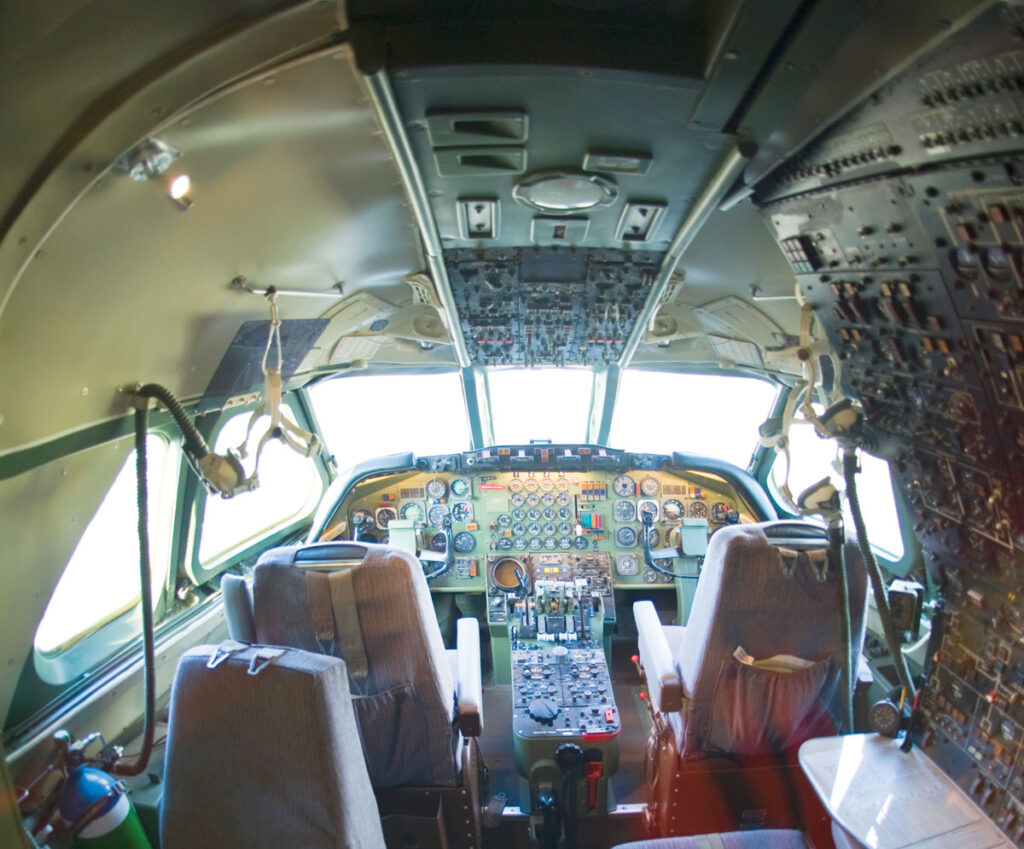
Forced, therefore, to delay their delivery, he was unable to offer TWA its rightful launch carrier status, and he even inhibited further aircraft production with armed guard surveillance.
In the event, Delta, the second to order the type, became the first to operate it, inaugurating “Royal Jet Service” with the CV-880 on May 15, 1960, from Houston to New York-Idlewild with aircraft N8802E configured with a 12-place forward lounge and a 72-passenger, four-abreast first-class cabin. Two other inaugural routes were also flown that day—from New York to New Orleans with N8804E and from New York to Atlanta with N8803E.
By mid-1972, the Convair 880 had notched up nine official speed records during its routine scheduled operations.
Convair 880M
Although the aircraft’s superior performance served as its strength, it still failed to meet its performance goals. As a result, Convair designed a minimal-change variant that would increase its speed and range.
Designated CV-880M, it introduced four leading-edge slat panels, two of which spanned the distance between the engine pylons and two of which ran from the outer powerplant to the wingtip. These, extending forward and down to increase airfoil camber, were actuated in conjunction with the existing, double-slotted trailing edge flaps and improved low-speed lift.
Power was provided by four 11,650-thrust-pound General Electric CJ-805-3B turbofans. This speed, American Airlines concluded, could provide it with the competitive advantage it needed to serve the transcontinental route with an even faster version–at least in theory.

Convair 990
Initially designated Model 30 and then CV-600, it was given the definitive CV-990 name when Convair decided to reflect its 990 kilometers-per-hour cruise speed by it.
Guided by American Airlines, which was viewed as its launch customer, the aircraft was designed to provide higher-speed, all-first-class, transcontinental service, in a four-abreast configuration, in competition with TWA’s 707s and United’s DC-8s, but it required significant design modification before it could even begin to deliver such performance.
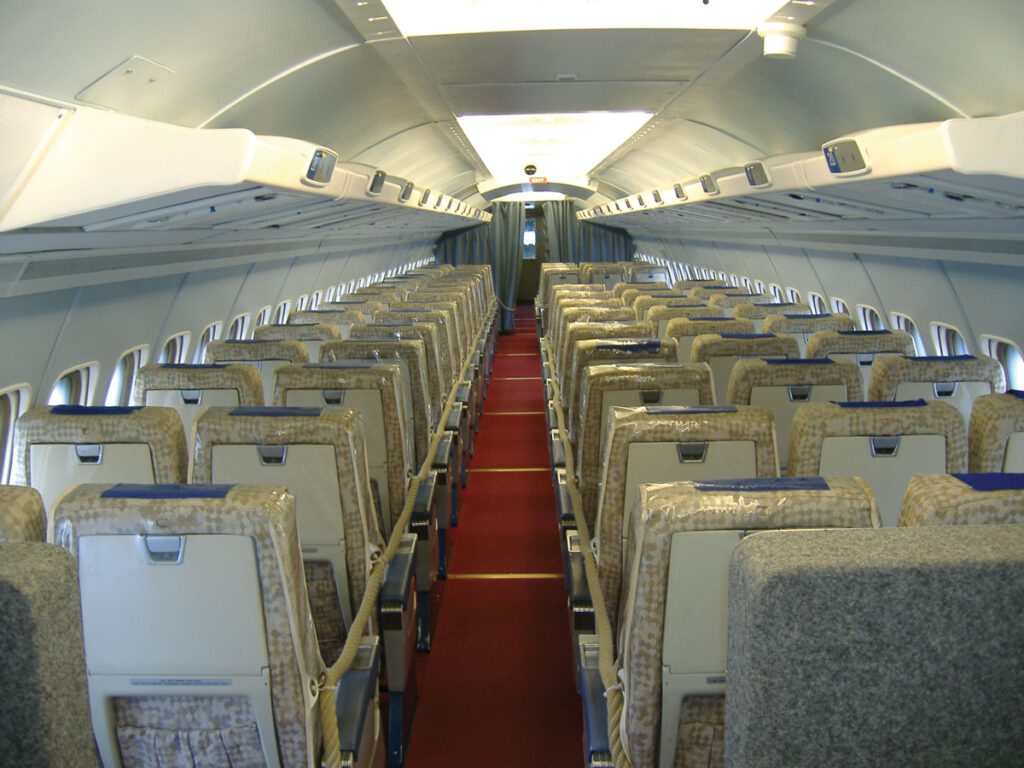
A 10.1-foot-longer fuselage, for instance, resulted in a new 139.5-foot overall length, but its width remained the same, and its cabin could accommodate 96 four-abreast, first-class passengers or 121 five-abreast economy ones. Maximum single-class capacity was 149, which was 16 fewer than that of the competing Boeing 720.
The type’s most significant modification, however—and also its most visually apparent—was its wing. As the thinnest airfoil ever used on a commercial aircraft, it introduced a 39-degree sweepback—or two degrees more than that of the later widebody Boeing 747—and four anti-shock fairings that appeared like upside-down canoes on the upper wing surface’s trailing edge.
Alternatively called “area rule fairings,” “speed bumps,” “conical fairings,” “Whitcomb fairings,” and “blisters,” they measured two feet wide by 24 feet long and prevented shock waves from forming at high speeds, thus reducing drag. The area rule itself, devised by Richard T. Whitcomb in 1953, stated that the cross-sectional area of an aircraft should uniformly increase from nose to tail, provided that the area of a complete airframe smoothly varies along its length. They also served as additional fuel tanks.
“The pods did increase the speed (although not nearly as much as expected), but when they were filled with fuel, the outboard engines developed a dangerous shudder at high speeds,” according to Robert G. Serling in Eagle: The Story of American Airlines (St. Martin’s/Marek, 1985, p. 341). “Convair had to realign the engines and then encountered a new headache: the realignment produced increased drag.”
Announced on July 30, 1958, after receipt of a 25-firm and 25-optioned order from American Airlines, it first flew three years later, on January 24. A second aircraft followed suit on March 30, and FAA type approval was granted that December after a full production standard flight test program.
Because it was unable to meet performance guarantees, American Airlines immediately cancelled its 25 options and reduced its firm order to 20. Its aircraft were sequentially registered N5601 through N5620, of which five were manufacturer-delivered as the modified CV-990A variant.
American Airlines, whose input significantly shaped the version, took delivery of its first still-unmodified Convair 990, registered N5605, on January 7, 1962, but it was only used for crew familiarization and route-proving purposes until March 18, at which time it inaugurated scheduled service with two daily round-trips between New York-Idlewild and Chicago-O’Hare with a quartet of them. No faster than the 707, the aircraft covered the westbound sector in two hours, ten minutes, and the eastbound one in one hour, 48 minutes.
American Airlines seriously considered selling or leasing its aircraft without ever operating them, but its 1962 timetable was already established with their inclusion, and it had already begun to dispose of its earlier-generation, piston-powered Douglas DC-6s.
As with other carriers, increased coach class demand and the need to maximize revenue resulted in progressive, less-luxurious cabin configurations—from an initial 92-passenger, all-first class one with a six-place lounge, to a dual-class, 42-first and 57-coach one with a four-place lounge, to a final 34-first and 67-coach one without any lounge.
Like Swissair, which originally inaugurated the type into service as the CV-900A, American Airlines made Herculean efforts to upgrade and modify its fleet itself to this standard at its Tulsa maintenance base in order to transform the design into the original vision of being a true, high-speed jetliner.
But it never fulfilled its intended, coveted, and competitive, all-first-class transcontinental purpose. Instead, the longest sector it was able to operate was the 2,143-mile one between New York and Phoenix.
“If Convair had met American’s specifications, the 990 would have been a winner,” Serling concludes (ibid., p. 341). “It fell far short of those specifications, including the most important one: General Dynamics guaranteed a cruising speed of more than 600 mph—almost 100 mph faster than any other jetliner flying.”
Replaced by the Boeing 727-100, the remaining 18 were subjected to progressive removal, entailing one in 1965, eight in 1967, four in 1968, and five in 1969 after its year-earlier retirement.
Aircraft and vision, in the end, were never realized in a failed battle between technology and speed.