

On November 25, 1934, The New York Times headline read… ‘La Guardia Won’t Land in Newark and Insists Line Fly Him to City from Rival Field ‘
Once characterized by its impressive size and accommodations in its infancy, LaGuardia Airport was the first commercial airport to be built in New York City. Its construction was among the largest endeavors of the New Deal’s WPA (Works Progress Administration) and it included a landplane field and a seaplane division. At its opening in 1939, the then named New York Municipal-LaGuardia Field had six of the largest hangars in the world and featured the Art Deco designed Marine Air Terminal (Terminal A) and a ‘Skywalk’ observation deck that wrapped around the airside of the terminals, capturing the attention of the public’s fascination with air travel while providing passengers a panoramic view of airport ramp activities.
The story of how LaGuardia Airport came to be is legendary in aviation history. It began in 1934, at the end of a routine TWA flight from Chicago to Newark, New Jersey. Onboard and on his way home after a meeting of the U.S. Conference of Mayors was New York City mayor, Fiorello La Guardia. After the plane landed in Newark, everybody prepared to exit the aircraft, with the exception of Mayor La Guardia who refused to get off at Newark because his ticket clearly read ‘CHICAGO to NEW YORK’. Airport officials implored him to deplane, but the mayor stood firm until a field manager agreed to fly him as a solo passenger to Floyd Bennett Field in Brooklyn. Upon his arrival at Floyd Bennett, reporters were summoned to record it, and in greeting his wife Marie, Mayor La Guardia exclaimed, “My ticket says, New York, and that’s where they landed me!”

While Floyd Bennett Field was initially intended to be New York’s municipal airport, its location in Brooklyn was remote and inconvenient for travelers needing to get to or from Manhattan. At the time, Newark was the largest airport in the region, but it was not in New York City. However, Newark was closer and more accessible to the city. Mayor La Guardia, a longtime aviation enthusiast and former combat pilot during World War I, understood that a new era of air travel was emerging and New York City was utterly unprepared for it. Fiorello La Guardia, the quintessential New Yorker, was not about to allow Newark or any other nearby city to ‘take the prize’ as the region’s leader in commercial air travel, and he was adamant that an accessible and modern airport be built in New York City; one that would directly serve Manhattan.
After locating the right area for a new commercial airport in New York, a plot of land along the northern Queens shoreline bordering on Flushing Bay was selected for redevelopment, which lay upon a privately owned civilian airfield called North Beach. A groundbreaking took place in 1937 and thousands of laborers worked in multiple shifts, filling the surrounding wetlands, installing its modern infrastructure, constructing its giant hangars and administration buildings, and four runways; the longest being 6,000 feet.
Whether you came over on the Aquitania or your ancestors came over on the Santa Maria, the Mayflower, or the Half Moon, you are an immigrant or a descendant of immigrants. Bear that in mind
Fiorello La Guardia -1922
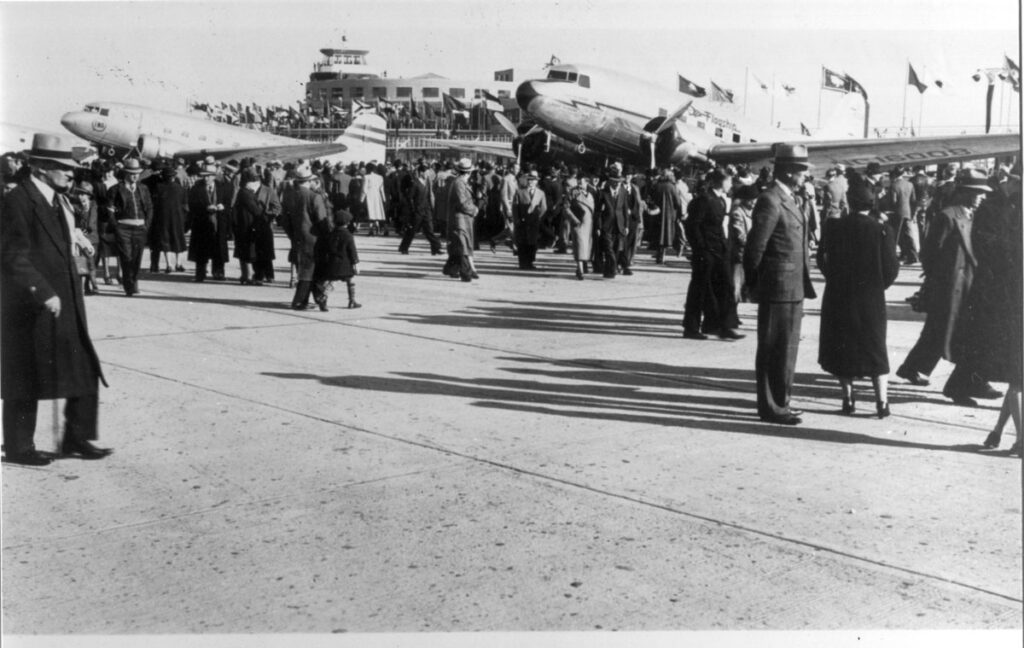
The airport was dedicated on October 15, 1939, as ‘New York Municipal Airport’ and it officially opened for commercial travel on December 2nd of that year. At its opening ceremony, Mayor La Guardia addressed an estimated 325,000 spectators. The event marked New York City’s entry into the age of commercial aviation and its establishment as a major airport hub. The mayor’s remarks highlighted the airport’s vital role in connecting New York City to the world and as a symbol of the city’s determination and progressive vision.
To celebrate the opening and acknowledge the airport’s La Guardia namesake, three skywriters flew overhead emitting smoke-clouds that formed the message, ‘Name It LaGuardia Airport!’. Visible to the cheering crowd below, the message was a symbolic gesture to name the airport solely as ‘LaGuardia’ after the man who was undeniably responsible for its existence. NY Municipal-LaGuardia Field became the busiest airport in the world within a year of its opening, and the airport was the pinnacle of Mayor La Guardia’s political career and his adamant efforts to reimagine his native city. In 1947, the airport, now under lease by the Port of New York Authority, was referred to as LaGuardia Airport.
The Old & The New LGA
LaGuardia was a remarkable ‘state-of-the-art’ airport for the era in which it was built, but by the 1960s, the main terminal building adjacent to the Grand Central Parkway and its surrounding facilities became outdated and congested. In 1964, a major renovation took place in preparation for the 1964-65 World’s Fair, and the main terminal was replaced by the new Central Terminal Building (CTB). But in the years to follow, time took its toll on the airport and it became physically and aesthetically worn down due to its aging infrastructure, limited amenities, and dimly lit cramped spaces and low ceilings.
Prior to the opening of the newly redeveloped Terminal B and Terminal C at the new LaGuardia Airport in 2022, in the decades to follow the 1960s, traveling through the airport was a considerably uninspiring and austere experience…that is… until the completion of the Port Authority of NY & NJ’s $8 billion redevelopment of a ‘Whole New LGA’, transforming the old LaGuardia Airport into a world-glass gateway that reflects the energy, innovation, and an emphasis on the diversity of New York.
In partnership with the Port Authority, LaGuardia Gateway Partners (the private entity responsible for managing and developing Terminal B) and Delta Air Lines (who developed, constructed, and now operates Terminal C), the airport’s major transformation is marked by modern terminal halls flooded with natural light, soaring ceilings, cutting-edge technology and security screening, sustainability, ample passenger amenities, and two terminals that are as efficient as they are beautiful.
Creating a uniquely New York sense of place across the new redeveloped terminals at LaGuardia includes its stunning collection of artwork curated by the Public Art Fund at Terminal B and by the Queens Museum at Terminal C. The diverse collection of public art at LaGuardia Airport not only enhances the travel experience and creates a strong sense of place for New York City, but it also speaks to the enduring spirit and vitality that New York embodies and that Fiorello La Guardia embodied.
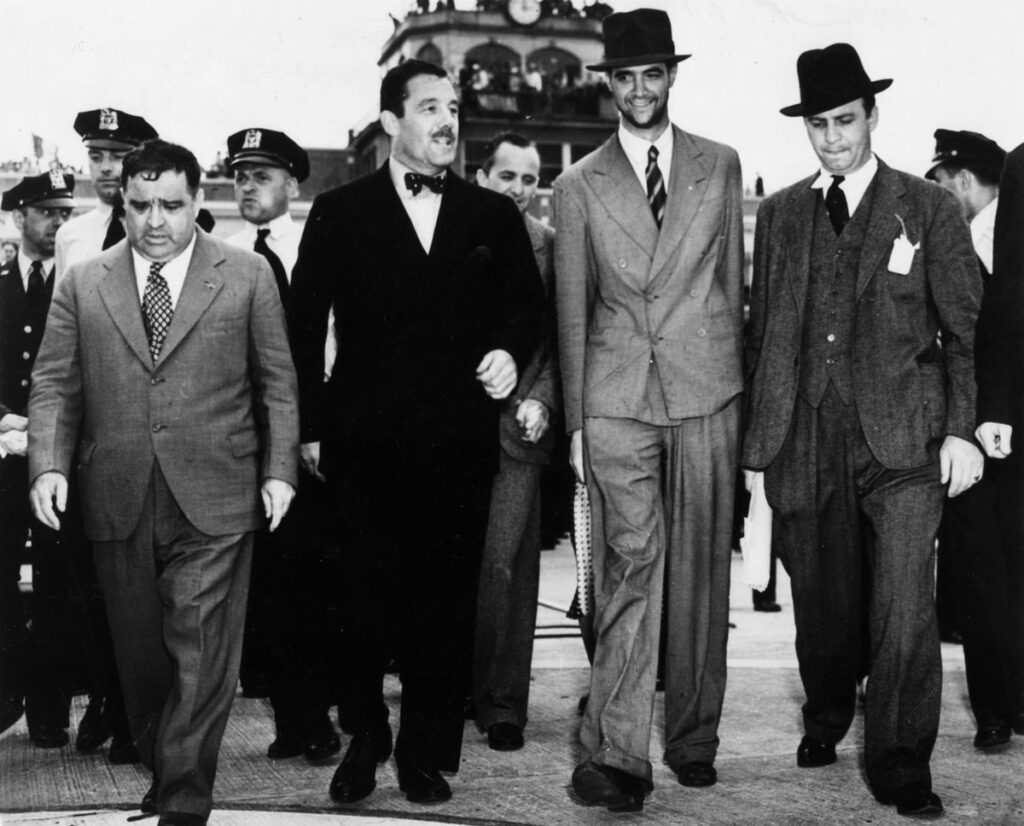
Fiorello La Guardia – The Visionary
LaGuardia Vistas is one of the curated public artworks at LaGuardia Airport that embodies the spirit of New York. Created by commissioned artist Sabine Hornig, LaGuardia Vistas is a 42-foot x 268-foot wide transparent photo collage of latex ink and vinyl prints mounted on glass that fills the expansive façade of the Terminal B Connector. Using the highest resolution camera commercially available, Hornig captured 1,100 photographs of minute architectural details and ephemeral moments in the life of New York City. This immense and highly detailed composition merges Hornig’s photographs of both Queens and Manhattan into a pair of interlocking cityscapes. This magnificent piece includes 20 quotes from and about Mayor La Guardia that reflect upon his life and legacy. As you pass through the expansive space of the Connector, visitors are immersed in a kaleidoscope of color, image, and text that contemplates time, place, history, and memory. It is a reminder of the power of Fiorello La Guardia’s visionary leadership, which largely shaped the shared environment of New York City. It includes his voice, still relevant today, and reminds us who LaGuardia Airport is actually named for.
Fiorello H. La Guardia was born in Greenwich Village on December 11, 1882, to Italian immigrant parents. His father, Achille, was originally from a Catholic family in Cerignola, and his mother, Irene Luzzato Coen, came from a well-established Sephardic Jewish family in Trieste. Achille LaGuardia was a professional musician who joined the U.S. Army as a bandmaster in 1885. That year, the La Guardia family moved west to various army posts, finally arriving in the Arizona Territory in 1892, where the young Fiorello spent the longest period of his childhood. In 1898, Fiorello’s father was discharged from the army due to poor health, and the La Guardias once again moved and settled back in Trieste.
In 1900, Fiorello left Trieste for Budapest, where he worked as a clerk at the U.S. consulate. Some four years later he moved to Fiume (Austria-Hungary, now Rijeka, Croatia) to become the U.S. consular agent. In 1906, Fiorello returned to the United States and later took a job as an Ellis Island certified interpreter, speaking several languages including Italian, German, Yiddish, and Croatian. While there, he attended evening classes at NYU Law where he received his law degree in 1910.
After practicing law for a few years, he immersed himself in public service. Having grown up with a strong sense of social justice and community engagement, Fiorello (whose name, translated from Italian, means’ Little Flower’) was a man of short stature. While he only stood at 5’2”, he possessed the heart of a lion who became a pioneering figure in American politics.
The war to make the world safer for democracy must not serve as the pretext for the curtailment of the most essential freedoms.
Fiorello La Guardia (1917)
La Guardia’s career in politics began in 1915 as a deputy attorney of the State of New York, and in 1916, he ran for Congress and was elected to the U.S. House of Representatives as a progressive member of the Republican Party, representing the 14th (Greenwich Village) from 1917 to 1919.
In 1917, La Guardia took a leave of absence from the House of Reps to serve as a pilot bombardier on the Italian-Austrian front during World War I. Though he was not a polished flier, having displayed many a ragged take-off and landing, when asked by an airman how he was doing with the Caproni bomber, Fiorello said with some modesty, “I can’t take the buzzard off, and I can’t land him, but I CAN FLY the son of a gun!”
Upon his post-WWI return to the United States, La Guardia was reelected to Congress but resigned to run for the New York City Board of Aldermen, for which he served from 1919 to 1921. He then returned to Congress representing the 20th East Harlem district; a district that sent him to Washington for five consecutive terms until 1932. During his tenure in Congress, La Guardia achieved attention for his broad-minded position on social issues, women’s suffrage, civil liberties, and advocating for workers’ rights.
“I tell you,” La Guardia said in 1920, “It’s damned discouraging trying to be a reformer in the wealthiest land in the world.”
In the early years of his work in government, Fiorello’s life was not without personal tragedy. In 1915, he met his first wife, Thea Almerigotti, when she worked in the garment district. They married in March of 1919 and had a daughter, Fioretta, who died in May 1921 of spinal meningitis. Only two months later, Thea contracted tuberculosis and died on November 29 at the age of 27. The death of Thea was described as ‘the greatest tragedy of La Guardia’s life’ by M.R. Werner, who aided La Guardia when he wrote his autobiography, ‘The Making of an Insurgent’ (La Guardia Fiorello, J. B. Lippincott Company, Philadelphia, 1948). His grief and the profound loss of both his wife and daughter most likely influenced his more populist and compassionate approach to governing.
Eight years after the weight of his loss, La Guardia’s second marriage to Marie Fisher took place in February 1929. Fiorello and Marie, a native New Yorker and his long-time secretary, adopted a girl, Jean, and a boy, Eric.
As a politician who was held in very high regard, La Guardia never cared for the word ‘politician’, and always referred to himself as ‘public servant’. He was a tireless fighter of corruption, denouncing Tammany Hall, the powerful political machine that ran New York City through much of the 19th century and reached its peak of notoriety when it harbored the unscrupulous political organization of Boss Tweed. Establishing himself as a champion of the people, La Guardia was one of the country’s most progressive congressmen. He campaigned for a graduated income tax, enlisted in the crusade against monopoly, and was consistently pro-labor in his outlook. He took stands against child labor and Prohibition, and supported giving women the right to vote. He fought hard against government waste and appropriations that yielded rich patronage benefits. Nonetheless, La Guardia’s tenure in Congress ended when he was defeated in his bid for re-election in 1932; a casualty of the Great Depression and a Democratic-Roosevelt landslide.
Characteristically, La Guardia was undeterred in pursuing the next chapter of his career as a public servant, and he became New York City’s most vehement advocate and a beloved leader, piloting the city through its most challenging times: the Great Depression and the Second World War.
Hizzoner! Mayor Fiorello H. La Guardia
Having previously run for Mayor of NYC in 1929 against the Democratic incumbent James ‘Jimmy’ Walker, La Guardia was defeated by a wide margin of votes. In 1933, Judge Samuel Seabury investigated the Tammany Hall-led city government with a focus on Mayor Walker. The investigation revealed that Walker had deposited nearly one million dollars for himself from various unnamed sources since taking office, leading to Mayor Walker’s resignation. A new anti-Tammany coalition was formed called the City Fusion Party, and they endorsed Fiorello La Guardia for mayor. Through his popularity and his well-earned reputation and experience as a tenacious leader, La Guardia won the election, becoming the 99th Mayor of New York City, serving from 1934 to 1945.
“I think I know New York City’s potentialities (sic) for good. It is the greatest and most daring experiment in social and political democracy which this world has ever seen.”
For the next 12 years of his tenure as the city’s mayor, before the Albany legislature and elsewhere, La Guardia identified himself with good government in New York City and he often did so with a dramatic flair. He was confident that he could rescue the city from the grips of despair and corruption, and with his energy and firm sense of righteousness, La Guardia was exactly the man that the city required in its hour of need and dire fiscal crisis.
I shall not rest until my native city is the first, not only in population, but also in wholesome housing, not only in commerce, but also in public health, until it is not only out of debt but abounding in happiness.
Mayor Fiorello La Guardia (1934)
With his dynamic personality and ‘can do’ attitude, in 1934 Mayor La Guardia secured legislation to balance the city budget through structural reorganization and special taxes. He implemented social and economic reforms aimed at improving the lives of NYC residents. With his support of labor unions and workers’ rights, he sought to balance the interests of workers and business owners, bringing about progressive labor laws.
In good standing with the Roosevelt administration and with New York being vital for FDR’s New Deal recovery program, the administration released a flow of federal funds for projects dear to Mayor La Guardia, and he prioritized public welfare programs, affordable housing initiatives, and infrastructure projects to uplift the city. In collaboration with urban planner Robert Moses, La Guardia expanded public transportation, invested in public parks, playgrounds, swimming pools, schools, libraries, courthouses, and more, offering the average New Yorker respite from the toil of urban life. Artwork and an attention to detail in architecture of new public buildings brought a touch of beauty and charm to neighborhoods of brick, mortar and concrete.
“You know,” La Guardia said, “I am in the position of an artist, or a sculptor…I can see New York as it should be and as it can be if we all work together.”
Under La Guardia’s leadership, he modernized the police force, and the city’s first sewage treatment plants were built. By 1942, the New York City Housing Authority, which had been brought into being eight years earlier, had constructed 13 public housing projects.
In 1938, he said, “We have established the lesson for the entire world. We have demonstrated that it is possible for people coming from all lands and climes of the world…to live together as good neighbors, in peace and harmony. If we can do it here, it can be done elsewhere.
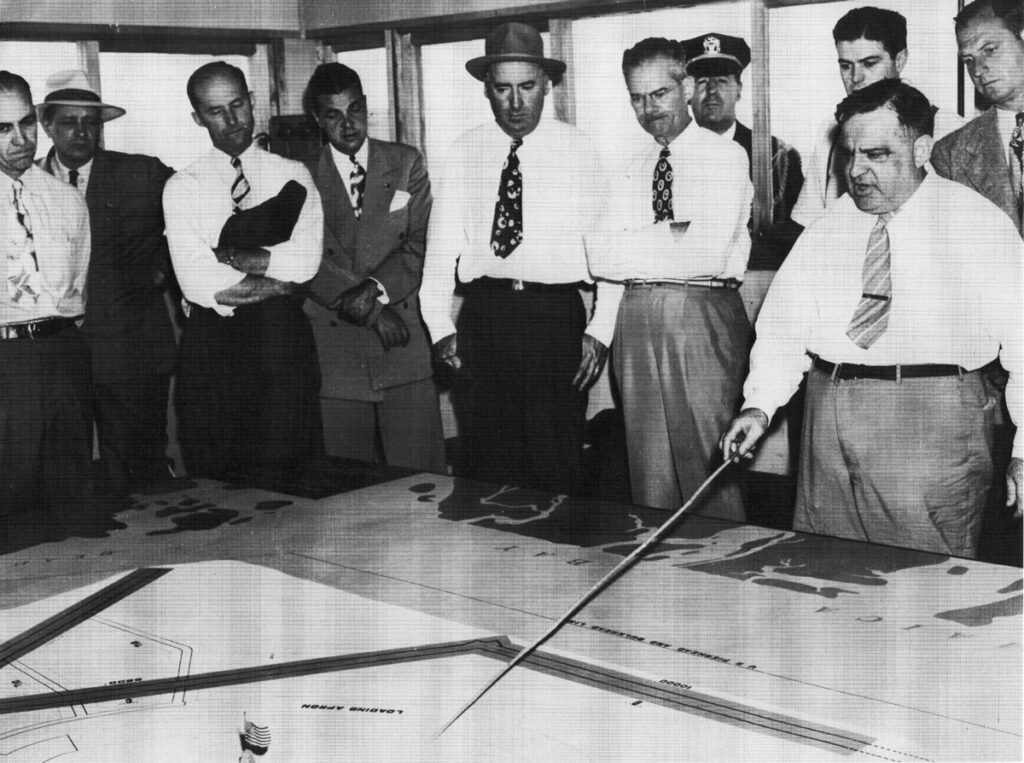
As the demand for air travel at LaGuardia Airport increased significantly after its opening in 1939, Mayor La Guardia recognized that the field would not be big enough to sustain its growing operations. In 1941 he began planning the building of an even larger airport as a reliever to La Guardia Airport and he announced that the city had chosen a large area of marshland along Jamaica Bay that included the Idlewild Golf Course. Title to the land was conveyed to the city in December 1941 and construction began in 1943. The new facility opened in 1948 as New York International, but was more commonly known as Idlewild Airport.
At the start of the United States’ involvement in World War II, La Guardia played a critical role in maintaining stability and protecting civil liberties. He oversaw the establishment of air-raid shelters, leading the city through air raid drills, and at the same time ensured the effective operation of essential services. His sturdy leadership during this difficult juncture garnered him national and worldwide respect and admiration.
In continuing to endear himself to his over 7 million constituents, La Guardia addressed the public over the radio, sharing his thoughts on current events and started a regular radio show called, ‘Talking with the Mayor’ making him one of the first political figures to utilize the media as a tool for public engagement. Toward the end of the Second World War, prompted by a city-wide newspaper delivery strike, in July of 1945, La Guardia began reading Sunday comics over the radio so that children who were unable to read their favorite comics (the funnies) in the papers could still enjoy them.
Following La Guardia’s departure from City Hall as New York’s mayor, he remained active as a public servant, serving as the director of the United Nations Relief and Rehabilitation Administration and as president of the Board of Commissioners of New York City’s newly created Port Authority.
Fiorello La Guardia firmly believed in the power of government to improve people’s lives and he remained an advocate for progressive causes and the underprivileged until his death on September 20, 1947 at his home in the Riverdale section of the Bronx from pancreatic cancer.
Leaving behind his voice and his legacy of public service, Fiorello La Guardia said in 1945… “This great city, unique in its kind – nothing like it in the whole world. The great city of huge spaces that are too small, of millions of little people who are really big, and people coming from every clime and country of the world, living in peace and happiness here…Yes, my friend, you gave me a job and I did it. Now I ask you to carry on. Patience and Fortitude”