

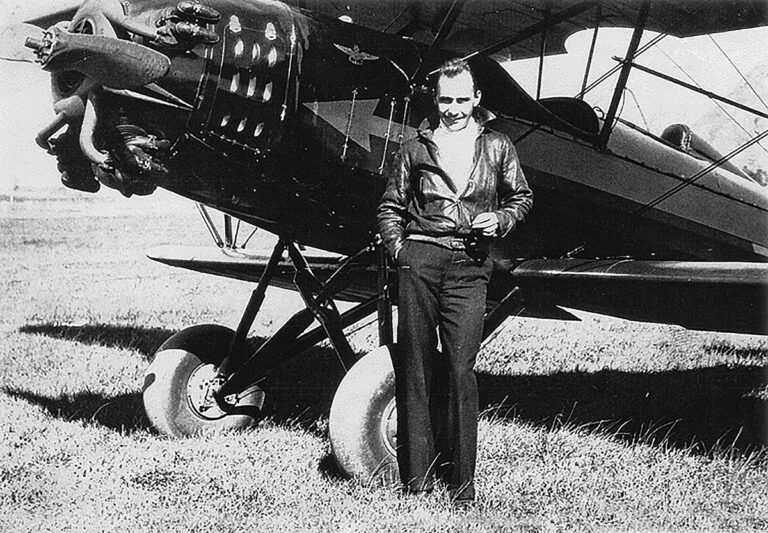
When a man stamps his name on the carrier he establishes, it reflects his strengths, philosophies, and ideals. In the case of Henson, they were quality and longevity.
Hagerstown Commuter
Both man and airline, in this case, were Richard A. Henson, who was born only seven years after the Wright Brothers conquered flight with the airplane that would characterize his career.
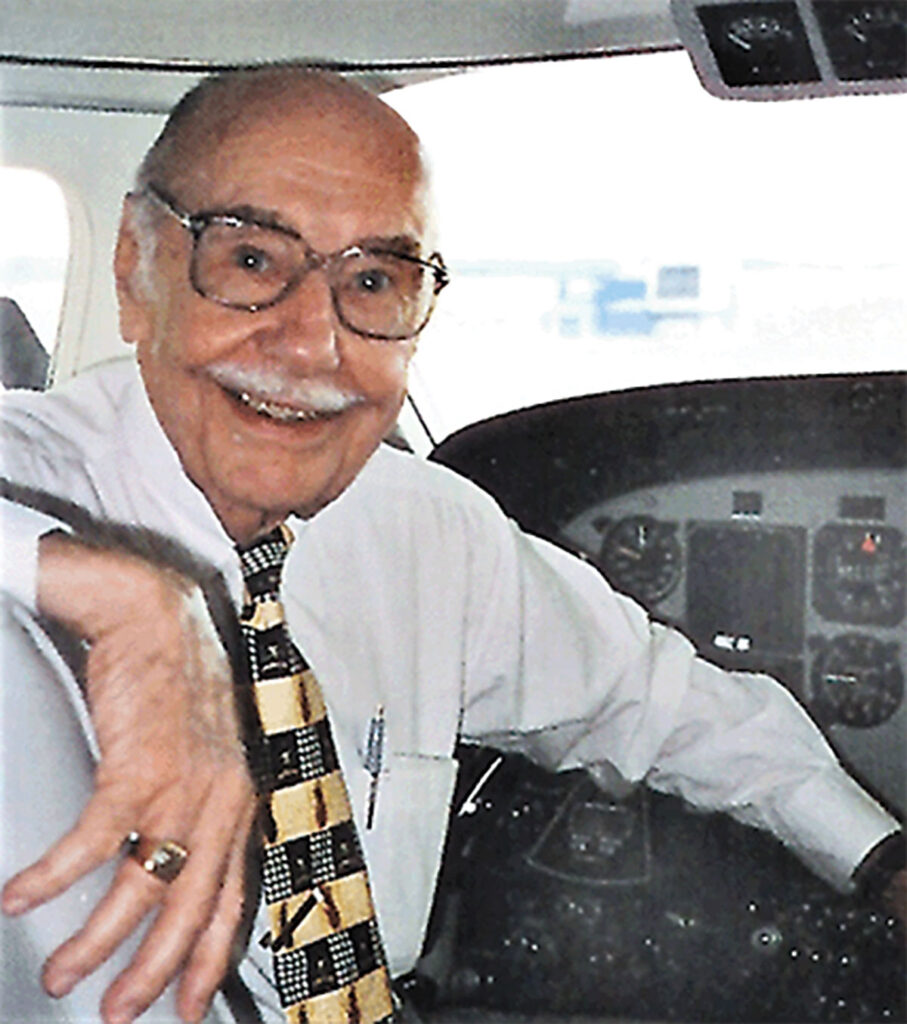
There are things a person wants to do in life. Then there are those things he must do to fulfill that life. For Henson, that was flying.
“First and foremost, Henson was a flyer – a flyer in the most spectacular sense of the word,” according to Barbara Audet in her article, Henson Flies High in Field of Aviation (The Daily Times, Salisbury, Maryland, September 13, 1997). “It was in his blood.”
But it coursed through his veins at a time when it was more of an adventure that had yet to prove its worth and helmets, googles, and scarves were just as integral to it as engines and wings.
“The story of Henson’s professional success began at age 20,” according to the University of Maryland Eastern Shore’s biography of him. “Dirven by ambition to fly, he procured a 25 percent interest in a $1,500 biplane as the Great Depression dominated everyday life. A year later, he purchased his own airplane and formed the Henson Flying Service in Hagerstown, Maryland. His company offered airplane rides, flight lessons, fuel, and service. By 21, he was chief executive officer of his own company.”
While a pilot’s license earned after a mere six-hour solo interval and 50-cent biplane rides to passengers may have been foundations of the airline he would later establish, more than three decades would pass while he designed, tested, flew, and sold airplanes at Fairchild Aircraft in Hagerstown.
Yet the time now became ripe to enter the airline industry.In 1962, Henson Flying Service became Henson Aviation and its Hagerstown Commuter division inaugurated scheduled service to Washington on October 1, both identifying and then filling a need.
Allegheny Commuter
Allegheny, operating the same route with excessive-capacity aircraft, took note of it and transformed competition into cooperation in what became the first code-share agreement.
“Starting on November 15, 1967, Allegheny suspended its once-daily F-27 service between Hagerstown and Washington and contracted with Henson Aviation to provide four daily flights with Beech 80 Queen Airs,” according to R. E. G. Davies in Airlines of the United States Since 1914 (Smithsonian Institution Press, 1998, p. 485). “The service was called the Allegheny Commuter Lines and was completely integrated with that airline’s facilities in reservations, interline bookings, and gate service.”
Although the operation was monetarily guaranteed, it quickly became apparent that it need not have been. It was self-sustaining and 15-passenger Beech 99s were introduced on July 1 of the following year to satisfy the demand.
In many ways, it marked the beginning of the highly successful Allegheny Commuter consortium and these code share agreements would characterize most of Henson’s history.

“In his history of navigating mergers, Richard Henson maintained the ideal that improving regional airlines, creating large commuter fleets, and establishing stations were essential in serving smaller communities to feed passengers into larger cities and hubs for major airlines,” advises Jennifer Dennis in “Great Strides: A History of Henson Aviation during the 1980s” (Embry Riddle Aeronautical University, April 12, 2017).
Henson embodied his philosophies in his airline, one of which was the importance of training to ensure safety, professionalism, and passenger satisfaction. Because deregulation freely permitted carrier entry and exit into markets, he envisioned a significant small-community air service loss by larger companies, resulting in the ever-greater importance of regional airline replacement, which operated smaller, more suitable turboprop equipment. While this facilitated route expansion and major airline code-share agreements, it also placed greater importance on the structure and quality of those replacements.
Toward this end, he relocated Henson Aviation from Hagerstown to Salisbury, Maryland, in the fall of 1975, introducing both larger hangars to house its growing number of 30-seat Shorts 330s and a pilot and flight attendant training center, complete with simulators. It also offered curriculums for instructors and mechanics and focused on engine and navigation subsystems.
Henson saw the program as the framework necessary for operations within a deregulated environment. He also believed in achieving passenger satisfaction by survey-assessing their needs and desires.
“Henson’s vast interest and understanding of business and the aviation industry helped to propel his success through endeavors with Fairchild, Hagerstown Commuter, (and) Allegheny Airlines…,” according to Dennis (ibid).
Under the Allegheny Commuter cooperation, he introduced new east coast destinations to integrate his route system with mainline Allegheny’s and provide hub-interconnectivity, ensuring both small community service and nationwide links.
In 1978, Henson-Allegheny Commuter carried 256,769 passengers. In 1979, this total increased by 34 percent to 343,986.
The October 28, 1979 timetable, which marked Allegheny’s name change to USAir and listed Henson Airlines as its “contract operator,” stated “The Allegheny Commuter will continue to grow and serve mid-size cities under its present name. Although Allegheny Airlines has changed its name to USAir, commuter passengers flying Henson Airlines will continue to get all these big airline benefits through the USAir-Allegheny Commuter association.”
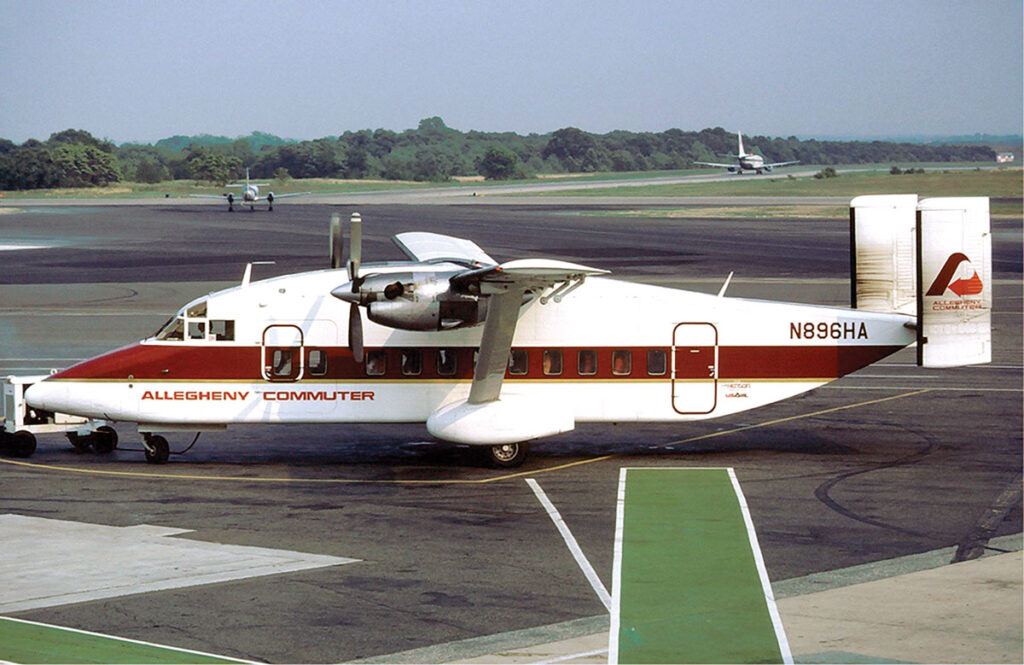
Operating Beech 99s and Shorts 330s, Henson itself served Baltimore, Hagerstown, Newport News, Philadelphia, Salisbury, and Washington.Two years later, it increased its six-city route network by a third, employed 287, carried almost half a million passengers, and operated a ten-strong fleet, now including the 50-seat de Havilland Canada DHC-7. Henson, always aware of the importance of technology, implemented it wherever feasible.
“Henson’s advancement in technology ensured that passenger satisfaction was maintained through analyzing data based upon demand for commuter travel and connecting flights to major airlines through the Henson system,” Dennis points out (ibid).
Piedmont Regional Airline
Henson changed its code-share agreement in 1984, relinquishing the “AL” two-letter Allegheny code and adopting the “PI” one, after Piedmont purchased it, now becoming “Henson: The Piedmont Regional Airline.” It served the 16 cities of Baltimore, Charlottesville, Hagerstown, Islip-Long Island MacArthur, Newport News, New York-JFK, Newark, Norfolk, Ocean City, Philadelphia, Pittsburgh, Richmond, Roanoke, Salisbury, Shenandoah Valley, and Washington-National. Flight numbers indicated aircraft type, as listed in its January 15, 1984 timetable: 1500-1599 (Beech 99s), 1600-1699 (Dash 7s), and 1700-1799 (SD-330s). It transported more than 700,000 passengers that year.
In 1985, it introduced the 37-seat de Haviland Canada DHC-8-100, which (now) 74-year-old Richard Henson himself flew on its delivery flight. It was inaugurated into service on May 2 between Salisbury and Baltimore and the type became the mainstay of its fleet.
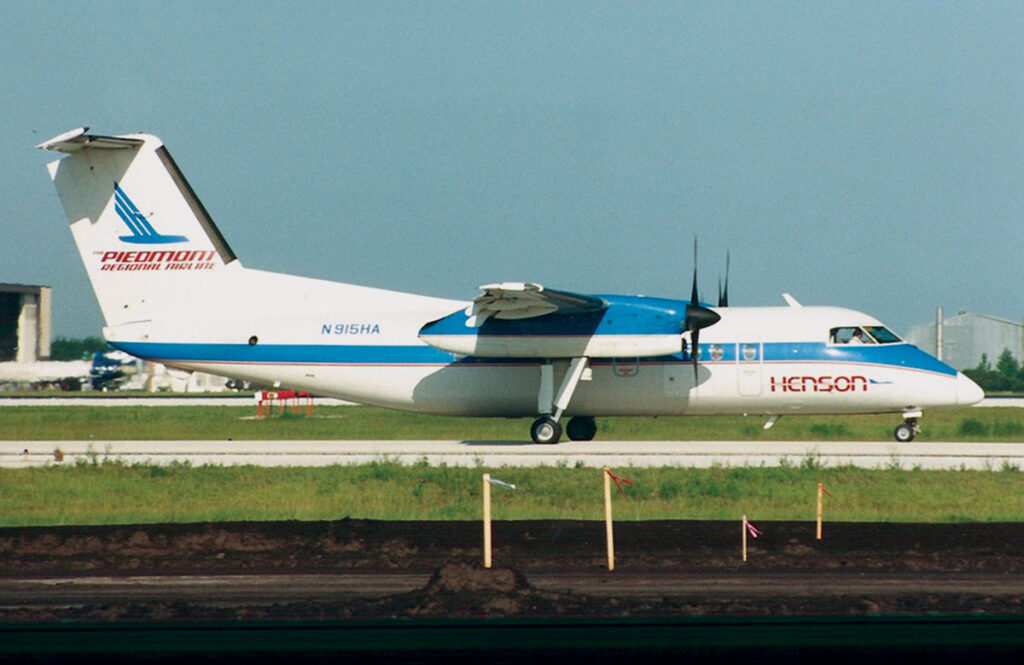
Although per-aircraft load factors were initially predicted as declining because it accommodated seven more passengers than the Shorts 330s it replaced, its quiet, wide-look interior and pressurized comfort served as attractions and ensured that this did not occur.
Norfolk became the maintenance base for the type and was chosen because of two factors.
It was centrally located and therefore route system logistical.
It was a major destination in its own right, ensuring high evening-flight load factors before the aircraft was subjected to overnight maintenance procedures.
Increased Piedmont synergies occurred when Henson began Charlotte operations, plugging service gaps, introducing the DHC-8-100, and increasing the size of the team’s market share, with service to such cities as Charlottesville, Lynchburg, Roanoke, Florence, Greenbrier/Lewisburg, and Hilton Head from the North Carolina hub.
By 1987, it employed almost 900 and served 38 destinations with 11 SD-330s, 11 DHC-8-100s, and 6 DHC-7-100s. But, in many ways, Henson would now come full cycle, realigning, without choice, with its original Allegheny partner.
American Eagle
Piedmont, along with Henson, was acquired by the USAir Group that year and Piedmont itself was fully absorbed by it in 1989, leaving Henson aircraft to be repainted in USAir Express colors.
“The USAir-Piedmont merger proved to be successful by slowly upgrading Henson’s fleet and introducing new stations and hubs that allowed for expansion…,” advises Dennis (ibid).
Henson’s own USAir Express portion extended further south to Florida and across the water to Rock Sound in the Bahamas, and its Dash 8s offered levels of service never previously available on them.Touching down in east coast cities from Boston to the Bahamas, Henson/USAir Express became the nation’s fourth-largest regional carrier.
In order to reflect its historical evolution, USAir respectively re-designated its Suburban Airlines, Jetstream, and Henson subsidiaries “Allegheny,” “PSA,” and (the second) “Piedmont” in 1983, and was itself rebranded as US Airways four years later, the same year that Allegheny and Piedmont became US Airways Express carriers.
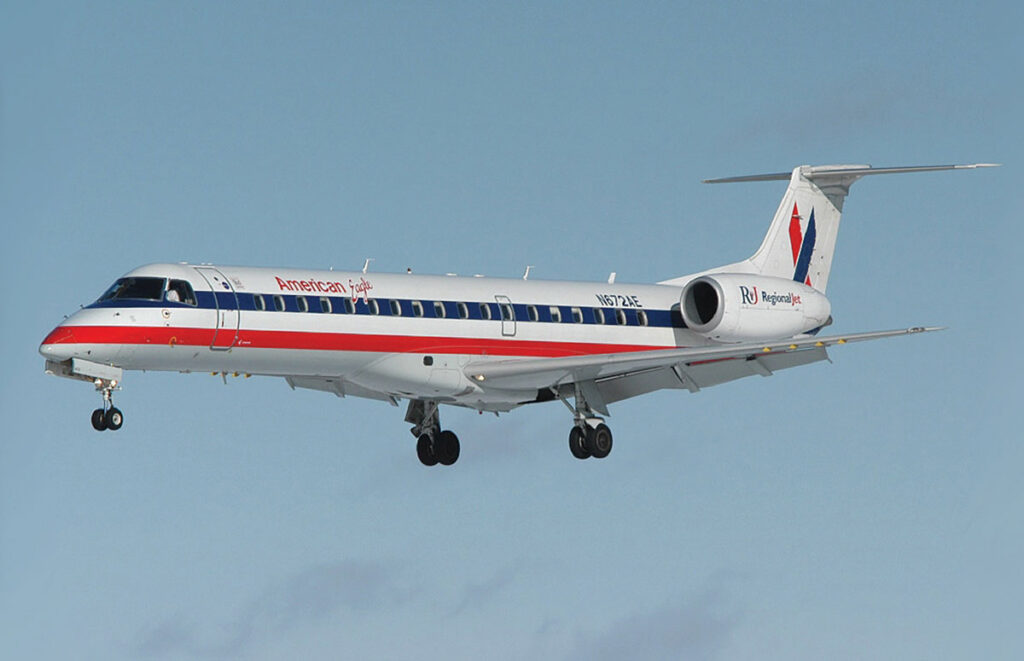
In 2004, Allegheny and Piedmont were combined, leaving the latter name, and nine years later, when US Airways was acquired by American Airlines, it became American Eagle, operating 50-passenger Embraer ERJ-145 regional jets to more than four dozen destinations mainly from Charlotte and Philadelphia hubs.
Navigating multiple, major-carrier code-share alignments, rebrandings, and mergers with Allegheny Piedmont USAir, US Airways, and American, Henson, beginning as Hagerstown Commuter and ending as American Eagle, somehow persisted and survived them all, clearly reflecting the embodiment of Richard Henson himself.