



States carry associations. In the case of California, it is Hollywood. In the case of Colorado, it is the Rocky Mountains. And in the case of Florida, it is sunshine. One carrier sought to reflect it in its very image: National, the Sunshine Airline. But, like many that evolved from puddle jumpers to major ones, it transported letters before passengers.
Airmail Origins
“National Airlines…is the only Florida-born, Florida-based, and Florida-chartered trunk carrier, and was founded in 1934 following the award of a 142-mile airmail route between St. Petersburg and Daytona Beach, linking Tampa, Lakeland, and Orlando,” according to Arch Whitehouse in The Sky’s the Limit (The MacMillan Company, 1971, pp 244-245).
Founded by George T. (Ted) Baker, it traces its roots to a midwestern city associated more with wind than sunshine–Chicago–and mostly catered to thirsty passengers in search of legal liquor across the Canadian border during prohibition, operating as National Air Taxi System.
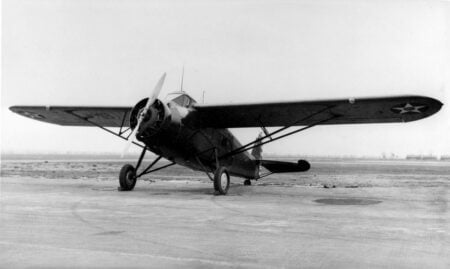
After the Volstead Act was repealed, demand decidedly dried up, and his fleet of single-engine, high-wing, four-passenger Ryan B-5 Broughams needed purpose. That purpose was the St. Petersburg-Daytona Beach airmail route, which was inaugurated on October 15, 1934, from Albert Whitted Field.
The airmail service, comparable to an aerial Pony Express, became a Florida spur to the north-south routes operated by Eastern and to which the mail itself was transferred for further carriage.
Passenger Expansion
After a period of reliability-proving mail flights, attention naturally turned toward the transport of passengers, which was first advertised in the local St. Petersburg newspaper.
“Passenger-Mail-Express,” it advised. “National Air Line System. Municipal Airport. Phone 42-775.”
Although the fledgling service only attracted 193 passengers during its first six months of operation, it planted a seed that sprouted into demand and soon necessitated the two larger, more suitable, 10-passenger Stinson SM-6000 trimotors that joined the fleet in 1935.
Charlotte, Georgia, whose previous “aviation experience” consisted of the Woolworths cosmetic counter, served as its first flight attendant. Although the aircraft lacked galley or lavatory facilities, she nevertheless distributed cigarettes, gum, and magazines. Flying then was a delicate balancing act: every time she walked the aisle to do so, the pilot had to adjust the airplane’s stabilizer trim to maintain its equilibrium. Nevertheless, these early flights were safe.
“National Airlines quickly established an enviable record of reliability,” Thomas Reilly reported in his article, “The Birth of National Airlines: The St. Petersburg Years, 1934-1939” (Tampa Bay History, Volume 19, Issue 1, Article 6). “In April 1935, the company had held the distinction of being the only domestic airline to complete 100 percent of its scheduled flights. Unlike the other 31 airmail routes in the country, it was seldom necessary to cancel or delay flights on National’s Florida route…”
In its first full year of operation, it carried 500 passengers and earned just under $5,000 in revenues.
An inauspicious beginning it was, perhaps, but air travel was hardly routine during these early days. Nevertheless, both a route extension from St. Petersburg to Miami via Sarasota, Ft. Myers, and Tampa in January of 1937, and increasing passenger numbers, prompted acquisition of more modern equipment—in this case, the low-wing, twin-engine, all-metal Lockheed L-10 Electra in September of that year.
A slightly westward extension to New Orleans the following year enabled it to touch down in Daytona Beach, Ft. Myers, Jacksonville, Lakeland, Miami, Morrison, Orlando, Pensacola, Sarasota, St. Petersburg, Tallahassee, and Tampa in Florida; Gulfport in Mississippi; and Mobile in Alabama, as well as New Orleans in Louisiana. All these cities encompassed what it called “The Buccaneer Route.”
Acquisition of the first quad-engine Douglas DC-4 enabled National to increase its capacity-per-aircraft, elevate its image, and inaugurate the first nonstop Florida-New York service on February 14, 1946.
“Encouraged by nonstop authorizations, National actually began to set the pace by introducing the four-engine DC-4 on a direct overwater route from Miami to New York…,” according to R. E. G. Davies in Airlines of the United States since 1914 (Smithsonian Institution Press, 1998, p. 343). It competed with Eastern’s own DC-4 flights.
In the decade between mid-1936 and mid-1946, its revenue passenger miles had exponentially increased–from 250,000 to 109 million–and it relocated its headquarters to Miami at this time.
The Jet Age
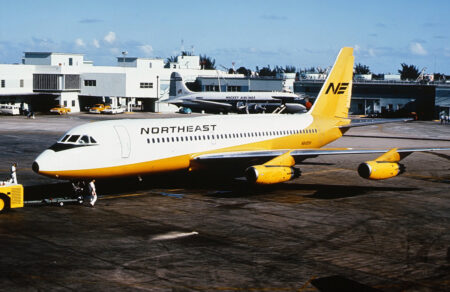
The last two years of the 1950s served as both the threshold to the next decade and considerable expansion. Perhaps its greatest achievement at the beginning of this period, however, was that it became the first US domestic carrier to inaugurate pure-jet service with 111-passenger Boeing 707-120s.
“To the American traveling public, the term ‘jet’ conveyed an image of progress and sophistication that transcended practical consideration of time-savings, noise, and vibration,” according to Davis (ibid, p. 513). “By an ingenious piece of interline cooperation, National Airlines was the first to operate a big jet within the United Sates. It leased aircraft from Pan American and began Boeing 707 service between New York and Miami on December 10, 1958.”
It connected the two cities in two hours, 15 minutes, as opposed to the three hours, 35 minutes required for the DC-6B to do so.
“First with jet service in USA,” it proclaimed on the cover of its April 26, 1959 timetable.
But the 707 in particular provided initial pure-jet experience and preparation for its own DC-8 equipment. As the second to take delivery of the type after Eastern on February 7, 1960, it inaugurated it into service between New York and Miami four days later, uniquely qualifying itself as the only airline to simultaneously operate the competing Boeing 707 and the Douglas DC-8.
“You can now board a National jet in New York, San Francisco, Los Angeles, Tampa, Miami, New Orleans, and Houston,” it proudly proclaimed in its March 2, 1962 system timetable.
Not all of National’s developments were aircraft- and route-related, however.
In April of 1962, for instance, Louis Bergman (“Bud”) Maytag, Jr., grandson of the Maytag Corporation’s founder and previous owner of Denver-based Frontier Airlines, acquired National from Ted Baker for $6.5 million.
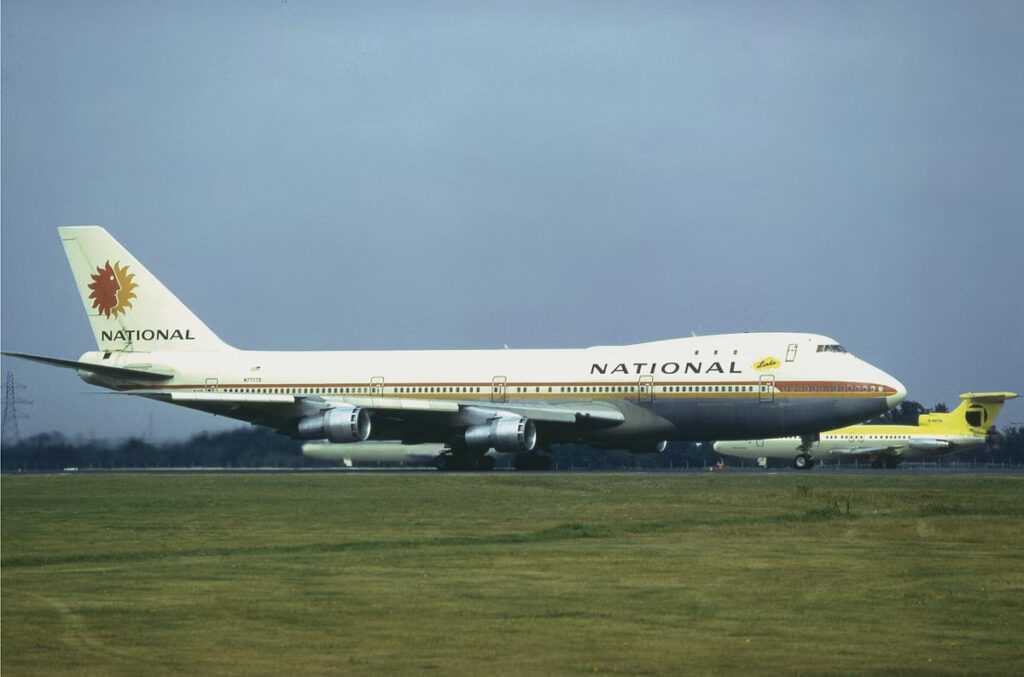
It adopted the sun-themed, Florida-reflecting Sun King logo. It extended this sunshine-state atmosphere to the glass-walled, Sundrome terminal designed by I. M. Pei that was built at John F. Kennedy International Airport.
It dressed its flight attendants in Oleg Cassini-designed uniforms and featured many of its crew members in a “Fly me” advertising campaign in which they sang, “I’m Barbara, fly me,” although often at the ire of feminists.
It also adopted the “Watch us Shine” song, whose refrain consisted of the lyrics, “We’re National the Sunshine Airline. Watch us shine.”
All of these efforts rendered it as synonymous with Florida as the names other carriers used to reflect their own states of origin, such as Air California, Alaska Airlines, Hawaiian Airlines, New York Air, and Texas International.
The short-fuselage 727-100, which it inaugurated into service in the 1960s, and the later, stretched 727-200, became the narrow body workhorses of its fleet, prompting it to advertise, “Jet National, coast to coast to coast” on the cover of its April 30, 1967 timetable.
A significant expansion milestone occurred when it became the first carrier since 1946 to be designated a transatlantic operator and was awarded the Miami-London route. Inaugurated on June 16, 1970 with the 747-100, it not only extended Florida’s reach to Europe, but facilitated passenger connections in Miami to and from tis domestic route system.
The McDonnell-Douglas DC-10-10 trijet became the backbone of its widebody fleet, facilitating its deployment to London the following month, but four more suitable intercontinental DC-10-30s enabled it to continue its European expansion with service inaugurations to Paris-Orly on June 22, 1977; Frankfurt and Amsterdam on May 1 and 4, 1978; and Zurich on July 22, 1979.
Earlier in the decade, National had grown into the sixth largest domestic carrier, serving 41 cities in 15 states and the District of Columbia with 6,185 unduplicated route miles.
Acquisition
Now dripping with potential, National Airlines became a coveted takeover target; and, although attempts by Texas International and Eastern under Frank D. Lorenzo’s reign failed, that by Pan Am did not, echoing the two companies’ earlier 707 cooperation.
Considered the proverbial “sum is greater than its parts” transaction, it gave Pan Am the domestic route system it could not achieve on its own in pre-deregulation days, as emphasized by Pan Am’s president when the merger became official on January 7, 1980.
“This is a merger of equals, each with unique skills and strengths,” he told reporters that day. “We welcome National people as equals.”
Operating 19 727-100s, 24 727-200s, 11 DC-10-10s, and five DC-10-30s during its last year of service, National carried almost seven million passengers and was assessed as having $500 million worth of assets at that time.



1 Comment
Actually National inaugurated its first service on the Miami-London Heathrow route, in the summer of 1970, with leased McDonnell Douglas DC-8-50’s rather than 747’s. The airline’s two 747-135’s did not begin flying from MIA to LHR until May of 1972. The 747’s were later replaced in the mid-1970’s by Mcdonnell Douglas DC-10-30’s which operated the service until the 1980 merger with Pan Am.