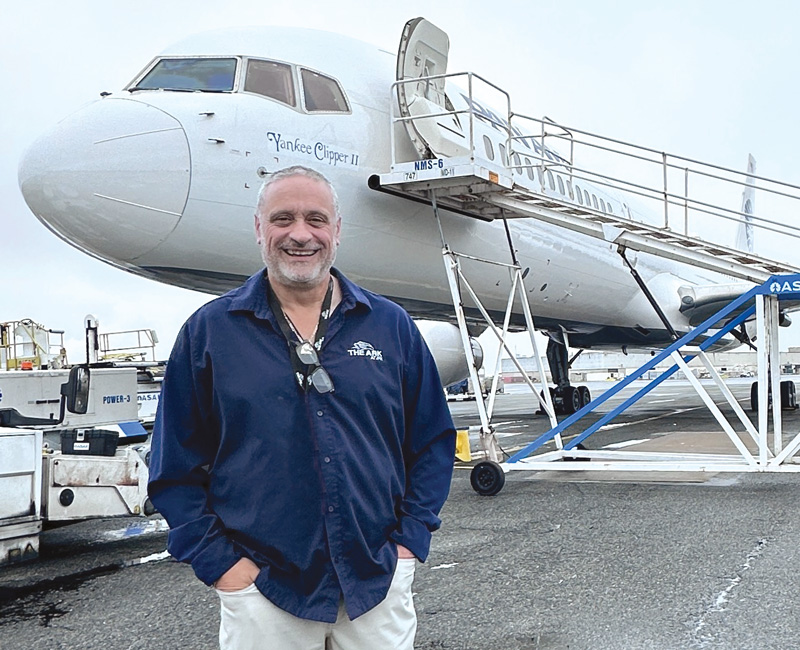




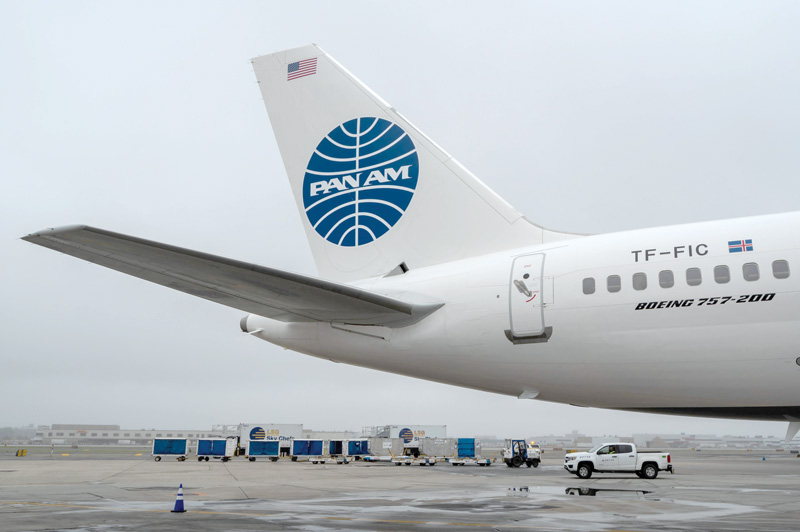
On a misty morning this past June, a white Boeing 757 taxied toward Terminal 7 at JFK International Airport. Inside the terminal’s Gate 5 waiting area, a huddle of enthusiastic passengers and spectators stood by the gate’s airside window overlooking the tarmac, eagerly awaiting the jetliner’s arrival. As the airplane neared the gate, the lettering on the forward section of its fuselage revealed the name ‘PAN AM’, and on its tail fin was the prominent blue ‘Pan Am Globe’.
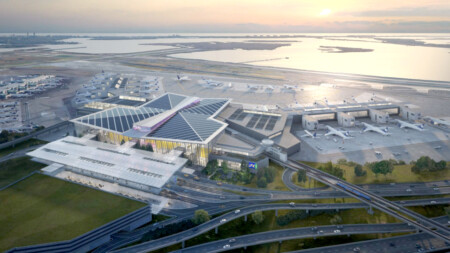
The return of the iconic airline Pan Am to Kennedy Airport that day, nearly 34 years after the carrier ceased operations on December 4, 1991, marked an evocative moment of ‘past and present’ in aviation history as the airport undergoes a massive $19 billion renovation to restore Kennedy Airport to the iconic status it enjoyed during the Pan Am years.

When the 757-200 painted in Pan Am’s classic blue and white livery pulled close to the gate, the buzz inside the terminal grew increasingly electric. A small group of former Pan Am flight attendants waiting to board the airplane raised their phones to take snapshots of the airliner through the window, and several of them grew visibly emotional while viewing the aircraft whose nose bore the inscription “Yankee Clipper II” just below the cockpit window.
Linda Freire, Board Chair, Co-founder and Director of the Pan Am Museum Foundation, was one of the former Pan Am flight attendants who, upon the plane’s arrival, commented, “It was emotional. It was almost like taking me back in time, and I was really welled up with tears. I was just so emotional seeing the Pan Am name up there again. It was wonderful and bittersweet all at the same time. I was there for almost 15 years. It was a long time ago, but it always lives with me.”
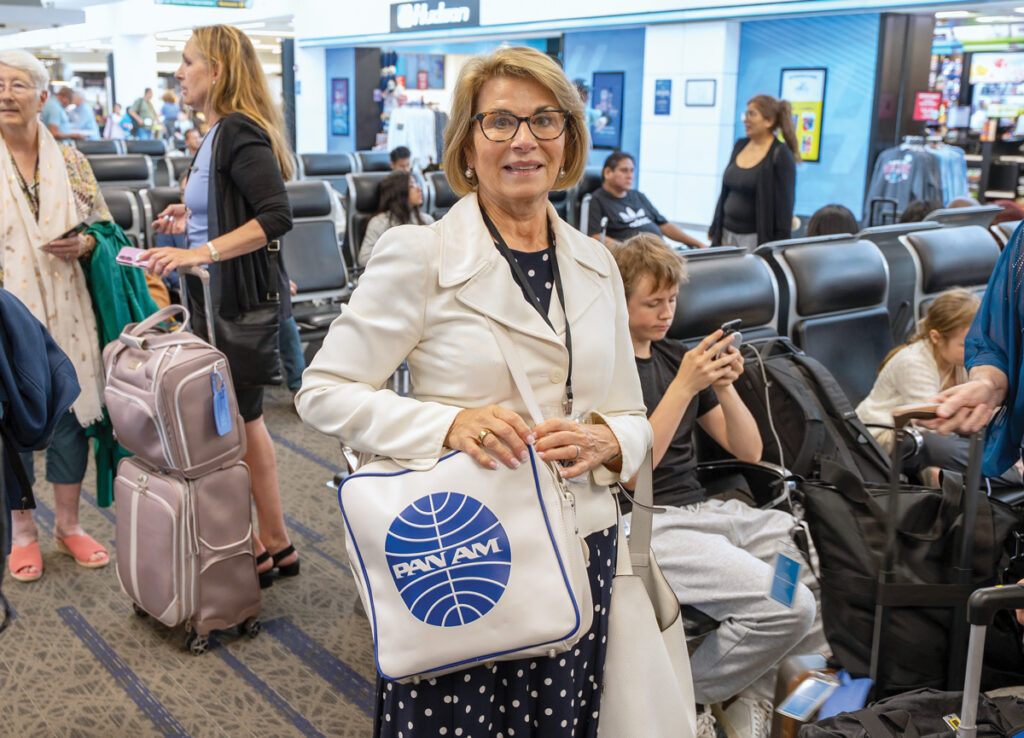
The significance of the arriving Pan Am airliner was not lost on all those taking part in this noteworthy occasion at Terminal 7, as the pioneering spirit of the early Pan Am years was being commemorated that afternoon with a privately chartered flight (utilizing an Icelandair 757 and crew) from New York to Europe carrying 35 passengers on a round-trip 12-day journey named, ‘Pan Am: Tracing the Transatlantic.”
Officially licensed by Pan American World Airways and supported by the Pan Am Museum Foundation, the Pan Am private air program is operated by Beyond Capricorn, a joint venture of Bartelings, a company specializing in touring worldwide by private aircraft, and Criterion Travel, a specialist in developing and operating tours and cruises for U.S. affinity organizations.
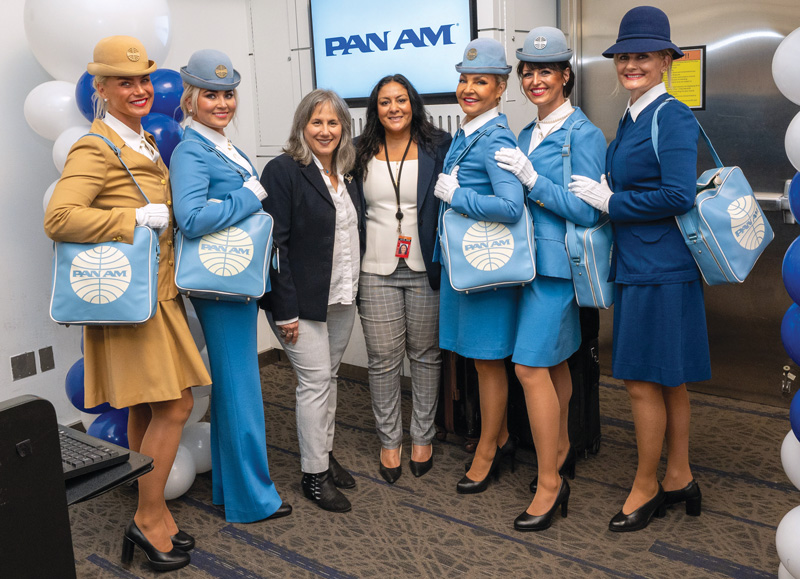
Departing from JFK, the 12-day commemorative journey, with a replicated Pan Am crew and 35 travelers aboard, the flight would closely follow the routes of the original Pan American World Airways flying boats with stops in Bermuda, Lisbon, Marseille, London, and Foynes in Ireland, staying at iconic hotel’s at each stopover. Traveling in comfort and style, some of the features of this privately chartered 757-200 include lie-flat, business-class seats, unique ‘buddy’ seats for dining and socializing, upscale catering, an open bar, and more.
Seated by the boarding gate were five Icelandair flight attendants dressed in replicas of Pan Am’s classically tailored uniforms in the airline’s timeless ‘Superjet’, ‘Tunis’, and ‘Galaxy Gold’ colors. For the complete Pan Am retro look, they wore reproductions of Evan Picone designed Pan American World Airways stewardess’ ‘Bowler Hats’. Standing nearby, an Icelandair Captain and First Officer were uniformed in black double-breasted blazers with gold buttons and braided cuffs and black trousers. Upon their white caps, above the cap’s black brim, a gold Pan Am hat badge was centered, bearing the airline’s name.
One of the five Icelandair flight attendants, Anna Maria, commented, “It’s such an honor and a privilege for us to be representing Pan Am and to bring back the airline that is so iconic and to embrace the classic Pan Am style,” as the other four flight attendants nodded in agreement.
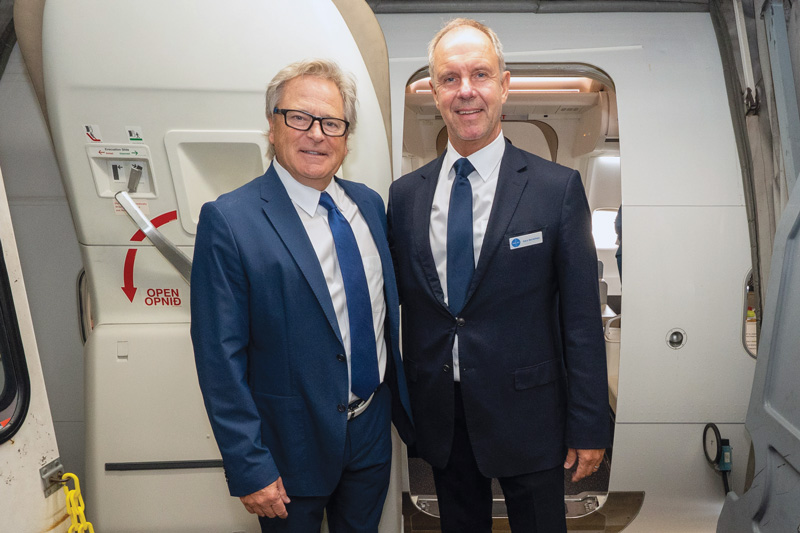
The flight’s captain expressed, “We are really thrilled to be part of this memorable event, as Pan Am is such a huge part of aviation history. We are deeply inspired and honored to be part of this.” First Officer, Joe, added, “We have been looking forward to this trip for a long time now. When I was a little boy learning to fly, I always knew about Pan Am. I knew it was big; a big legacy in the business. This is something you would only dream about doing, and now it’s the first day, and it’s a dream come true.”
Mike Brenner of Winston-Salem and his wife were two of the more than three dozen passengers waiting to board the flight. “I like to take trips like this,” he said, “I’ve been around the world twice, and when I saw this one advertised in the Wall Street Journal, it struck a chord, like a dream come true. And starting today, we’re going to places that we’ve never been to before. We’re ready to go!”
Prior to the take-off of the ‘Tracing the Transatlantic’ journey, voyage host Craig Carter, CEO of Pan American World Airways, said, “Since 1927, Pan Am has left an indelible mark on the world. From humble beginnings as the first commercial carrier for the U.S. Air Mail, Pan Am and its founder, Juan T. Trippe, went on to create a vast aviation empire across the globe, literally bringing the world closer together one flight at a time. It is exciting to embark on this journey, tracing both the original Pan Am Southern and Northern Transatlantic routes. “
Tracing Back: the Clipper Era
In 1927, Pan American Airways (PAA), later known as Pan American World Airways, was founded by American aviation pioneer Juan Trippe. Widely regarded as one of the most influential figures in the development and advancement of commercial aviation, Trippe created an enterprise that in its 64 years of operation set the gold standard for the world’s air transport industry, bringing the benefits of aviation and its evolving technology to greater numbers of people throughout the world.
By October 1927, when there were few aviation facilities in Latin America, Pan American Airways launched scheduled mail service between Key West and Havana. On January 16, 1928, passenger service began, and within two years, PAA routes extended from Miami to Brazil and Buenos Aires, and the airline expanded its service throughout Latin America. As PAA commenced exploratory survey flights over both the Pacific and the Atlantic, commercial air routes opened where there had previously been none.
When the 1930s heralded many of the earliest commercial trans-Atlantic flights, PAA was a forerunner, carrying passengers across the Atlantic in their fleet of flying boats, or ‘Clipper’ aircraft. The airline’s first scheduled transatlantic service began in June 1939, initially flying from Port Washington, Long Island, while the new Marine Air Terminal at LaGuardia was being built to accommodate future flights.
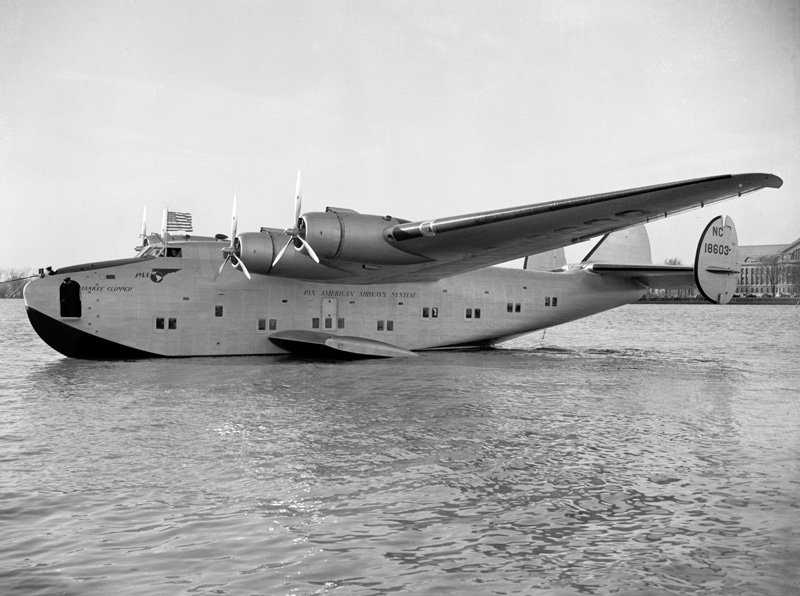
The Boeing 314 was considered the ultimate ‘Clipper’, carrying up to seventy-four passengers across the Atlantic and entering trans-Pacific service, linking all the continents in the Northern Hemisphere. The B-314 was a long-range flying boat that could land anywhere at sea, provided the destination had a sheltered harbor in which it could taxi. Pan Am’s Clippers were built for one-class luxury air travel, a necessity given the long duration of trans-oceanic flights. One of the many features was the seats which could be converted into bunks for overnight accommodation.
Striving to provide the most pleasant flight experience, Pan American Airways set the benchmark for superior passenger service. The Boeing 314 had a large upper flight deck and a lower passenger cabin divided into five seating compartments. There was a galley kitchen, a baggage compartment, men, and women’s changing and restrooms, as well as a main lounge that converted into a dining room. White-gloved, tuxedo-clad stewards catered to their passenger’s needs. Meals were lavish experiences, featuring gourmet foods and beverages served on fine china, accompanied by silverware set on white linen tablecloths.
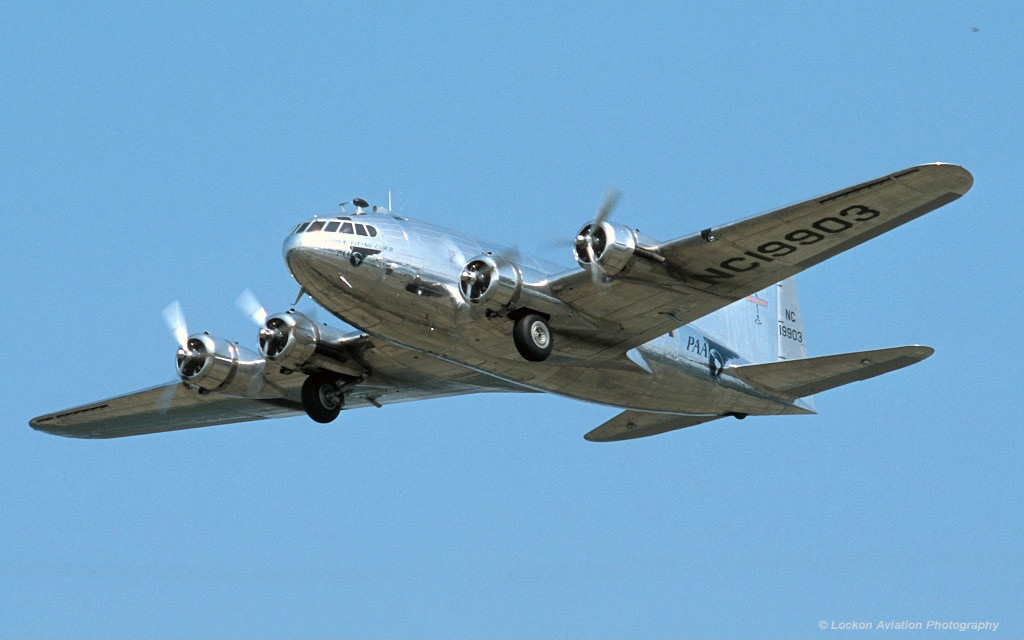
Pan Am entered the Boeing B-307 Stratoliner into scheduled domestic service on July 4, 1940, with routes to Latin America and from New York to Los Angeles. The Stratoliner was the first four-engine airliner to feature a pressurized cabin, enabling it to cruise at an altitude of 20,000 feet, well above the clouds and above the reach of rough weather.
As the 1930s drew to a close, with war looming on the horizon, Pan American Airways collaborated with the U.S. government to secure and maintain vital air routes, delivering essential supplies, personnel, and communications. According to PanAm.org, at the time of the Pearl Harbor attack on December 7, 1941, Pan American World Airways had a significant global presence with 88,478 total route miles, serving 52 countries, and employing 8,750 people. This included new divisions in Africa and an Air Ferry service, and Pan Am also operated a network of 192 radio/weather stations and 300 airports.
In the post-war years, flying boats became obsolete, and a new breed of large, streamlined landplanes began to transport thousands of passengers to overseas destinations that were previously untraveled by the majority of people.
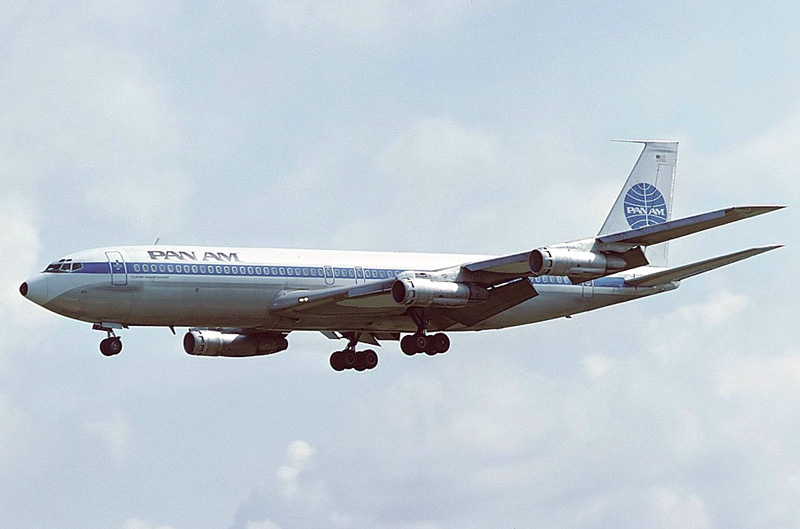
In 1958, Pan Am adopted its iconic blue globe logo, which replaced the previous PAA half-wing design and symbolized Pan Am’s global reach into the forthcoming Jet Age. Over 30 years after Pan Am’s first flight to Havana, the first Boeing 707 jet was bound for Paris from New York.
In the 1960s, Pan Am introduced the first computerized global reservation system and established its headquarters at the newly constructed Pan Am building in Manhattan, also investing in supersonic transport.
At that time, Pan Am’s iconic ‘Worldport’ terminal at JFK, originally the Unit Terminal Building (UTB), was a striking example of modern architectural innovation when it opened and its design was indicative of Pan Am’s global vision of air travel. Known for its unique circular motif with a roof that resembled a flying saucer, it allowed aircraft to park directly beneath the roof’s overhang, bringing passengers closer to their airplane. The elliptical terminal also had a panoramic lounge called the Panorama Room where passengers could relax and dine before boarding their flight.
With the arrival of 1966, Pan Am set an even higher bar for global commercial air travel as the first airline to order the Boeing 747, the first wide-body airliner, earning the name ‘Jumbo Jet’ or ‘Queen of the Skies’. By the early 1970s, Pan Am was the first to operate the 747 on regularly scheduled service and the first airline to open the largest single-air terminal in the world with the expansion of Worldport in 1971.
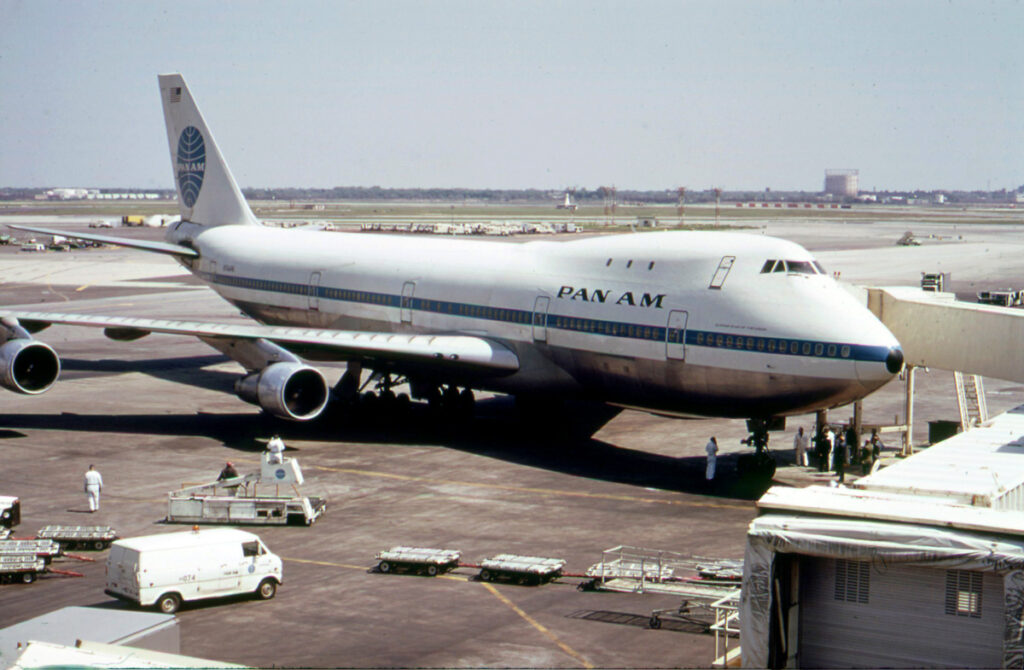
As a symbol of the Jet Age and hub for Pan Am’s global operations, the Worldport was reflective of the most important and innovative airline in the U.S.. To the delight of thousands of passengers, plane spotters, and employees, the Worldport had a rooftop parking deck that offered a spectacular view of all the runways, taxiways, approaches, and swathes of aircraft.
During the height of its years, Pan Am was considered the most prestigious international airline and was known for its glamorous image and for the exceptional training that its employees received. Working for Pan Am offered employees the thrill of adventure and excitement, especially for pilots and flight attendants who enjoyed a great opportunity to travel the globe and experience different cultures.
Today, thirty-four years after Pan Am ceased operations in 1991, many former Pan Am employees and their families feel a very strong sense of nostalgia and the camaraderie that staff experienced during their time with the airline. This enduring connection is evident through online communities, including the Pan Am Museum Foundation and its award-winning The Pan Am Podcast, which brings the iconic airline’s 64-year history to life through storytelling and insightful interviews with employees, passengers, historians, authors, fashionistas, and aviation enthusiasts.
Pan Am Memories
While writing this feature on Pan Am’s ‘Tracing the Transatlantic’ flight, I had the opportunity to speak to a few former Pan Am employees who fondly recounted their experiences with the airline over the decades, and their children who shared their vivid memories of their mothers and fathers who had worked for Pan Am and who grew up as part of the extended Pan Am family.
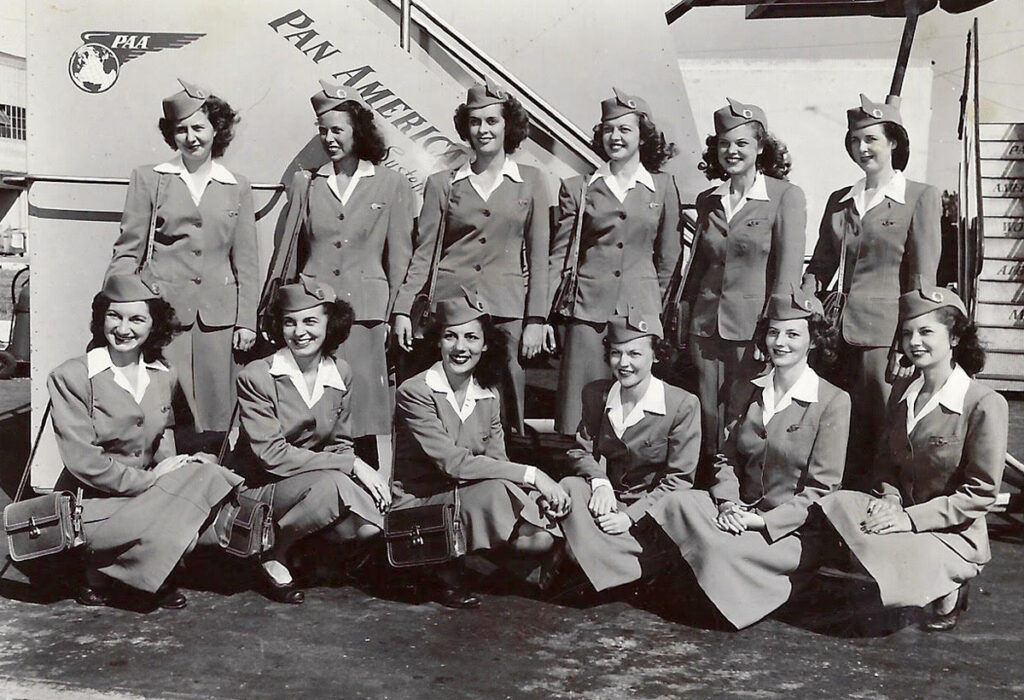
There are stories about Pan Am pilots and stewardesses who met, fell in love, and married while working for the airline. Frank and Toni Dionne Duffy’s story is just one of them….
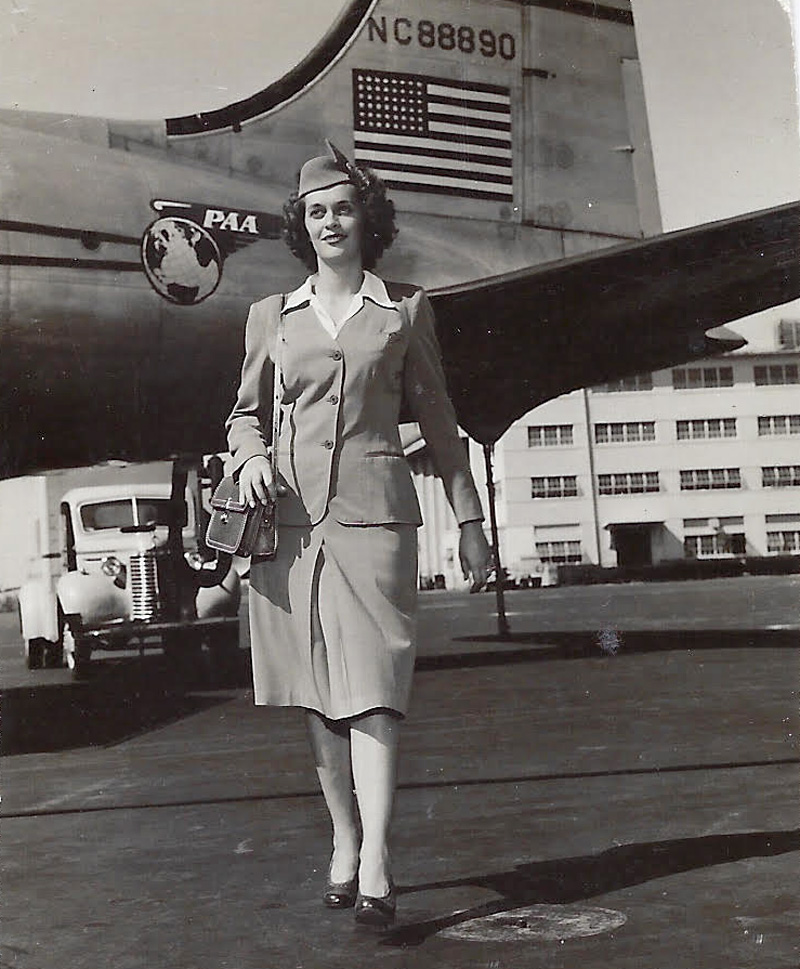
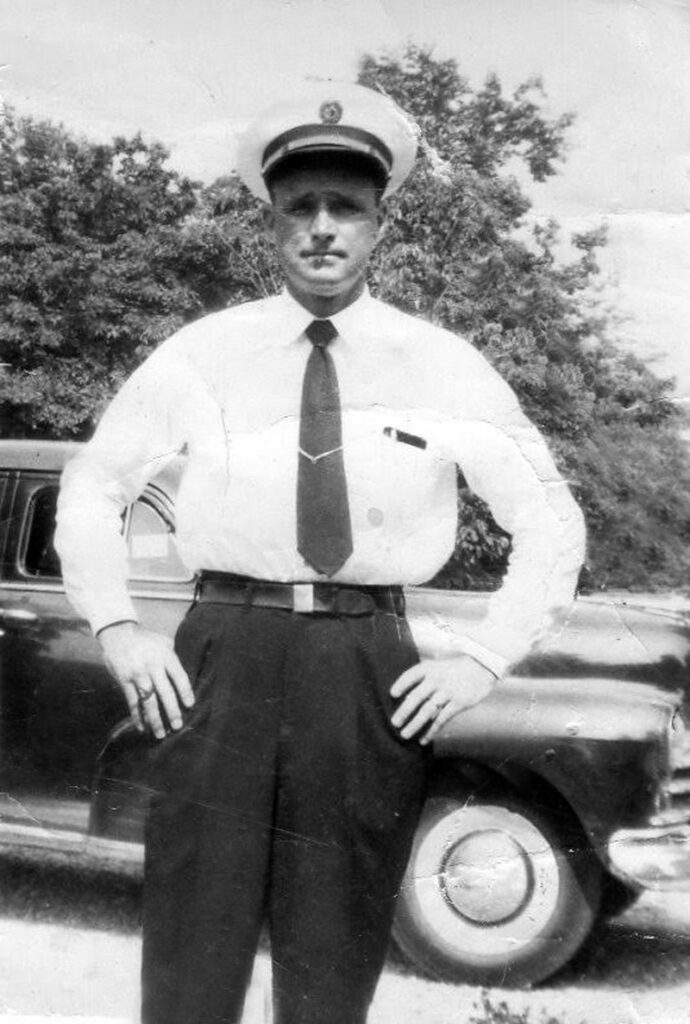
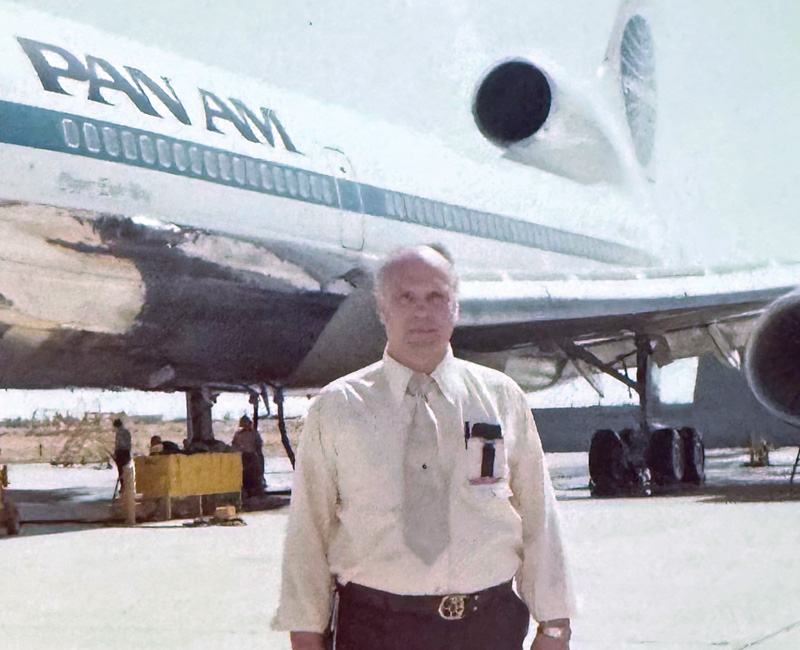
During WWII, Frank ‘Duff’ Duffy flew for the Navy and subsequently became a flight instructor for trainees recruited for the Women Airforce Service Pilots at Avenger Field in Texas. After leaving his position there, Frank continued his career in aviation as a pilot with Pan American Airlines for an illustrious 36 years, when the mandatory retirement age was 60. At the time of his retirement, he had accumulated nearly 30,000 flight hours and qualified on 24 different aircraft. Frank’s last flight as a commercial pilot with Pan Am was to Rome, Italy, his favorite destination.
Back when Frank was at the start of his career with Pan Am, in the later 1940s, a tall, elegant young woman by the name of Myrtle ‘Toni’ Dionne was hired by Pan Am as a stewardess. She initially flew out of the Marine Air Terminal at LaGuardia before the airline moved its operations to the newly established New York International Airport, then best known as ‘Idlewild’ (and later JFK).
Toni and Frank’s daughter, Denise Meehan, recently recounted an amusing story of how her parents met, explaining, “My mother lived with a group of other stewardesses in Flushing, Queens and one day she was knitting an argyle sock when my father, who was a First Officer, saw Toni and said to her, “I’d really like you to knit one of those for me.”
After they married, Toni resigned from Pan Am in 1949 and they raised a family in Lloyd Harbor on the north shore of Long Island which was originally part of a pilot’s community. The idea behind the pilot’s community in those days was that the pilots could be gone for as much as three weeks on a long haul. And with that being the case, among all the pilots living in the community, there would always be a man at home to take care of any situation that might emerge.
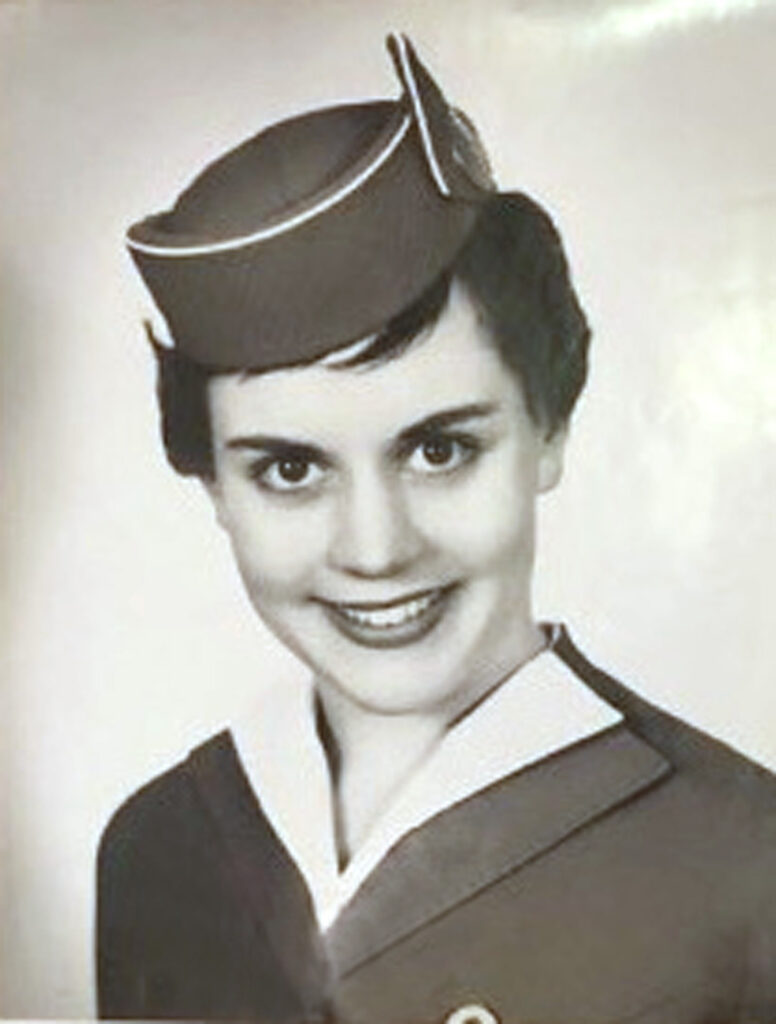
With the advent of the Jet Age, Judith Iurka MacKinnon, an aspiring dancer in 1958, applied for a job with Pan Am. In late 1959, she was hired as a stewardess and was based in New York, from where she primarily flew routes to Europe, as well as to China. She met her future husband, who was a pilot for TWA, and they married in 1962. When speaking to Judith’s son Joel, he and his sister recalled how their mother bought the material for her wedding dress in China and then had it custom-made. Judith worked for Pan Am for about two years before having to retire, due to Pan Am’s policy (and that of most airlines at the time) that required their female flight attendants to remain unmarried.
With the recent ‘Tracing the Transatlantic’ flight recreating Pan Am’s transatlantic routes, there is a continued interest in the airline’s history and the want to relive the glamour of the Pan Am era, as was evident at JFK’s Terminal 7 that day.
As one of the passengers making the 12-day journey, Cynthia McMillen, who hails from the San Francisco Bay area, excitedly awaited the call to board the 757 at Gate 5. She spoke to me beforehand and said, “It’s good to be in the sky again. While I did not fly with Pan Am, I worked in Sales and Reservations in San Francisco many moons ago. But I’ve been involved with Pan Am since 1941 when I was born and went to Asuncion Paraguay as a child via Pan Am. And then I came back to the States on Pan Am and later flew around the world for $300 for three months because I worked for a year and got a 90% discount. So, I have a whole story that I’ve written about my life with Pan Am and…well… I’m supposedly the oldest person in the group today. I’m 84 and I think this may be my last flight because I’ve been to 50 countries now. And It’s pretty exciting that I started with Pan Am, and I think that, today… I’ve finally come full circle.”
The Pan Am Bonds That Tie Us
Mike Falacara comes from a family where both his mother and father worked in separate areas for Pan Am in the 1950s and ’60s, at what is today JFK International Airport. His mother, Ann Falacara, worked on the passenger side, and his father, Frank Falacara, a graduate of Aviation High School (1949), worked in maintenance. Ann retired from Pan Am in the early 1960s to raise four children, and Frank stayed with Pan Am until the year before the airline ceased operations in 1991. Older brother Frankie Falacara also began his career at Pan Am as a ramp supervisor in 1988, where he met his wife, Jackie Martinez Falacara, a Pan Am passenger service supervisor, before joining the NYPD.
Mike was around Pan Am and the airport his entire life, and his family traveled regularly due to the travel perks Pan Am provided its employees. At the age of 18, when the airline began allowing family members to work at the same airport, Mike applied for a job fresh out of high school and was hired on July 24, 1985.
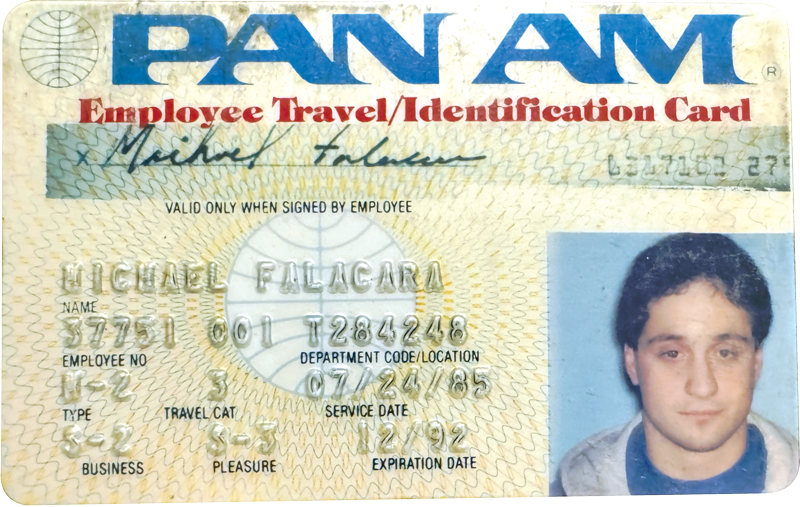
He began working part-time on the ramp, performing lavatory services and loading aircraft. Over time, Mike advanced to become a crew chief lead for ramp operations. As a lead, he undertook nearly every operations job available, eventually becoming a supervisor in 1989. He then remained in the position until 1991, when Delta Air Lines acquired a significant portion of Pan Am’s assets following the airline’s bankruptcy filing. The filing came after a series of financial difficulties, rising fuel costs, increased competition following airline deregulation in 1978, and the impact of the Lockerbie, Scotland, bombing in 1988.
Reflecting on his time at Pan Am, Mike Falacara emphasized the unique sense of community that defined the airline. “It’s always going to be the people and the friendships that you made as you worked – it was almost as if you were in triage every day at Pan Am during the summer operations. It was very busy, and we all spent more time with people at work than with those outside of the airport. So, you built long-lasting bonds, and to that avail, four co-workers were in my wedding party! We were close then, and we still remain close to this day. It was a very fun environment,” said Falacara.
Pausing for a bit, he then recalled a special memory, “On a 3rd grade class trip, we went to Hangar 19 to walk along the catwalk above the 747s there for servicing. Fifty years later, those same classmates have recently told me it was ‘the best class trip they have ever been on.’ We still communicate, and they still remember that day. The memories will never go away, but it’s nice to see the logo on a plane again. It’s such an amazing legacy, you couldn’t go anywhere in the world without seeing the Pan Am globe, and if you said you worked for Pan Am, people would do anything you needed. When I got the job at Pan Am, I was told, ‘If you go to work for Pan Am, you will have a job for the rest of your life.’ Forty years later, I am still working at JFK.”
Mike Falacara is currently the Chief Operating Officer of The ARK at JFK.