



When technological innovations occur, someone or some company becomes the first to invent and introduce them, and others often follow, sometimes improving upon them. In the case of commercial jet aviation, that introduction was the de Havilland Aircraft Company’s DH.106 Comet, the world’s first jet airliner. The Avro C-102 followed it into the sky only 13 days later and could have been the second. But it never entered service. What went wrong?
Engine Selection
Aside from the nascent state of jet engine development during the 1940s, few were available for use by commercial airliners. But promise came from across the pond, in England.
Rolls Royce was developing a 6,500 thrust-pound, axial flow AJ65 engine. Mated to an aircraft, it could offer the same advantages enjoyed by military designs—that is, dramatic performance improvements, such as 400-mph or greater speeds and reduced travel times, enabling passengers to take more frequent trips and spend less time traveling to their destinations. Any airline that operated such a jet-powered aircraft would clearly have offered a competitive edge over those that did not, attracting passengers because of its innovation and comfort.
The airline for what could have been the world’s second jet airliner was then-named Trans Canada Airlines (TCA), which is today’s Air Canada.
It needed a replacement for its outdated Lockheed L-18 Lodestars and Douglas DC-3s, which served its low-capacity, short-range routes, usually from airfields with short runways, and it submitted its requirements for such a design to A. V. Roe (or “Avro” for short), the Canadian division of A. V. Roe of the UK.
Two of the AJ65 turbojets under development, mated to a small, 32-passenger aircraft, would not only have offered it a cutting-edge solution and “first in jet flight in North America” status, but would have been a win-win situation and solution for airline and manufacturer alike in a “for Canada by Canada” relationship.

Design Features
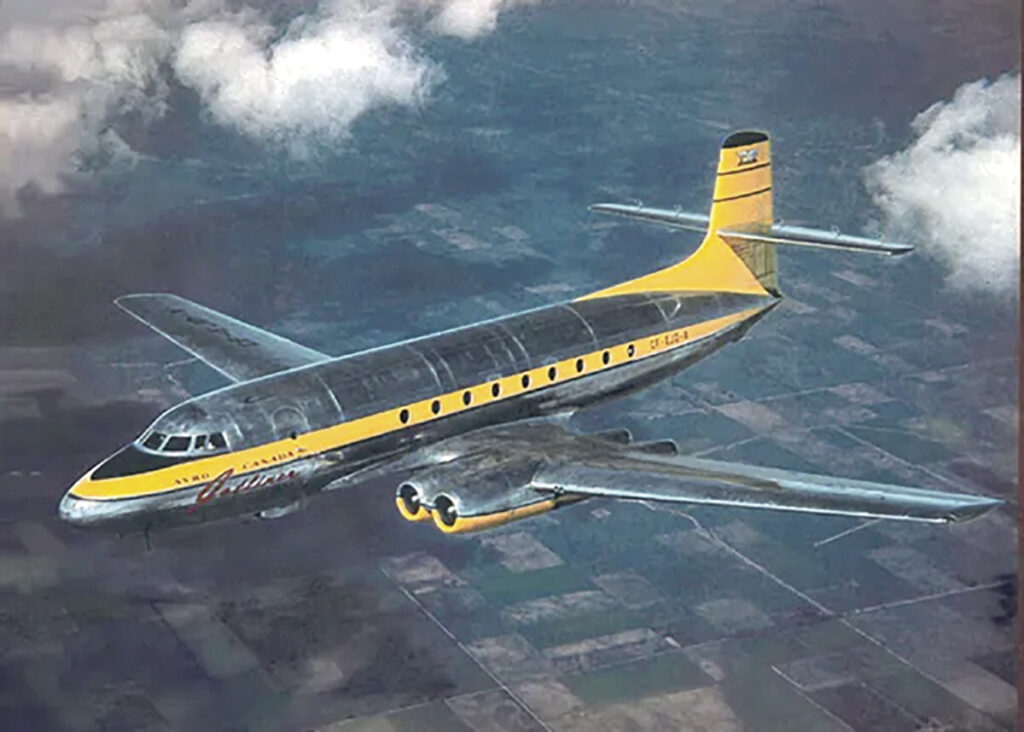
Despite the innovative nature of what became the Avro C-102 Jetliner, its overall design was conventional and not unlike that of the traditional piston aircraft, with a low-set, all-metal wing.
A wrap-around windshield provided vision and protection for the two-person cockpit crew, which did not require a flight engineer. Entry was through a forward, left odor. And the fuselage, wide enough for four-abreast seating and a capacity of 40, featured round passenger windows. It was pressurized for operation at or above a 30,000-foot altitude.
Because the intended AJ65 turbojets were not sufficiently developed in time for the aircraft’s introduction, they were replaced with a pair 3,600 thrust-pound Derwent 517 ones mounted under each wing.
“What Avro came up with was an outstanding airplane which met or exceeded every one of TCA’s many requirements, promising a safe, simple, and reliable airliner for medium-range work,” according to John Proctor, Mike Machat, and Craig Kodera in their book, From Props to Jets: Commercial Aviation’s Transition to the Jet Age, 1952-1962 (Specialty Press, 2010, p. 17).
Flight Test Program
Under the command of Chief Test Pilot Joseph Harold Orrell, the C-102, registered CF-EJO-X, the only one ever built, first flew from Avro’s Malton, Ontario, production plant on August 10, 1949, 25 months after its design was initiated. It was Canada’s and North America’s first pure-jet airliner and the world’s second after the UK’s Comet.
In April of 1950, it operated the world’s first international, jet-powered air mail service, flying between Toronto and New York-Idlewild in just 58 minutes. The following January, it covered the Toronto-Chicago-New York route in four hours, 35 minutes.
Airline Interest
Sales brochures and demonstration tours attempted to spark airline interest and orders. In the former, which it entitled “The Avro Jetliner: America’s First Jet Transport: More Passengers, Fewer Aircraft,” it stated, “In presenting the AVRO jetliner for consideration by airline operators in the medium-range field, AVRO Canada is sincerely aware of the responsibility it must assume in the introduction of this new and dynamic medium of jet flight. Facts and figures about the Jetliner’s performance, carefully acquired during the past eight months, merit immediate attention by interested operators. They will be agreeably surprised about the economic advantages of the Jetliner. Their flying customers will be even more pleased with the quiet, restful, vibrationless comfort of Jetliner flight. Pilots, crews, and maintenance personnel will find their duties and work simplified. AVRO Canada is prepared to submit studies of Jetliner application which will show how its high cruising speed can improve schedules and influence the flying habits of this generation.”
Because of its passenger-attracting speed, TCA estimated that it would need fewer aircraft to operate the same routes and frequencies it already did, particularly the transborder ones from Toronto and Montreal to New York.
After an Indianapolis-Washington/National demonstration flight for American Airlines, an official commented, “You’ve got a good aircraft there. I reckon it could be the DC-3 of jets.”
“The Avro Jetliner was an airplane ahead of its time…,” according to Robert J. Serling in Eagle: The Story of American Airlines (St. Martin’s/Marek, 1985, p. 238). “If American had been the launch airline, given its leadership reputation, this alone might have triggered a follow-the-leader impetus and the jet age would have begun years before it actually did.”
National Airlines went a step further in turning that into reality. Its president, Ted Baker, witnessed its capabilities firsthand when he flew on the prototype from Miami to New York in a record two hours, 23 minutes at a 35,000-foot altitude. He later signed a contract for three C-102s and three options, which was contingent upon its production go-ahead.
The aircraft was even demonstrated to the Royal Canadian Air Force (RCAF). But, despite its promised performance, no firm orders were ever placed.
Program Cancellation
Hindsight may be 20/20, according to the philosophy, but the accuracy of that vision in the present becomes decidedly clouded if circumstances in the middle of the 20th century, when the jet age was still little more than an unproven concept, are not taken into consideration. Like a string of falling dominoes, all seemed to simultaneously do so in the direction of the C-102’s demise.
Although TCA submitted revised design requirements, such as a swept wing to facilitate higher speeds, they were inconsistent with its original short-filed performance needs and may have constituted a deliberate attempt to camouflage the fact that it was unwilling to introduce such a radically new design.
It already wrestled with the problems experienced with its turboprop-powered Rolls Royce Merlin North Star airliners, and was in no position to tackle a second airplane introduction into its fleet.
The Korean War and the pressing need for jet fighters also occupied available production resources and space. Avro was already concentrating on its two-seat CF-100 Canuck, and in November of 1951, the Minister of Reconstruction and Supply ordered the company to terminate the program and scrap the second, half-completed C-102 prototype.
Fleeting hope came with Howard Hughes. Eccentric and reclusive, but wealthy and influential, he always sought the biggest, latest, and fastest, and was intensively interested in acquiring 30 aircraft for TWA. Having already inspected it and later flying it when it logged 13.5 additional hours during its six-month relocation to Culver City, California, he offered to pay for their production in Canada, but the government refused to resume it.
The C-102’s glory was brief. And for a cutting-edge, record-breaking, boundary-eclipsing commercial design that was the second in the world, its end was the diametric opposite of its beginning.
Grounded in November of 1956 after having logged just over 500 airborne hours, it was donated to the National Research Council (NRC) in Ottawa. But, lacking sufficient storage space, it succumbed to an undeserved and undignified dismembered end.
“In 1956, Avro Canada offered the aircraft to the National Research Council in Ottawa for research,” according to the Canada Aviation and Space Museum. “Only the aircraft’s nose and some engines were kept due to lack of space. The rest of the aircraft was sold for scrap. The main wheels ended up on a farm wagon and the autopilot was used for many years in a Douglas DC-3.”
A decade later, that nose section, now displayed in the museum itself, became the only remnant of what could have been and served as a symbol of Canadian aircraft manufacturing potential. Trans Canada itself filled the short-range C-102 niche with the turboprop-powered Vickers Viscount, which achieved a milestone of sorts: it was the first turbine airliner to enter North American service, but was produced in the UK, not Canada.
What then was this single, still-born aircraft’s value? “It is difficult to measure the C-102’s real worth from the performance and record of the one prototype that was built, but aeronautical engineers say that it was a better airplane in every respect, except range, than the tragic Comet, especially in the vital area of structural integrity,” Serling suggests (op. cit., p. 238).
Authors Proctor, Machat, and Kodera provide a more philosophical view.
“The world of aeronautical advance is littered with unrequited aircraft and ideas which all share one aspect in common: they were the perfect machines for their moments, but seemingly…are never allowed to come to fruition and flourish,” they wrote (op. cit. p. 17).