


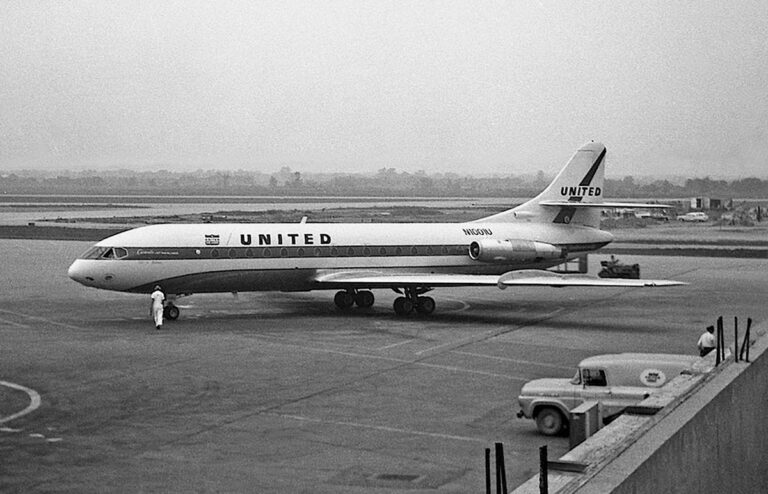
As the 1960 decade dawned, jets appropriate for short ranges did not yet exist. But there was always a “first” for everything, and United Airlines took that distinction when it became the first US carrier to order the first short-haul jet just rolling off of the production line. Added to its gamble was the fact that it did not come from the US, but from France, where it was dubbed ‘la belle Caravelle”—or “the beautiful Caravelle”–by its own engineers.
Design Origins
The aircraft traces its origins to the French Ministry of Civil Aviation’s November 5, 1951 specification for a “moyen courier”—or “medium range”—airliner capable of carrying a 12,000- to 14,000-pound payload at speeds of between 380 and 435 mph on sectors of up to 1,200 miles in length.
The X-210, submitted by then-designated SNCASE, or, simply Sud-Est, most closely conformed to the requirements with three aft-mounted, 6,600-thrust-pound SNECMA Atar turbojets and a 60-passenger capacity.
Progressive iterations resulted in design changes: more powerful Rolls Royce RA.16 Avon engines provided sufficient power so that only two were needed and passenger capacity increased. Designed by Pierre Satre, the resultant and redesignated Sud-Est SE.210 was named “Caravelle” after the small 15th- and 16th-century sailing ships that connected cities by sea—the same role the intended airliner would fill by air.
Design Features
The aircraft essentially established the configuration of most of the small-capacity, short-range twinjets that followed it.
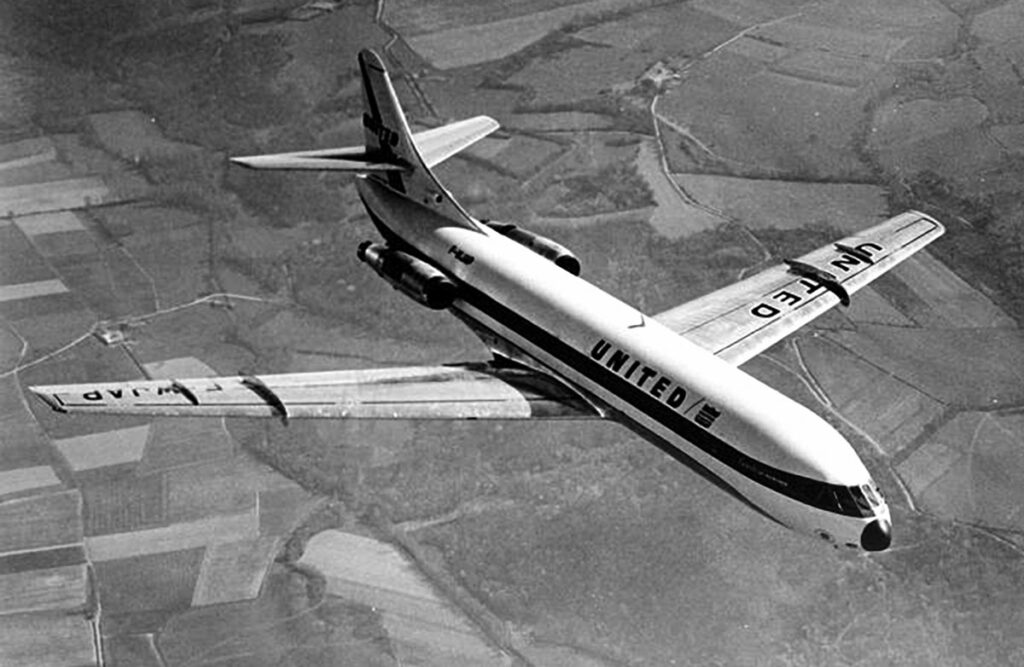
In order to reduce program risk and development costs, it employed the de Havilland Comet’s cockpit and forward fuselage, which was the world’s first commercial jetliner. The wings, at a 20-degree sweep, were joined at the fuselage centerline but were devoid of engine mountings to achieve maximum lift on takeoff and therefore be able to use shorter runways.
Power was provided by two 10,500 thrust-pound Rolls Royce RA.29 Mk 522 Avon engines mounted on either side of the aft fuselage, thus reducing internal noise, and a cruciform tail eliminated exhaust interference from them.
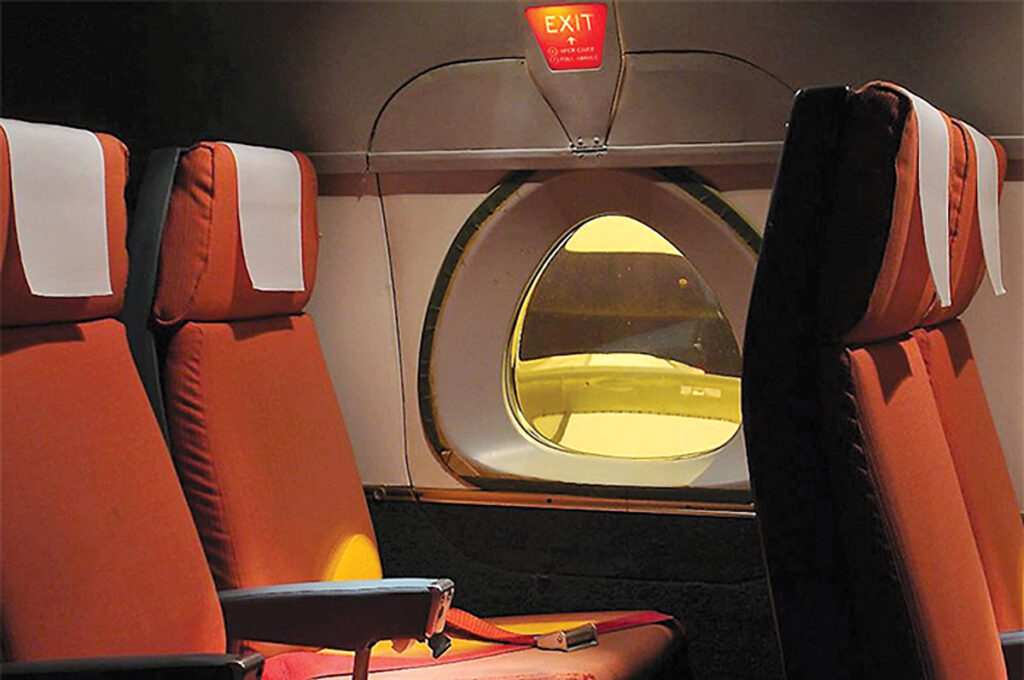
The cabin, equipped with appropriate galleys, lavatories, and garment storage closets, was wide enough for five-abreast seating and had an 80-passenger, single-class capacity. Vision was through fuselage-lined, Caravelle-signature, triangular shaped windows.
The SE.210 I’s prototype first flew on May 27, 1955, and delivery to Air France, its launch customer, occurred four years later, on March 19. It subsequently began service with it on the Paris-Rome-Athens-Istanbul route.
Sparked by an order from Alitalia, the Caravelle III introduced uprated engines, a greater fuel capacity, and higher weights.
Of even greater capability were the Caravelle VIN and VIR versions, the latter of which was ordered by United Airlines.
United’s Caravelle Operations
In order to satisfy passenger demand for jets on both short and long ranges, United made a landmark, $68 million order for 20 Caravelle VIRs in February of 1960, after its engineers traveled to France to experience its flying characteristics.
“Once the public’s appetite had been whetted by the speed, comfort, and outstanding reliability of the new jet airliner, the operators began to sense the pressure to extend such service to all of their route systems, including the shorter-range segments,” advises R. E. G. Davies in Airlines of the United States since 1914 (Smithsonian Institution Press, 1996, p. 517).
What remained to be demonstrated was such an aircraft’s ability to exploit its speed on very short routes and justify its higher operating costs compared to those of the piston airliners like United’s Convair 240s.
Nevertheless, the order was significant in many ways,
- It represented the first short-haul jet purchase by a US carrier.
- It was for a foreign, and not US, design.
- United represented one of the then “Big Four” US carriers, resulting in a major breakthrough for the French manufacturer.
- It was the third time in as many years that United had introduced a jet type to its fleet, the others having entailed the Douglas DC-8 in September of 1959 and the Boeing 720 in January of 1960.
It later emphasized its status by advertising, “United serves the nation with the world’s largest jet fleet and provides jet service to more US business and vacation centers than any other airline.”
Its order for the French twinjet, however, was contingent upon manufacturer Sud-Aviation’s (which Sud-Est had become after its merger with Sud-Ouest), incorporation of numerous modifications. These included higher-capacity, thrust reverser-equipped Rolls Royce Avon 532R (hence the Caravelle “VIR” designation) engines; wing spoilers to immediately transfer the aircraft’s weight from its wings to its wheels after touchdown; a cockpit and windshield redesign to more closely conform to that of its other jet aircraft; new wheels and brakes; larger, but still-triangular-shaped passenger windows; and higher weights.
Its aircraft accommodated 64 in an all-first class, four-abreast arrangement and had a 2,765-pound cargo capacity. They were slated to operate routes of between 200, and 1,000 miles no further west than Omaha, Nebraska, replacing its piston airliners.
Despite the need for ferry flights, they were maintained and overhauled in San Francisco, and their crews were given instruction at the Flight Training Center in Denver.
United took delivery of its first Caravelle VIR, registered N1001U and named “Ville de Toulouse”—or “City of Toulouse” to reflect the location of its production–on June 12, 1961 and it was inaugurated into service the following month on July 14 on the all-important New York-Chicago route. Its importance, in fact, was multifaceted. It was on it that it offered its highest daily frequency. When operations were later mostly transferred from New York-Idlewild to Newark, the type became the first jet to land there ahead of TWA’s 707s and Eastern’s DC-8s. And it offered Red Carpet Service on it. The latter was described as “Cocktail service for first-class passengers on all Red Carpet flights.”
Its eventual, 20-strong fleet of French twinjets carried registrations N1001U through N1020U and all but three entered service in 1961.
By early the following year, it operated 67 daily sectors to 16 cities with the type, roughly divided into three areas of concentration: the northeast (Hartford, Newark, New York-Idlewild, and Pittsburgh), the Midwest (Chicago, Cleveland, Detroit, Des Moines, Milwaukee, Minneapolis/St, Paul, and Omaha), and the south (Atlanta, Birmingham, Jacksonville, Miami, and Tampa).
According to its August 15, 1963 timetable, in which it identified the aircraft with the three-letter “CVL” code, it operated sectors such as Hartford-Milwaukee, New York-Cleveland, Philadelphia-Cleveland, Philadelphia-Chicago, Chicago-Cleveland, and Chicago-Des Moines. A multiple-stop flight entailed a New York-Detroit-Milwaukee-Chicago-Minneapolis routing.
Small-capacity jet economics were not immediately known.
“Initial statistics show that the Caravelle had a total direct operating cost of 152.7 US cents per revenue aircraft mile,” according to the “Untied Caravelles with 227 Changes” article in Key.Aero (June 23, 2021). “The cost per seat-mile of those 64-seaters worked out at 2.40 cents at a load factor a fraction under 60-percent in the first three months of operation. The cost per passenger-mile was 4.02 cents.”
In many ways, the Caravelle’s economics were residual in value.
Passenger acceptance of jet aircraft, first and foremost, was overwhelming due to their speed and comfort, resulting in high load factors, and the draw it provided from competing airlines that still operated piston types.
Pure-jet engine simplicity and lack of propeller-caused vibration reduced downtime and maintenance costs.
And finally, the cost of kerosene that jet engines burned was half that of the high-octane gas that piston ones used.
Service Withdrawal
Although United will be forever credited with introducing pure-jet aircraft on short-haul routes in the US, it did not always view the type as having met its expectations and withdrew the last from service in 1972—or a decade after it had entered it. Nevertheless, its fleet had carried more than 10 million passengers over some 117 million miles.
The operation alerted US aircraft manufacturers of the need for indigenous short-range twinjets, which led to the Douglas DC-9 and the Boeing 737, the latter of which United ultimately ordered.
While most of its Caravelles were subsequently acquired by the likes of Transavia Holland and Sterling Airways of Denmark, one, finally passing into the hands of Airborne Express, was displayed at the New England Air Museum in Windsor Locks, Connecticut, after the carrier had donated it to it.
“(Nevertheless), the Caravelle established the French aircraft industry as a major force in airliner manufacturing,” sums up the “Trendsetter: Sud-Aviation’s Caravelle” article in Key.Aero (September 10, 2020). “It was France’s first turbine-powered production aircraft and the first jet-powered short- to medium-haul airliner. The jet’s strong performance sparked collaboration between its manufacturer and other European aviation industries–first on Concorde and then with Airbus, now one of the two predominant airliner manufacturers in the world.”