
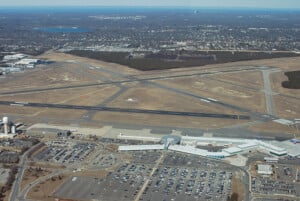



Both Pan American World Airways and it’s famous Terminal 3 at John F. Kennedy International Airport are not around any longer. But what is typical for the aviation community is the fond remembrance of an iconic symbol.
The architects immediately dubbed it “the flying saucer,” but for aviation aficionados and others who indulge in nostalgia for the golden age of jet travel, Terminal 3 of New York’s John F. Kennedy International Airport will always simply be the home of Pan American World Airways.
The terminal’s construction was financed by the airline itself, which baptized it as the “Worldport.” But its nickname “flying saucer” stuck, because of a similarity with the round building’s large, slim, circular roof created to protect the airplanes and their passengers from bad weather.
New York Times aviation reporter Richard Witken best described the design’s function in 1957: “It will eliminate the huddled dash through bad weather by extending the roof like a huge oblong umbrella over the aircraft parking space.”
And it did. Inaugurated in 1960 and designed by the architecture firm Ives, Turano & Gardner Associated Architects and by Walther Prokosch of Tippets-Abbett-McCarthy-Stratton, the terminal reflected a new philosophy of air travel in which planes need to get as physically close to passengers as possible. With its radial form and a roof much wider than its base, which housed the passenger waiting area, Terminal 3 enabled pilots to park the jets directly beneath the roof so that passengers could reach the plane by foot or by uncovered bridges. Just as importantly, the terminal had a panoramic lounge called the Panorama Room where passengers could eat, as well as a museum telling the story of Pan Am.

Pan Am decided to call the building the “Pan Am Worldport” in 1971 when it was enlarged to host the new fleet of Boeing 747s, becoming the largest terminal in the world.
The “flying saucer” did its job for over 50 years, reaching its peak of popularity during Pan Am’s golden age in the 1960s and 70s, when it was widely seen as the most important and innovative airline in the United States. The fortunes of this landmark piece of infrastructure crumbled however in 1991 along with the fortunes of Pan Am itself, which went bankrupt. Delta Airlines scooped up some of Pan Am’s assets, and began to use the “Worldport” as its own terminal. But by then the facility was starting to show its age, and plans for a new terminal started to take shape. Delta started to invest in expanding Terminal 4, which it picked as its headquarters instead of the historic “flying saucer.” The construction of Terminal 4 took several years, and when it was finished, the flight operations in and out of Terminal 3 were moved elsewhere. On May 23rd 2013 at 11:25 PM, flight 268 departed from Gate 6. It was a Boeing 747 leaving for Tel Aviv and – after 52 years of service – was the last flight to take off from Terminal 3 at J.F.K.
The terminal’s demolition did not take place immediately. The infrastructure is considered to be such an important symbol for the New York airport that a “Save the Worldport” movement sprung up to halt its destruction. An online petition to protect it was signed by over 3,000 people. The National Trust for Historic Preservation even went so far in 2013 to include the terminal on its list of “Eleven Most Endangered Historic Places” in the country.
“The old Pan Am Worldport terminal at J.F.K. served this region for more than a half century, but is obsolete for 21st-century aviation purposes. Said a Port Authority spokesman; “Unfortunately, J.F.K. is a land-constrained airport, and the space where Worldport is located cannot be set aside for preservation because it is needed for other aviation uses that will lead to job creation and economic growth.”

The Port Authority spokesman’s words could not be clearer. The old terminal was pulled down in 2014 to make way for an airplane parking lot. The Worldport terminal was not demolished to make way for something else, but as part of a renovation of its neighboring terminals, 4 and 2, which have been fundamental for Delta Airlines in positioning itself as transport leader in the skies.
The curtain fell on Pan Am’s Terminal 3, an infrastructure that along with the vanished airline itself had been symbols of the golden age of aviation across the globe for many years.
In the Jet Age, the world’s most famous architects were designing terminals for John F. Kennedy Airport. Many of these buildings would not have the same luck as the TWA Flight Center, the iconic, landmarked terminal that was to be turned into a hotel after years of preservation activism and support from inside the Port Authority. It may come as surprise that airline companies have control over the fate of historical buildings, but such is the nature of airport architecture, which is perpetually looking forward to accommodate the new trends and demands of jet travel.
Like in the demolitions of Pennsylvania Station and the renovation of Grand Central Terminal, travel must continue undisrupted in any renovation or construction. As a result, for a period of time, new and old often sit by side at airports offering passengers and flight industry members a chance to reflect.