

Harriet Quimby was once described to me by her biographer, Giacinta Bradley Koontz, as “a woman moving forward with purpose.’’ In Koontz’s book, The Harriet Quimby Scrapbook: The Life of America’s First Birdwoman, 1875- 1912, Quimby’s life story is that of a modern woman living in a not-so-modern age “that touched the fringes of the Civil War, the Industrial Revolution, the Ragtime Era, and the new Age of Aviation.”
Born on a Michigan homestead in 1875, Harriet moved to San Francisco in 1888. Though she initially sought a stage career, her sharp writing led her to journalism and a move to New York City in 1903. From 1903 to 1912, Quimby was a world-traveling journalist for Leslie’s Weekly. A lover of speed, she personified feminine independence by driving and repairing her own car, smoking cigarettes, and living on her own
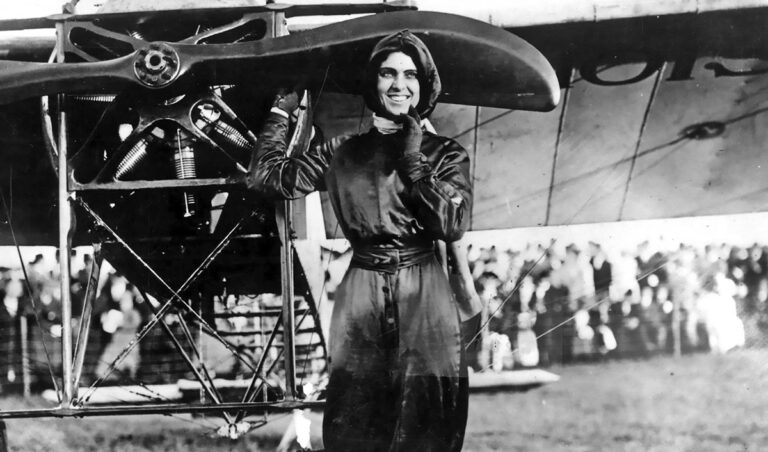
After attending the 1910 Belmont Air Meet, Harriet Quimby began lessons at the Moissant School of Aviation on Long Island in 1911. That August, she became the first American woman to earn an aviator’s license, officiated by the Aero Club of America and certified by the Federation Aeronautique Internationale (FAI).
Harriet soon joined the popular exhibition flying circuit, bringing glamour to the male-dominated field in her custom-designed plum satin flight suit.
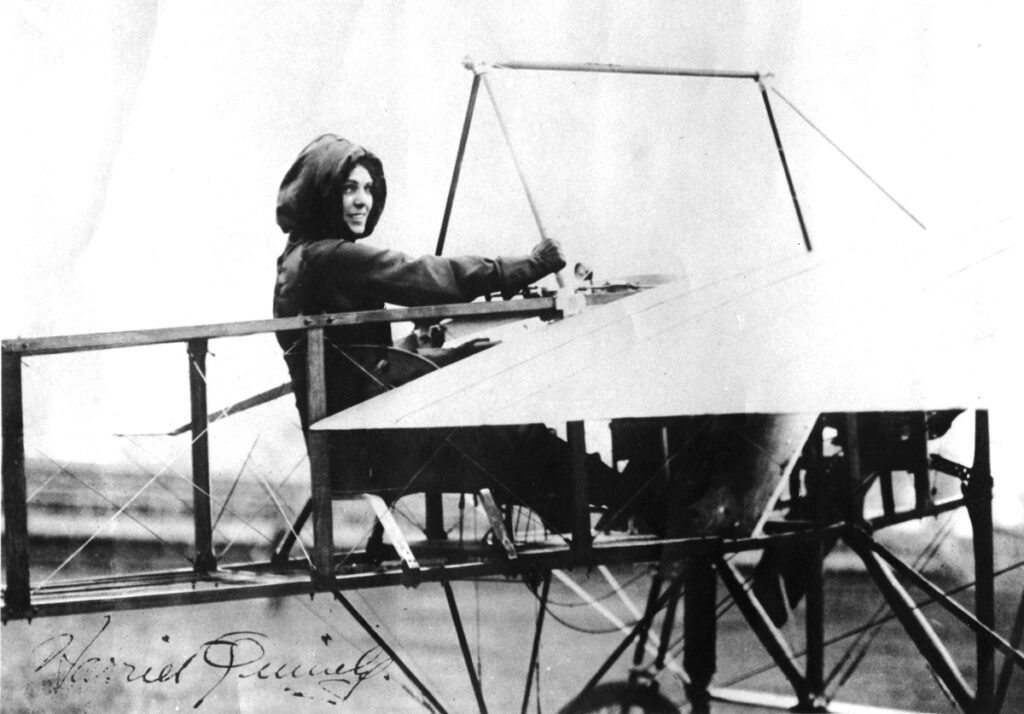
In 1912, while still a journalist, she became the first woman to fly across the English Channel in a Bleriot XI monoplane. Later that year, during a publicity flight for the Boston Aviation Meet, with her manager as a passenger, hundreds of spectators watched in horror as Harriet and her passenger fell to their deaths when the aircraft suddenly pitched forward. The ongoing speculation as to the cause of the aircraft’s malfunction spawned the development of safety devices for pilots and several parachute patents. Just prior to her untimely death at age 37, Harriet wrote in her article for Good Housekeeping, ‘’There is no reason why the aeroplane should not open up a fruitful occupation for women. I see no reason they cannot realize handsome incomes.”
Reflecting upon Harriet’s legacy, she left behind a vision of courage, glamour, and intelligence. With a pen and camera, she provided an intimate view of life at the turn of the century—a ‘person’ in a society defined by the binary of ‘man’ and ‘woman.’ She remains a timeless role model who redefined her destiny, serving as a metaphor for the American Dream and the limitless potential she realized throughout her life.
While Quimby’s place in history as a pioneering aviator is most notable, the many stories of her predecessors, contemporaries, and successors involved in various aviation interests have largely gone unnoticed. Yet, women have been essential to every era of aviation history, from the first balloons to fixed-wing aircraft, helicopters, and jets, to the Space Shuttle and beyond.
It is a pursuit that continues today, with the expanding technology of air travel and future careers for women in aviation. Such is the case of the women who grace the cover of this month’s Metropolitan Airport News – all who are women moving forward with purpose.