


Newark Metropolitan Airport was the first major commercial airport in operation in the United States. Its development began in 1928, and in the first years of its existence, one-third of the world’s air traffic ran down its runways.
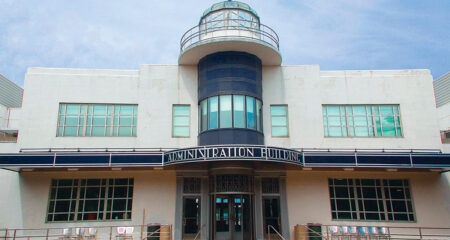
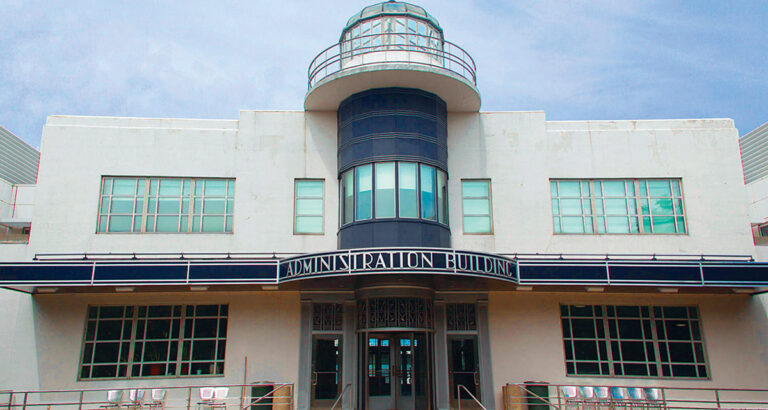
With an innovative legacy spanning nine decades, Administration Building 1 (formerly Building 51) was at the center of Newark Airport, where many firsts took place. The building, originally dedicated in 1935 by Amelia Earhart, served as the nation’s first passenger terminal. It housed the first air traffic control tower and the first weather bureau. Newark was also the first to have a paved runway and runway lighting.
In 1934, a $700,000 permanent administration building was commissioned through the Federal Civil Works Administration. Designed by John Homlish, the glass-and-steel Art Deco structure featured a geometric interior inspired by the theme of flight. The main entrance featured a two-story, three-bay central block with angled wings. Its facade consisted of alternating horizontal bands of smooth concrete, windows, and orange brick spandrels. Ground-floor public areas featured highly polished marble walls and aluminum stair rails. Aluminum birds on decorative grillwork above the boarding doors continued the flight theme, while fluted milk glass fixtures lit the ceilings.
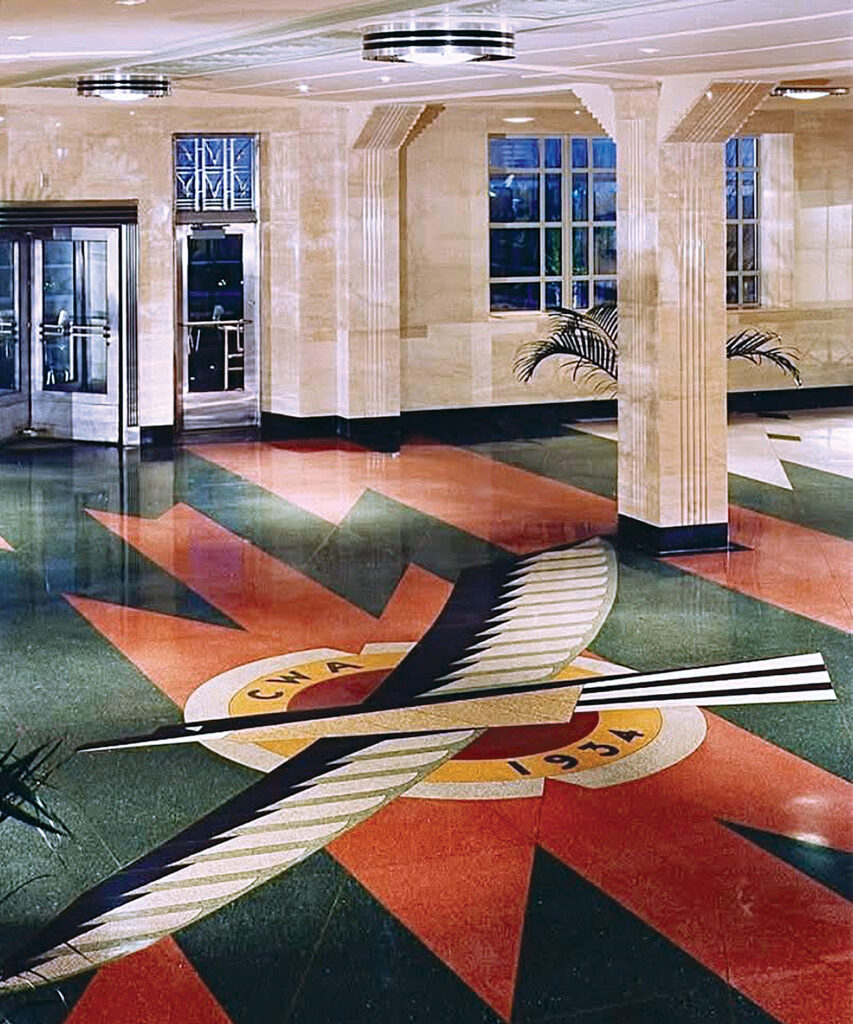
The main central concourse provided access to interior corridors on either end, which led to three small waiting areas. Passenger access doors led to the field from the concourse and from each of the six waiting rooms. The ground floor contained loading rooms where mail was prepared for air transport. This section was divided into office and mail destination stations. The main floor also contained space for commercial airline ticket counters, the airport physician, and the State Aviation Commission.
The second-floor concourse featured offices and bedrooms in opposing wings. One side of the lobby housed the manager’s office, a lounge, and a restaurant space, all adorned with a massive Arshile Gorky mural, while the other side offered open-air terraces overlooking the airfield. The rooftop held a control tower and a glass-walled room accessible via a spiral staircase.
Until 1939, Newark was the world’s busiest airport, until the opening of LaGuardia (Municipal) Airport at North Beach. In 1942, Newark Metropolitan Airport was used for military purposes. In 1948, the Port Authority assumed administration and launched a major expansion program and land acquisition. Viewed as too small for continued operations, the Administration Building was replaced and fell into disuse.
In 1999, the firm Beyer Blinder Belle was hired to repurpose the historic building and prevent its demolition. When a runway extension forced the Port Authority to relocate the structure, the firm utilized the move to restore, expand, and adapt it for modern use.
In 2000-2001, Administration Building 1 was separated into three sections, lifted by hydraulic jacks, placed atop dollies, and moved about three-quarters of a mile to its present location at the airport, where it houses the Port Authority Police Department, airport administration offices, an operations center, and aircraft rescue and firefighting equipment.
Though nearly ‘hidden in plain sight’, it is a sterling example of preserved Art Deco architecture.