


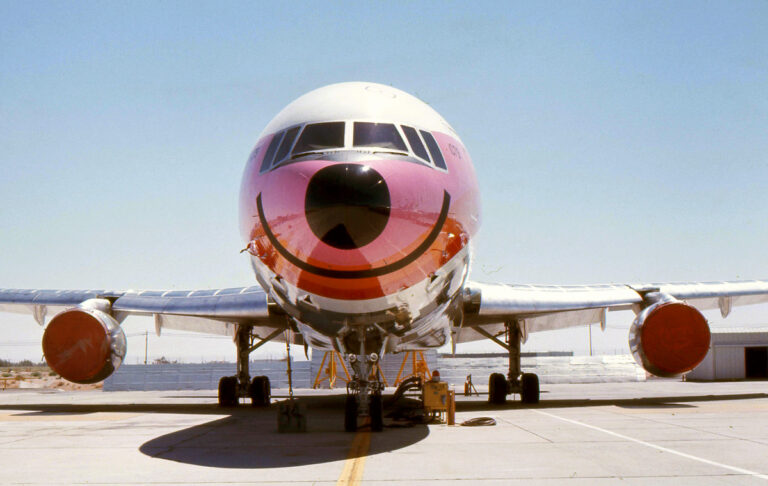
A smile, it is often said, goes a long way. For one airline in California, that way eventually led to eight states and Mexico across the border, enabling it to carry a record of almost 11 million annual passengers in the process. The airline was PSA Pacific Southwest.
From School to Airline
The catalyst to what ultimately became a 39-year journey was Kenneth G. Friedkin, who established the School of Aeronautics at San Diego’s Lindbergh Field in 1945 for the purpose of training ex-servicemen. But when demand waned after a five-year period, he decided to give himself the wings he had given to his students and create an airline.
Because of their size, California, along with Texas, exerted far greater authority on such matters than other states, giving rise to Friedkin’s Pacific Southwest Airlines, or PSA, the same way Texas-based Southwest was made possible. But both were restricted to intra-state service.
Initial operations entailed a weekly frequency between San Diego and Oakland with a leased, 31-seat DC-3 on May 6, 1949. He soon acquired a second aircraft, and by the end of the year, carried just over 15,000 passengers and made a net profit of $11,984 on operating revenues of $172,796.
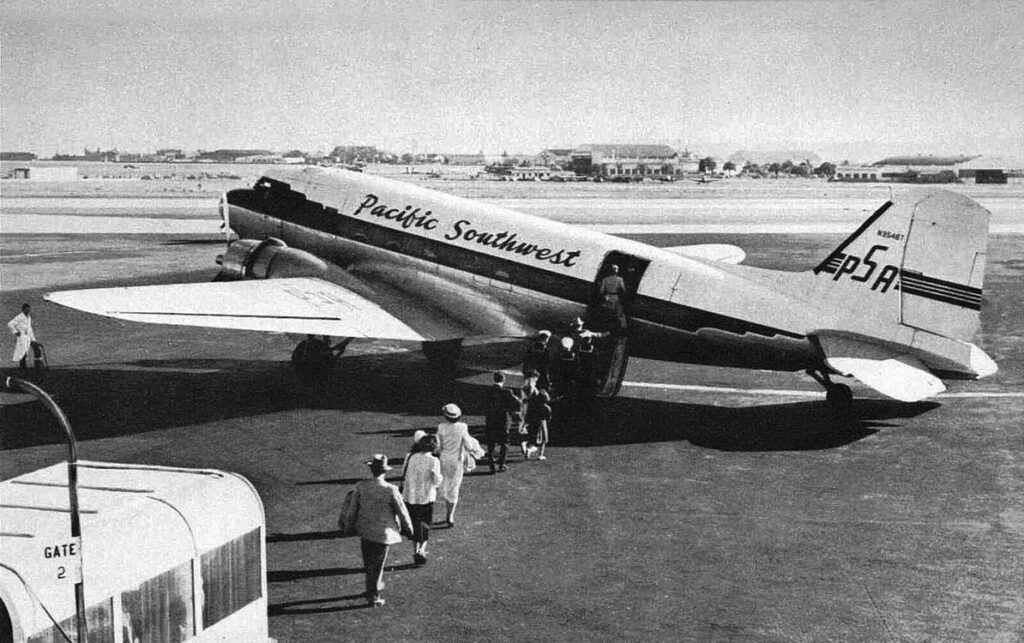
“It all started 20 years ago with determination and a sense of humor, when the management of a once very profitable San Diego flight training school decided to form an airline,” Skylines, PSA’s employee publication, described its beginning in its August 1969 issue.
Without tax or mail subsidies, its initial success was seen as doubtful. “Instead, PSA gambled on the old American theory of sound management and good business practices and made it work,” Skylines further explains. Its early operation was hardly prestigious.
“We had no facilities. We checked people in through the lobby of our old flying school and bought a set of bathroom scales to weigh the baggage,” J. Floyd Andrews, who assumed the presidency position in 1963, once shared.
Passengers quickly disregarded the lack of sophistication when it was exchanged for the lower fares it made possible—in this case, $10.00 versus the standard $25.00 ones.
Because of them, and because its San Diego base offered close proximity to Navy installations, it attracted throngs of servicemen, quickly earning the nickname of “Poor Sailor’s Airline.”
While its ability to offer such fares certainly resulted in “big boy battles” with the likes of United, Western, and short-lived California Central Airlines, it saw them as an incentive to convert surface, road and rail travelers into aerial ones.
Although the strategy ultimately proved sound, its lower revenues could only be counteracted with multiple-function employee productivity. Pilots flew the airplanes, but also loaded baggage onto them.
It totted its service with an “Insist on the best: Fly Pacific Southwest” slogan on the cover of its first timetable. On another, it displayed a DC-3 and enticed, “Fly the route of the padres.”
Expansion was cautious. In 1951, its tri-city route system, encompassing the “California Corridor,” gained an additional point with a San Francisco-San Diego connection. The following year, it operated a quartet of DC-3s. And in 1953, it touched down in Long Beach, the year it billed itself as “The world’s friendliest airline.”
Larger Equipment
Demand, soon exceeding capacity, necessitated the acquisition of two larger, 70-seat, former Capital Airlines DC-4s in November of 1955. The following year, it purchased a third. It introduced themed flights and cocktails aloft. And by 1958, with four DC-4s in its fleet, it inaugurated service to Los Angeles, carrying 296,000 passengers that year.
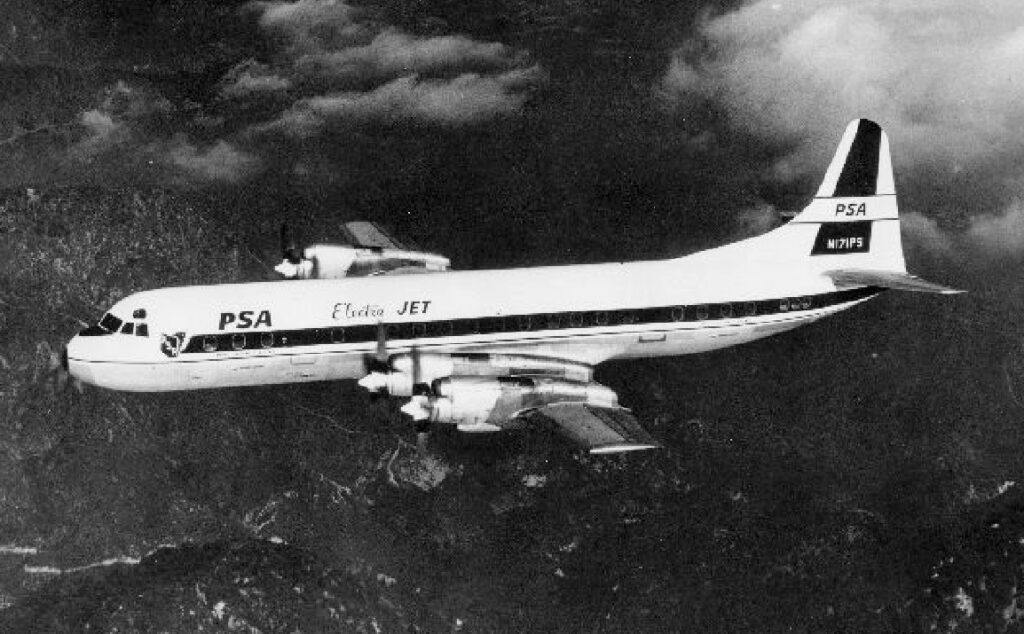
But its most major milestone was reached the following year when it introduced the speed, power, and prestige of the Lockheed L-188C Electra turboprop, advertising “PSA Electra Jets” on the covers of its timetables.
Crewed by five and accommodating six in a forward lounge and 92 in standard seats, the first L-188C was inaugurated into service on December 11, 1959, operating the San-Diego-Burbank-San Francisco, San Diego-Los Angeles-San Francisco, and San Diego-San Francisco sectors, offering significantly higher speeds than its competitors’ piston airliners. It subsequently acquired two additional ones.
Despite its battle with the incumbent carriers, its low fares, coupled with high frequencies, reigned supreme, prompting it to advertise, “First class care at a reasonable fare.”
The Civil Aeronautics Board (CAB) designated PSA “the most efficient carrier in the country.” In 1962, it achieved the one million annual passenger mark for the first time.
The Jet Era
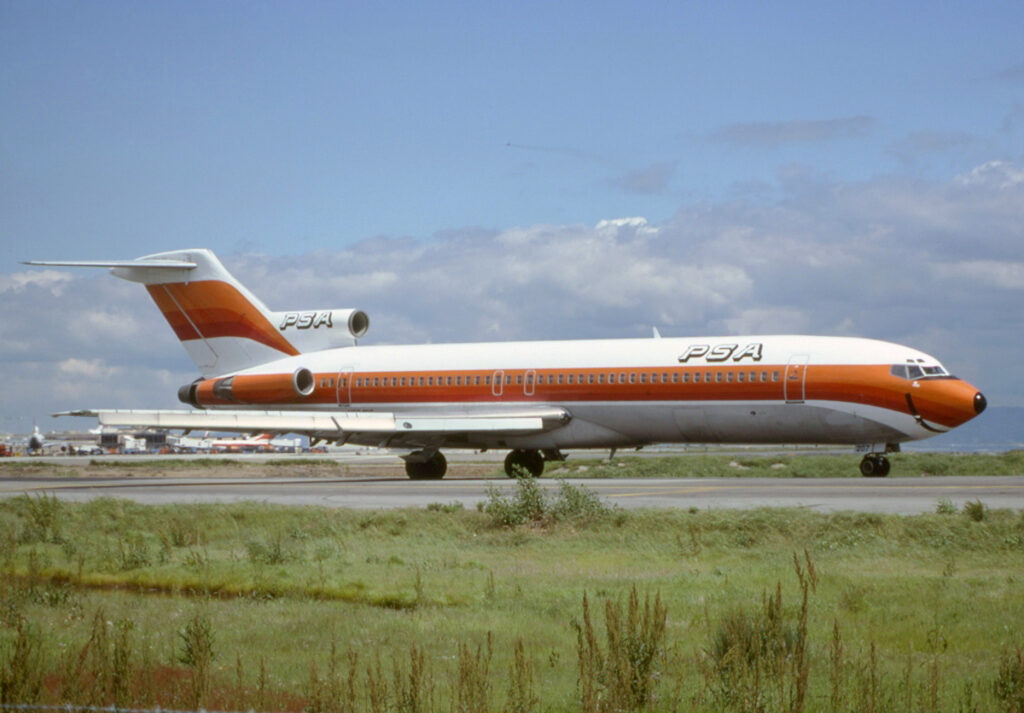
Although PSA offered considerably higher speeds with its turboprop Electras, it crossed the pure-jet line when it inaugurated Boeing 727-100 service between Los Angeles and San Jose on April 9, 1965, charging $12.00 fares, or half those of the larger carriers. It emphasized its modern fleet by advertising in its June 4 timetable that year, “727 Fan Jets and Super Electra Jets.”
Its route system continued to expand, and by 1967, it operated to Hollywood-Burbank, Los Angeles, Oakland, Sacramento, San Diego, San Francisco, and San Jose. It also continued to add to its narrowbody fleet.
“Last July (1966), PSA announced an order for the purchase of nine Boeing jets, plus two on option, for a total package cost of $53 million,” it reported in the July 1967 issue of Skylines. “The Boeing 737 purchase today was exercised under this contract.
“The $53 million order assures PSA of receiving seven 727-200 series jets and four 737-200 aircraft. The 727-200 will seat 158 passengers, compared to the 122-seat 727-100s presently operated by the carrier. The smaller 737 will seat 106 passengers.”
First deliveries of the stretched 727 tri-jets and twin-engine 737s were then respectively scheduled for January and August of 1968.
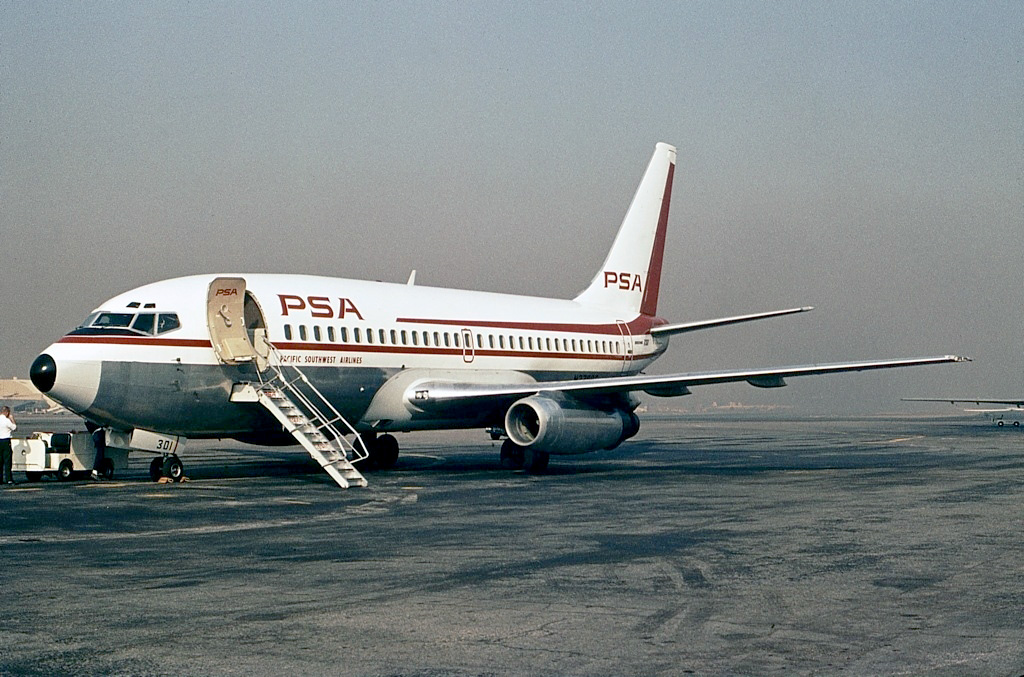
The 727-100’s speed, comfort, and large-carrier appeal were directly responsible for PSA’s dramatic growth, resulting in an annual passenger total jump from 1,500,000 in 1964 to 3,346,484 in 1967, thus prompting the additional jet orders.
“Long-range planning is necessary in order to meet the needs of California’s rapidly expanding air travel market with the most modern and up-to-date equipment available,” J. Floyd Andrews commented on the occasion.
Widebody Experiment
In order to meet demand on key California Corridor routes, yet avoid the impossible struggle to obtain the necessary gate facilities to cater to it with two simultaneous 727-200 departures, PSA placed a $75 million, two-firm and three-optioned Lockheed L-1011 TriStar order, citing its ability to accommodate double the number of passengers, maintain boarding speed with its double-width doors and twin aisles, and exert a ramp footprint only marginally larger than that created by its narrowbody types.
“The high takeoff performance and quick climb out of the L-1011 will make it possible for this 300-passenger aircraft to operate from the same satellite airports now served by PSA’s present-day jets,” Andrews stated in the “TriStars to Give You a Lift” article in the October 1970 issue of Skylines.
Main deck, twin-aisle accommodation entailed 281 passengers, while 16 saleable, lower-deck lounge seats brought capacity to 297.
“With its widebody comfort, intermediate airport capability, all-weather operation, capacity, quick turnaround ability, and low operating costs, the TriStar offers maximum passenger appeal,” Andrews later stated in the “Getting Ready for the Big Birds” article in the October 1973 issue of Skylines. “It was precisely these points that prompted us to select the TriStar for our high-density, short-haul California routes.”
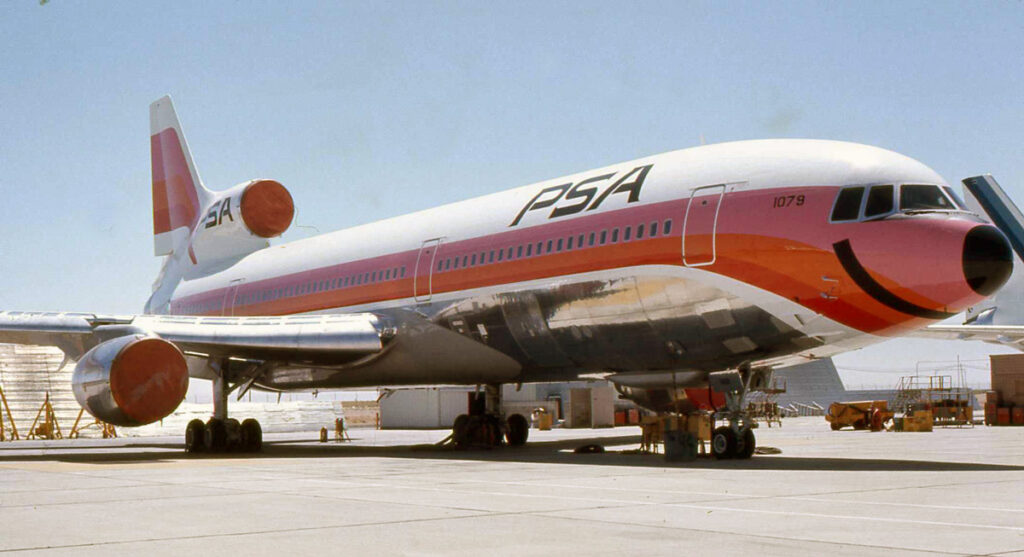
Although it inaugurated the type into service on the San Diego-Los Angeles-San Francisco route on August 1, 1974, and the “Mother Griningbird” was certainly instrumental in PSA’s ability to carry more passengers from Los Angeles than any other carrier, rising fuel costs and reduced demand transformed its early Airbus operation into a failed experiment.
Nevertheless, its 11-city route system encompassed Fresno, Hollywood-Burbank, Long Beach, Los Angeles, Oakland, Ontario, Sacramento, San Diego, San Francisco, San Jose, and Stockton at the time.
The balance of the decade was characterized by additions to these cities, the first of which, South Lake Tahoe, constituted its first interstate one after the California Public Utilities Commission granted it authority to serve it in December of 1977.
Additions continued: Monterrey, Las Vegas, Reno, Phoenix, and Salt Lake City. So, too, did frequencies. In fact, PSA offered 1,158 weekly flights connecting eight California metropolitan areas, with hourly service between Los Angeles and San Francisco and Los Angeles and San Diego in each direction.
“PSA has always attempted to provide flights designed to make it easier on the passenger,” Andrews stated in the July 1969 issue of Skylines. “With our new hourly flights, most of our passengers don’t really need a schedule. If they miss one flight, there is another coming along in 60 minutes.”
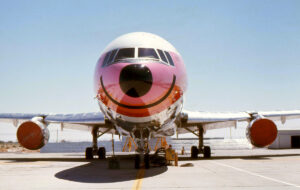
Aside from these changes, the carrier introduced one of its most visually characteristic aspects—the smile-suggesting line under the nose of each of its aircraft.
“There’s a new look in the skies over California lately, and it has people smiling,” the July 1974 issue of Skylines reported. “The reaction has been catalytic, as these smiles have proven to be extremely contagious. The smiles, simply black lines painted under the noses of PSA’s ten 737s and 18 727s, seem to transpose a huge jetliner into something real and friendly. It’s almost as if the planes were happy.”
“We’re happy to put across the idea that PSA is an airline of people and our airplanes are an extension of these people,” Andrews commented. “PSA is a feeling. PSA’s history is based on a fun-loving approach to life.”
Its mid-1970s timetables, not surprisingly, that recommended “Catch our smile” and “California is all smiles.”
“With its low fares and friendly service and distinctive orange, red, and white planes, complete with a beaming smile, PSA was immediately recognizable to those living on the West Coast,” according to the San Diego Air and Space Museum.
The element extended PSA’s “new look” concept, which entailed its fuchsia, orange, red, and white aircraft paint scheme; widebody interior features; and flight and ground crew uniforms.
It ended the decade with a 15-strong route system encompassing four states.
Not All Smiles
Not all was a smile. Although it weathered a 52-day pilot’s strike represented by the Southwest Flight Crew Association, the impact caused by the PATCO Professional Air Traffic Controllers Organization strike, and competition from the likes of Air California (later AirCal) and Pacific Express Airlines, PSA’s darkest day occurred on September 25, 1978.
While one of its 727-200s, registered N533PS, was conducting its visual approach to Runway 27 at Lindbergh Field, it collided with Cessna 172 N7711G of the Gibbs Flite Center three nautical miles from the airport at a 2,600-foot altitude, killing the 137 on both aircraft and an additional seven on the ground.
“The National Transportation Safety Board,” according to the final report, “determines that the probable cause of the accident was the failure of the flight crew of Flight 182 to comply with the provisions of a maintain-visual-separation clearance, including the requirement to inform the controller when they no longer had the other aircraft in sight.”
The Last Eight Years of Success
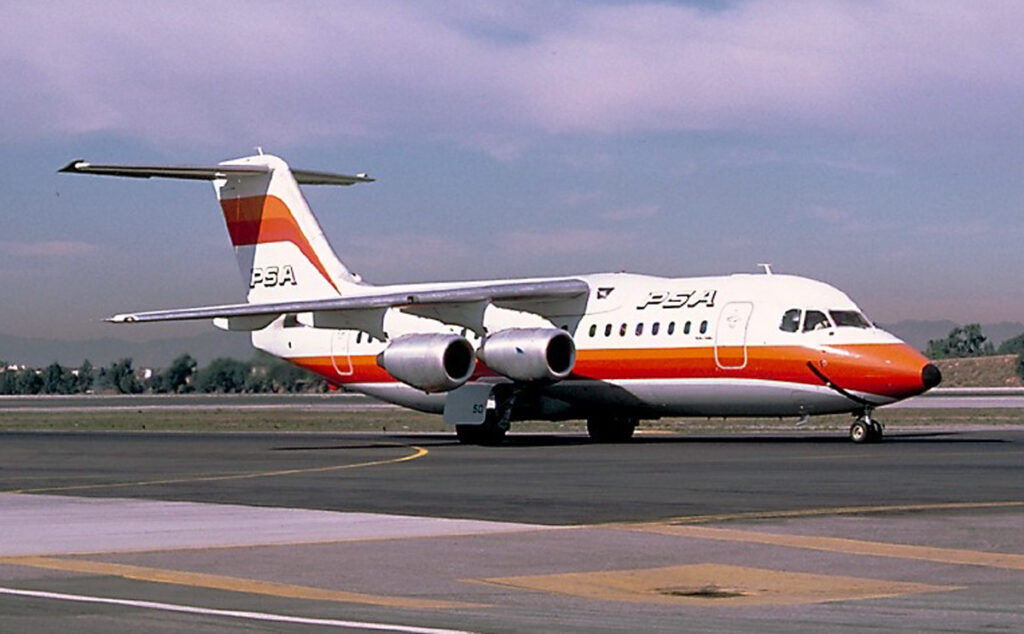
PSA’s successful journey continued into the 1980s. It ordered a dozen quieter, more fuel-efficient, twin-engine MD-80s to replace its remaining 727 trijets. It expanded into the Pacific Northwest, touching down in Portland, Spokane, Pasco, Yakima, Medford, Eugene, and Boise, for which it placed a 20-firm and 25-optioned order for high-wing British Aerospace BAe-146-200 “Smiliners,” then the manufacturer’s largest single purchase of its regional jet.
Ideal for low-density routes, operation from noise-sensitive airports like Burbank and Orange County, and direct city pair service, the type offered 37-percent lower trip-mile costs than even its MD-80s after eight were delivered in 1984 and the remaining 12 were handed over in 1985.
Its first, registered N346PS, was inaugurated into service between Burbank and Oakland on June 20, 1984.
PSA eventually operated 325 daily flights to 19 cities in California, Oregon, Washington, Nevada, Arizona, and New Mexico with the type.
It advertised its new aircraft by saying, “PSA: Leading the Way with the New Super 80” and “The BAe-146: Introducing our new Smiliner.”
PSA was smiling from ear to ear. It was designated the Official Airline of Disneyland, offered seat assignments for the first time, served inflight meals, expanded its Executive Flyer Program, and carried a record 10.7 million passengers in 1986.
But the mid-decade period proved a time when carriers ascribed to the Darwinian philosophy of “survival of the fittest,” and they sought to do so by growing through mergers: Northwest acquired Republic, Delta acquired Western, American acquired AirCal, and USAir acquired PSA, which temporarily became its division as of May 29, 1987.
“It soon became apparent that the trend of airlines merging and increased competition might be too much for PSA to overcome,” according to the San Diego Air and Space Museum. “The era when airlines could offer low-cost fares and still provide friendly service had come and gone.”
On the cover of its September 9, 1987, timetable, it confirmed the acquisition. “Now our smile is even wider—USAir,” it said.
But when the last PSA flight from San Diego to Las Vegas landed on April 8 of the following year and shut down its engines for the last time, there may have been more than a few passenger and employee frowns.
Retrospective
“Pacific Southwest Airlines was more than just an airline,” Kevin Trinkle concludes on “The PSA History Page” website. “It was a family—an innovator whose success was one of the primary motivations to deregulate the airline industry in 1978. (It was) a leader in the industry, an integral part of the Golden State, (and) a way of life for residents, as well as employees. Best known for smiles on airplanes and stewardesses in hot pants, (it) graced California skies for 39 years before being merged into USAir.”