



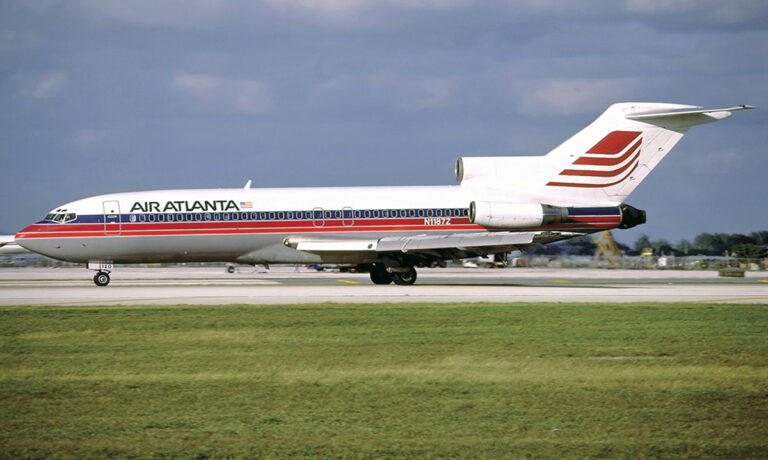
Deregulation offered entrepreneurs opportunities to craft their own versions of airlines, which varied in concept, fare structure, and destination, and passengers the opportunities to choose new, major carrier-challenging ones. Because of their tenuous natures, the battle between them and the established ones was often a David versus Goliath one, and successes were only temporary, if at all. Air Atlanta fits into this category.
“Air Atlanta was an anomaly in the airline industry,” according to Tiffany Hart in her “Gone, but not Forgotten: Air Atlanta” article (Atlanta History Center, September 28, 2023). “It was a low-cost carrier that ferried passengers in its distinctive gray, blue, and burgundy Boeing 727s to major destinations, such as Miami, Tampa, Orlando, and Washington.”
Salmon return to their birthplaces to spawn. Many entrepreneurs do the same to give birth to their airlines. In the case of Air Atlanta, it was Michael R. Hollis drawn back to its namesake city. Born and raised there and living by the “can do” philosophy that he changed to “will do,” he practiced law in that very city before joining Oppenheimer and Company and moving away. But he researched the airline scene and ultimately concluded that there was “a hell of an opportunity” back there for a new one, and “back there” is where he went.
An international crossroads and the US’s largest airport in terms of passengers processed, it was ripe for a new concept that catered to business clientele.
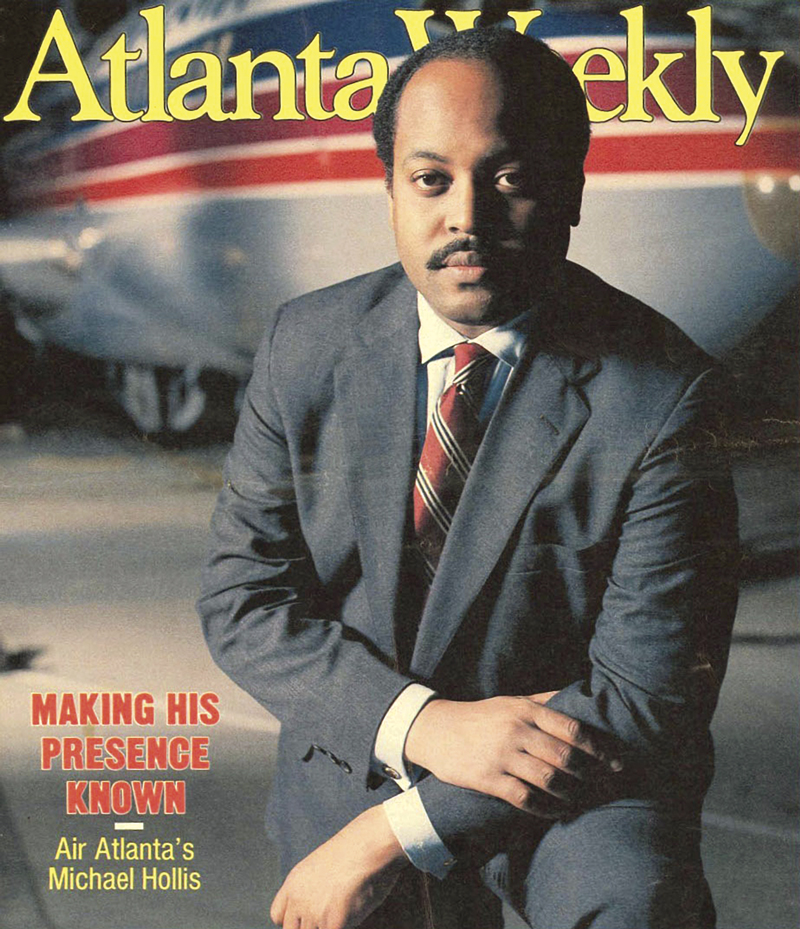
“For years, the business flyer has been the airlines’ best customer,” according to the carrier. “But airline service has been geared to the masses. Air Atlanta doesn’t cater to the crowds. We cater to business. Because we’re specialized, we can fly when it’s convenient for you. Starting with schedules designed for the business day. And including times that let you sleep late and still make your meeting.”
Although he had no airline experience and a personal bank account that topped out at $500, he was never known for just “talking the talk.” While he had a plan in one hand, it served no purpose without funding in the other. And toward that end, the origins of his funding were nothing less than a family affair. Both his mother and godmother threw $35,000 into the pot—their life savings—and other relatives filled it to the $100,000 brim.
Hardly enough to cover the cost of a single airplane, it became the seed that sprouted into a significant harvest when he used his high-profile connections as branches—in this case, the National Alliance of Postal and Federal Employees (NAPFE), which acquired 400,000 shares for $500,000. It certainly constituted a firmer beginning.
But an airline also required experienced people and the fledgling carrier attracted some heavyweights who provided exactly that—Roden Brandt, former Service Vice President for Pan Am; Robin H. H. Wilson of TWA; and James Purcell of the FAA. They not only established its foundational experience, they also elevated its image before it even took flight and attracted additional investors.
Air Atlanta, with Hollis as its founder, chairman, and CEO, was incorporated in May of 1981. Promise was high. President Ronald Regan praised it as a beacon of free enterprise, and Atlanta Mayor Maynard Jackson endorsed it as the city’s carrier.
Taking Flight
Provisioned with five leased 727-100s, 420 employees, and a route system that was a shadow of that of the major carriers, it advertised its inaugural, February 1, 1984, service in the January 30, 1984 issue of the Atlanta Constitution.
“Air Atlanta’s first flight is at 7:45 a.m., Wednesday, to Memphis, Tennessee,” it said. “A half-hour before the flight, Mayor Andrew Young will hold a ribbon-cutting ceremony at Hartsfield International Airport. The first jet airline to be founded in Atlanta this decade, the business-oriented carrier is initiating service to Memphis and New York’s JFK Airport with specially reconfigured Boeing 727-100s. A first-class round-trip fare to Memphis is $344, and a round-trip coach ticket is $286.”
While carrier commonality entails air transportation between two points, how they do so becomes the variation, and Air Atlanta put many pieces into place to do so differently.
In Atlanta, a curbside security checkpoint and a “GateExpress” bus enabled passengers to bypass airport congestion and be transported directly to the aircraft only minutes before its departure. For those wishing to make their way through the labyrinth of concourses, a waiting area at the gate more suggestive of a lounge, with beverages and newspapers, was available. From there, the industry’s first roll-on garment bag valet freed them of the burden and was secured in a forward, left position on the aircraft.
Its five leased, former United Airlines 727-100s, with subdued interior color schemes, accommodated 20 four-abreast first and 68 five-abreast coach class passengers, or an 88 total that was a third less than the aircraft’s certified single-class maximum.
“Air Atlanta flies the jet that business travelers told us they prefer for trips of two hours or less: the reliable Boeing 727,” the carrier advertised. “Familiar on the outside, but on the inside it’s a whole different plane. We’ve completely redesigned it to add substantially more space for carry-on baggage, including a roll-on valet. We put only 88 seats on board. That’s 20 percent less than most airlines squeeze in. And that’s a lot more legroom and more comfort.”
Dining was always on formally set tray tables with white linens, china, and crystal stemware. Selections, according to the time of day, were more reflective of those served by a five-star restaurant, including peach crepes dusted with cinnamon; broccoli, mushroom, and cheddar cheese pastry cups; duck a l’orange; creole chicken with almond-pineapple rice; veal chanterelle; and French petite fours.
“From the moment I founded Air Atlanta, it has been dedicated to the standards of experience, commitment, and excellence,” according to Hollis. “Our success results from the dedication of our many professionals who know that the business traveler wants a better type of service. We at Air Atlanta make a commitment to make business travel a positive experience, to bring service back in vogue and to do so at competitive fares.”
By the summer of 1984, it served the four east coast destinations of Atlanta, Memphis, Miami, and New York-JFK, with four to five daily frequencies to each. Operating from the Pan Am Worldport at the latter one, it served as “Air Atlanta Pan Am Express,” feeding passengers to the larger carrier’s flights. “One ticket. One check-in. One baggage claim,” it stated. “From Atlanta to Memphis to more than 45 cities worldwide.”
Although its handful of David-comparable flights posed little threat to the Delta and Eastern Goliaths at their fortress Georgia hub, they initially engaged in a Cold War with it, refusing to list its flights in their computer reservation systems (CRS) and interning with it. Delta was particularly resentful of a carrier that bore the name of, and received political endorsement to be, the city’s namesake one since Delta itself touted itself as its “hometown airline.”
Its aircraft climbed much faster than did its load factors, which began at a paltry 32.2 percent, but rose to 44 percent. By December of 1984, it was losing about $800,000 per month, despite passenger accolades. Nevertheless, it made progress.
Of the 114 requests for the 25 available slots at La Guardia, the preferred New York airport because of its Manhattan proximity, it won four. By December 1, 1986, it served the 11 Northeast, Midwest, and southeast destinations of Detroit, Ft. Myers, Greenbrier/Lewisburg, Memphis, Miami, New Orleans, New York, Orlando, Philadelphia, Tampa, and Washington with more than 30 daily departures from its Georgia flight base. And the Delta-Eastern relationship thawed: Air Atlanta finally achieved a listing in their CRS. But the financial picture told a different story.
Turbulent Terminus
An airline concept can only be sound if its revenues exceed its expenses. Air Atlanta’s did not, and only continued investments, along with Hollis’ faith, kept it in the air—at least for the time being. But an article in Business Week illustrated the carrier’s reality.
“In the 21 months since Hollis launched Air Atlanta, the privately-held company has been unsuccessful, wooing business travelers with a mix of roomy seats, fancy meals, and free booze at airport waiting areas,” Business Week pointed out in its November 18, 1985 article, “Air Atlanta is Scratching Just to Pay the Rent.” “The formula hasn’t worked. Losses are at $35 million—and climbing.”
Desperate and unable for a time to even pay its rent at Hartsfield International Airport, it searched for a buyer, with the greatest prospect offered by Kimberly-Clark Corporation, which already owned Midwest Express Airlines. It would have given it air service divisions with both midwestern and southeastern hubs. But talks stalled, as did the airline, and this forced it into a final, Chapter 11 bankruptcy landing on April 2, 1987, or little more than three years after it had taken off. Although it could hardly be credited with financial success, there are other measures of this achievement.
“The story of Air Atlanta is a testament to the tenacity of the human spirit,” according to Tiffany Hart (op. cit.). “As Vice President of Properties at the Atlanta History Center Jackson McQuigg pointed out, Air Atlanta faced impossible odds in the deregulated era. Its existence and brief success in such a competitive space is remarkable.”
Nevertheless, in the end, David failed to win the battle with the airline Goliaths.