


“Aloha, the Hawaiian greeting of “hello” and, by little stretch of the imagination, “welcome,” became the name of the state’s second major airline because its founder realized that not everyone was. He was once one of them.
The People’s Airline
That founder, Ruddy F. Tongg, Sr., an Asian-American and Honolulu publisher, was once refused boarding on a flight to the U.S. mainland because of his ethnicity, and the event became the catalyst for a Hawaiian carrier that would both employ and transport non-Caucasians. It would, for the first time, offer competition to Inter-Island Airlines, a subsidiary of the Inter-Island Steam Navigation Company, which would later be renamed Hawaiian Airlines.
Initially operating a pair of war-surplus Douglas C-47s converted to DC-3 passenger standard and initially operating on a charter basis, TPA Trans-Pacific Airlines dispatched its first flight from Rodgers Field, Honolulu’s original airport that equally sported its World War II roots with its Navy-built Quonset huts, on July 26, 1946.
From that branch of service came the two pilots who took the aircraft to the air, Al Olson and Louis Lucas. “It was an Aloha Friday, back in the days when that meant something special in the Islands,” according to the account in “A Proud History: The Story of Aloha Airlines.” “As the morning sun warmed the air hanging limply over Ke’ehi Lagoon, the freshly painted DC-3 taxied to the end of Runway 4-Right at John Rodgers Field.”
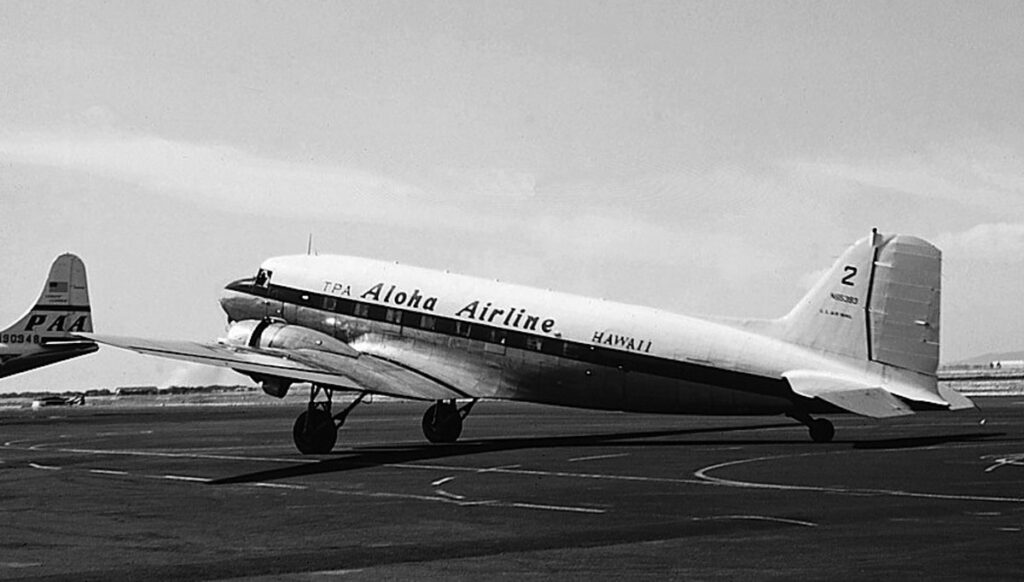
Take-off clearance was granted by the Aloha Tower, then the tallest building in all of the Hawaiian Islands.“…The plane turned into the wind and gunned its twin Pratt and Whitney engines,” the account continues. “The throaty roar scattered the snowy-white terns…foraging by the runway and echoed across the Ke’ehi Lagoon toward Diamond Head….”
Founded for and by Islanders and therefore embodying the very concept of inclusion, it quickly became known as “The People’s Airline,” avoiding all types of exclusivity. Roy Umaki became its first Asian-American pilot.
Opening its arms to everyone, TPA served as the aerial passenger and cargo link between Oahu, Maui, and the Big Island of Hawaii, eliminating the need for the longer journey by sea. Three years later, it achieved scheduled-airline status, and the first post-war seed to tourism expansion was symbolized by the opening of Honolulu International Airport, which replaced Rodgers Field.
“After the end of World War II, Hawaiian lost its monopoly on air transport in Hawaii,” according to R. E. G. Davies in Airlines of the United States Since 1914 (Smithsonian Institution Press, 1998, p. 316). “On June 9, 1946, Trans-Pacific Airlines was incorporated under the Law of the Territory, and non-scheduled services were started on July 26. Progress to full scheduled-airline status took almost exactly three years…”
It initially made significant inroads into the once monopolistic Inter-Island. Serving Honolulu, Molokai, Maui, Upolu, Kona, Hilo, and Kauai by the summer of 1950, it operated 22 daily flights. Two years later, having since been approved for the carriage of mail, it transported 175,000 annual passengers, a 26-percent increase over the year-earlier period, and turned its first profit of $36,000.
Now dubbed “TPA—The People’s Airline,” it uniquely satisfied the senses in flight- sweet pineapple juice for the taste, ukulele playing for the sound, and hula dancing for the sight- courtesy of its flight attendant “entertainers.” It advertised its 28-passenger DC-3s as “Alohaliners,” and their elongated windows offered panoramic views of the islands.
Fleet Upgrades
Unable to adequately compete with Hawaiian Airlines, which operated more modern Convair 340s, Trans-Pacific ordered faster, higher-capacity, turboprop-powered Fairchild F-27s, the first of which was delivered on April 15, 1959. The year marked a milestone for the carrier: it changed its name to Aloha Airlines to reflect its location, and Hawaii became the nation’s 50th state.
In its timetable, it urged, “For more than just transportation, fly Aloha Airlines—The People’s Airline in Hawaii.” It served the Honolulu, Molokai, Maui, Kona, and Hilo route with some dozen daily frequencies and the Honolulu-Kauai route with four. Its market share increased to 40 percent.
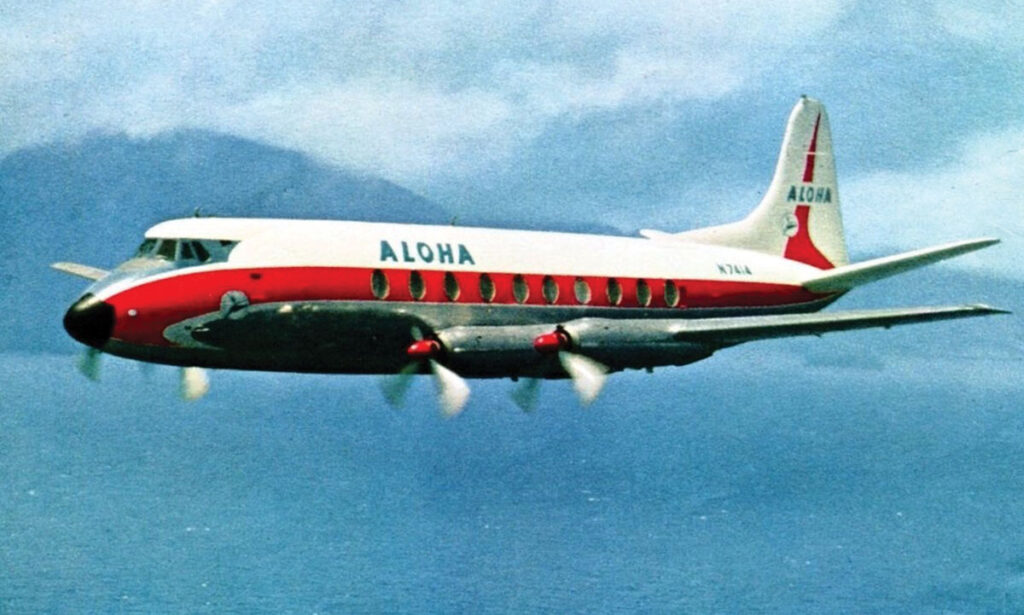
In 1963, it introduced quad-engine Vickers V.745 Viscounts, which complemented its F-27s, enabling it to emphasize that “Only Aloha Airlines provides the modern convenience of all jet power for Hawaii,” urging passengers to “Fly Aloha jet-prop Viscounts and F-27s at no extra fare.”
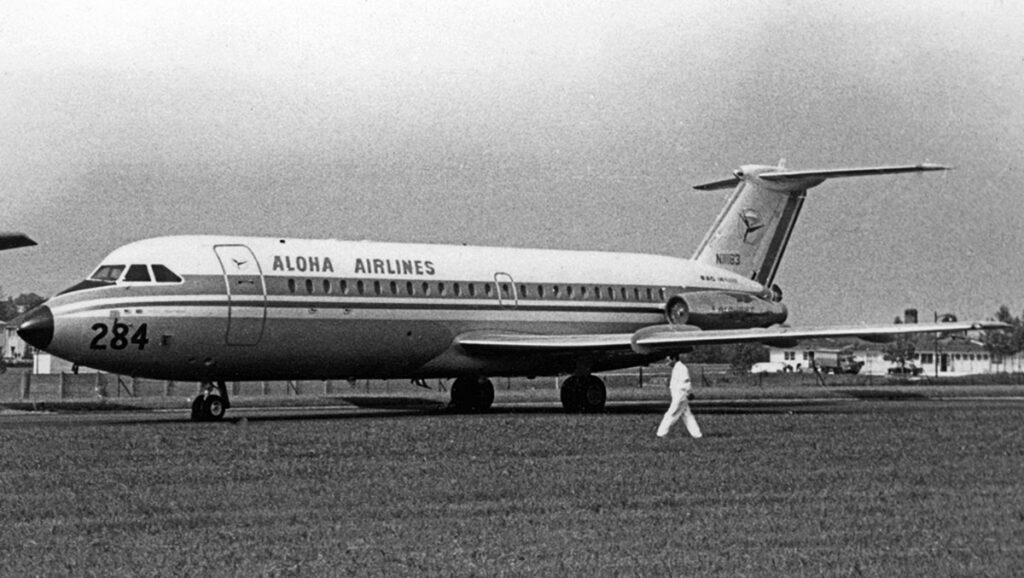
Although both aircraft were powered by turboprop engines, whose turbine core turned propellers, it began service with a type powered by pure-jet engines three years later, when it took delivery of the first of two Rolls-Royce Spey-powered British Aircraft Corporation BAC 1-11-215s, named “Queen Kapidani,” to more effectively compete with Hawaiian’s DC-9s.
Still able to boast of an “all-Rolls Royce-powered fleet,” it assured passengers of “the powerful confidence of Rolls Royce engines on every aircraft,” providing them with “a quiet, lounging refinement with the friendliest name in flight—Aloha Airlines.”
Designating the type as its “Alohajet,” it stressed that it was “the elegant way to fly between the islands. And in Hawaii, only the Aloha jet offers you a central lounge designed to accommodate businessmen or families. Pamper yourself in the jet, which combines elegance with the colorful décor of Hawaii.”
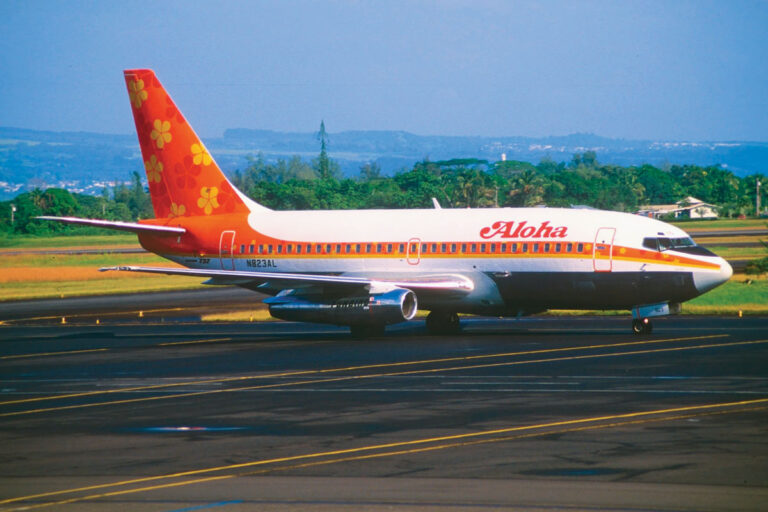
Yet, performance restrictions, precluding it from full-payload operations at some of the destinations in its route system, later prompted it to replace the BAC 1-11s with 737-200s. Featuring a new, more colorful livery of orange and yellow with a tropical flower design on their vertical fins, they were dubbed the “fun birds of Aloha” and became the mainstay of its fleet.
“After introducing British-built Vickers Viscount four-engine prop-jets in 1963 and the all-jet BAC 1-11s in the mid-1960s…Aloha found the new Boeing 737 passenger jet,” according to “A Proud History: The Story of Aloha Airlines” (op. cit.). “It was love at first sight.”
Route Expansion
Seeking to expand its reach, it acquired Princeville Airways in 1987 and renamed it Aloha Island Air. Equipped with appropriately-sized, 19-passenger DHC-6 Twin Otters, it was now able to serve small, limited-traffic Hawaiian destinations, such as Lanai City, Kalaupapa, and Hana.
Nevertheless, remotely located on the Hawaiian Islands and limited with its existing, first-generation 737-200 fleet, Aloha embarked upon a U.S. Mainland expansion strategy by initially leasing two next-generation, ETOPS (extended-range twin-engine operations performance standards)-equipped 737-700s, which enabled it to inaugurate service to the West Coast on February 14, 2000, connecting Honolulu with Oakland.
Well-received, it continued this secondary-city expansion to Burbank, Orange County, and Vancouver after taking delivery of additional aircraft, with extensions beyond them to Sacramento, Reno, Las Vegas, and Phoenix. Several Mainland flights originated in Maui and the Big Island of Hawaii, altogether avoiding Honolulu.

Westbound Pacific routes were also offered to Christmas Island, Rarotonga, Johnston Atoll, Majuro Atoll, and Kwajalein, its aircraft now sporting a new “bird of paradise” flower livery.
“Some say, ‘It’s not about the destination, but the journey,” it wrote in its October 26, 2003, timetable. “We believe it’s both. At Aloha Airlines, we always strive to create the most relaxing and enjoyable flying experience possible. So, whether you’re island-hopping, flying across the Pacific, or simply buzzing around the U.S. West Coast, you can count on comfortable leather seats and in-flight service that’s second to none.
“Every trans-Pacific flight includes Hawaii’s regional cuisine by award-winning chief Alan Wong, freshly baked cookies and milk, complimentary Mai Tais, and free entertainment.”
Although its strategy was highly successful, the post-9/11 terrorist attacks reduced travel to a trickle, and rising fuel costs and low-fare competition forced it into a decline.
“Go!” Came and Aloha Went
Despite continual competition from Inter-Island/Hawaiian, briefly with Mid-Pacific Airlines, and three failed attempts to merge Aloha with Hawaiian itself, Aloha’s demise came when Go!, a regional jet operator and a division of the Mesa Air Group, began its own inter-Hawaii service with progressively lower fares that finally reached the $1.00 level.
Unable to generate a profit when it had to match them to retain passengers, Aloha was forced to file for Chapter 11 bankruptcy in 2008. It operated 13 127-seat, single-class 737-200s, eight 124-seat, dual-class 737-700s, and one 162-seat, dual-class 737-800 at the time.
Go! even had the audacity to try to legally change its name to “Aloha,” but failed to attain the authority to do so.
“Mesa succeeded in inflicting great harm, not only upon the Aloha corporate entities, but also upon thousands of Aloha families,” Lloyd King, a U.S. bankruptcy judge, commented at the time.
“After 61 years of service, Aloha Airlines flew its last flight on March 31, 2008—an inter-island hopper from Maui that landed in Honolulu at 10:34 p.m.,” Christine Hitt reported in her article, “The Fare War that Killed Hawaii’s Aloha Airlines” (SFGATE, September 15, 2022). “It was the end of an era for a storied airline with deep roots in Hawaii that went back to before Hawaii became a state, and its closure resulted in the loss of 1,900 jobs.”
While it is not always easy to offer a proper perspective about an airline that was instrumental to Hawaii for more than six decades, “A Proud History: The Story of Aloha Airlines captures its essence.
“(Aloha offered its) passengers what they wanted: comfort, convenience, value, and something more—that friendly Aloha spirit that comes from the Islands and from the heart.”