





This year, Earth Day is marking its 55th anniversary, and EARTHDAY.ORG has chosen the theme of Our Power, Our Planet, calling for a tripling of electricity generated by renewable sources by 2030 to put solar and other non-fossil fuel energy sources into the spotlight. Three of the Port Authority of NY & NJ’s major airports may have gotten there before us!
Most travelers are aware that air travel is a major contributor to carbon emissions, and airports themselves can also be massive hubs of energy use with in- and out-going vehicle traffic, bright lighting 24/7, air conditioning and heating, as well the production of vast amounts of waste. The aviation industry, including airports themselves and the planes actually flying, contribute around 2.5% of global carbon dioxide (CO2) emissions. However, some airports are taking steps to reduce these emissions and become a part of the solution.
All over the planet, airports are embracing sustainability and recognizing the need to make more eco-friendly choices. This includes three of the major airports in the United States’ largest and most famous city, New York – John F. Kennedy International Airport (JFK), LaGuardia Airport (LGA), and Newark Liberty International Airport (EWR), all operated by the Port Authority of New York & New Jersey.
These three airports are going through major redevelopment projects to embrace renewable energy, move away from fossil fuels where they can, and strategically reducing the volume of waste they produce.
NY Metropolitan Airports Cleared for a Green Landing
JFK and LaGuardia airports collectively serve over 90 million travelers annually — JFK alone handles 63.3 million passengers, and LaGuardia sees 33.5 million. And at Newark Airport, 49 million travelers were served in 2023.
In 2024, a total of 145.9 million air passengers flew through JFK, LaGuardia, Newark, and New York Stewart airports, according to initial estimates. That total surpassed the previous record of 143.8 million set in 2023. To support this level of traffic, the Port Authority of New York & New Jersey is responsible for managing a significant portion of the region’s transportation infrastructure, including bridges, tunnels, seaports, and airports, all within its designated geographical area. Spanning 1,500 square miles and centered around New York Harbor, it covers parts of 17 New York and New Jersey counties, making it the largest employer in New York State. The Port Authority’s goal is to achieve net-zero carbon emissions by 2050.
One of the most exciting projects helping them get there is the recently upgraded electric charging station at JFK. This station has added 24 brand-new EV chargers, bringing the total number of chargers at JFK to 46, open 24/7 to the public to quickly charge their passenger vehicles.
Even better, the chargers are being used for the airport’s own ground fleet of EV vehicles at the airport as well. This aligns with the Port Authority’s net-zero emission goals, which have seen it commit to electrifying its entire light-duty fleet by 2028 and its ground service equipment fleet by 2035.
Gas-powered ground operations and light-duty fleets require enormous amounts of fossil fuel, but by transitioning all their vehicles to electric, that will significantly reduce greenhouse gas emissions. Imagine, if you will – security vehicles, concessions, baggage carousels, kiosks – all run on electricity generated by renewable energy like solar. That is what New York is working towards. Here’s how: solar-powered terminals.

Running on Sunshine
A brand new, solar-powered sustainable terminal at JFK is already underway and is due to open in 2026.
“The development of the New Terminal One is rooted in resiliency and sustainability, extending from our design and construction to operations and maintenance after we open our doors in 2026. We are building the terminal to withstand challenges posed by climate change and extreme weather events, so we remain fully operational no matter the environmental conditions,” says Uzoamaka N. Okoye, Chief of Staff, The New Terminal One (NTO) at JFK.
Okoye explains that NTO is committed to reducing its environmental impact through innovative energy systems. Their state-of-the-art microgrid, built in partnership with AlphaStruxure, is key to these efforts. Featuring the largest solar array in New York City and on any U.S. airport, the microgrid will enable them to function independently of the power grid with locally generated and lower carbon energy.
Reducing Waste, Elevating Sustainability
Vehicle carbon emissions are where our minds go when we think of waste at airports. Unfortunately, that is just one part of the problem. Airports also generate huge amounts of waste every single day, from plastic food packaging to lavatory water, uneaten food to deplaned waste to oil, grease spills to single-use plastic bottles. This list is long and daunting. When was the last time you made it through an airport without throwing something away?
But for most travelers, sustainability is not top of mind when we are rushing to a gate or trying to fill up on food between flights. For most of us, convenience is always going to win out over reducing waste.
Fortunately, the Port Authority is taking steps to mitigate this and make it easier to dispose of our trash properly. Revamping their recycling policy is the first step, by having clear and separated receptacles for different recyclable items helps to make sure waste is at least handled properly at the airport and “to get the most use out of waste-bound materials as possible in order to avoid landfilling,” says Alexandria Cassidy, lead on zero-waste at the Port Authority.
She is absolutely right!
One of the more significant issues with our recycling system in the United States is improper waste sorting and insufficient facilities to handle the waste, especially plastics. These clearly labeled bins are a start in helping to keep the waste in the right place while maintaining convenience for passengers. Ultimately, EARTHDAY.ORG would like to see a drastic reduction in the use of single-use plastics at airports, across the U.S., and globally, and a move towards more eco-friendly alternatives like water refilling stations, bamboo cutlery, paper, and reusable glass bottles.
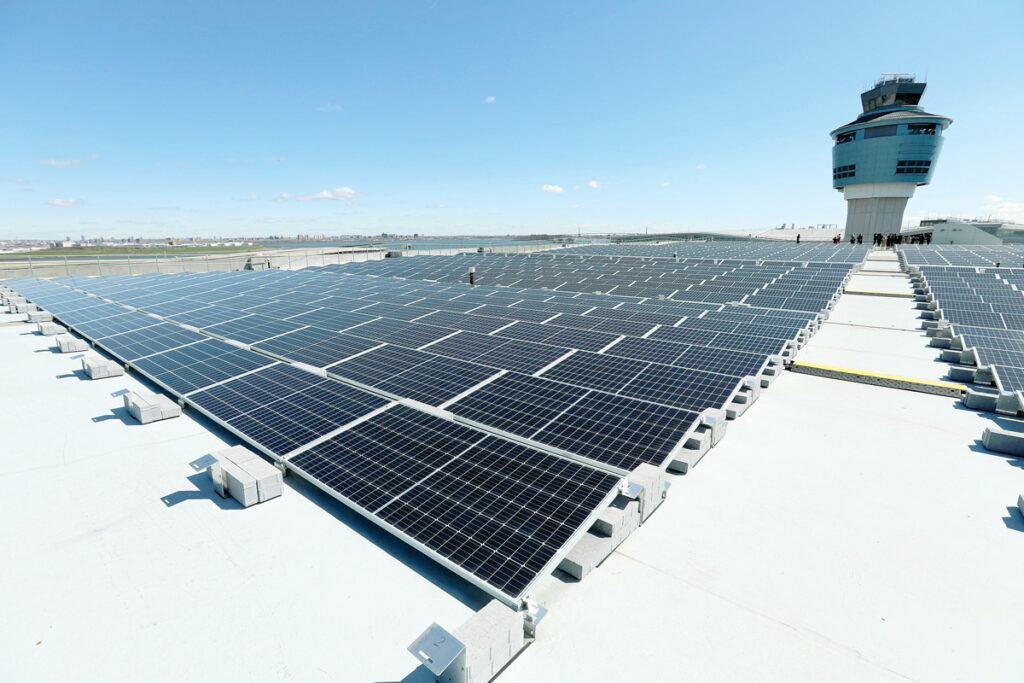
With the redevelopment of the new Terminal 6 at JFK, “Sustainability is a top priority for us and has been built into the design of T6, with floor-to-ceiling windows, over 6,000 rooftop solar panels, energy-efficient baggage systems, and graywater collection and reuse throughout the terminal,” said Rishali Chaplot, Manager, Environment and Sustainability at JFK Millennium Partners. “Both during the construction of T6 and its operation in 2026, we aim to divert as much waste as possible by implementing various waste recycling and composting guidelines across all our products and vendors. Through January of this year, our waste diversion rate at the construction site was 98.87% — a figure we are very proud of.”
Doing the Right Thing = Saving Money
LaGuardia Airport’s newly developed $5.1 billion Terminal B stands as a prime example of sustainable design that ultimately is good for the bottom line as well. The Terminal earned a LEED v4 Gold certification from the U.S. Green Building Council (USGBC). This recognition makes it the world’s first airline terminal to meet these advanced environmental standards, highlighting the airport’s commitment to sustainability.
Its design has allowed LaGuardia to save more — reducing its water bills by 43% and its energy costs by 18%. This has been achieved through reduced window glazing, installation of a specialist roof that reflects solar heat, using solar water heaters, and light-sensitive artificial lighting control. Every aspect of Terminal B is designed to maximize efficiency and minimize waste. This ambitious project reflects LaGuardia Airport’s ongoing efforts to lead in both eco-conscious infrastructure and innovation.
In November 2023, the Port Authority announced that Newark Liberty International Airport’s Terminal A achieved LEED Gold certification by the USGBC for leadership in Energy and Environmental Design (LEED), the most widely used green-building rating system in the world and an international symbol of environmental responsibility.
The one-million-square-foot Terminal A at Newark Airport features a variety of sustainable design elements, including the largest solar rooftop installation at any U.S. airport atop the terminal’s parking deck, new electric buses to support shuttle operations, water-efficient fixtures reducing potable water demand by more than 45 percent, a cool roof designed to reflect sunlight, absorbing less solar energy and reducing the heat gain on the building, and energy-efficient indoor lighting and controls. In achieving LEED Gold, the project meets the Port Authority’s goals to reduce greenhouse gas emissions by reducing annual energy costs by an estimated 30 percent.
“The LEED Gold designation exemplifies the agency’s commitment to environmental sustainability and being a good neighbor,” said Port Authority Chairman Kevin O’Toole. “By establishing rigorous building standards and adopting aggressive measures to reduce our carbon footprint, we are creating a healthier environment and striving to improve the quality of life for those in the region we serve.”
Newark Liberty also provides charging and electrical infrastructure to enable airlines to transition to electric ground-support equipment (GSE) across the terminal. The agency’s 2022 Zero Emission Airside Vehicle Rule mandates the conversion of all GSE to electric models by 2030, where commercially available. It’s satisfying to see major airports taking responsibility and recognizing their role in cutting carbon emissions and reducing waste.
Like the Port Authority, we see the shining benefits of renewable energy—whether through solar, wind, or other sustainable sources. Beyond their environmental impact, renewable energy helps to lower operational costs, proving that sustainability and financial savings go hand in hand. As more airports and industries embrace these green technologies, they not only contribute to a healthier planet but showcase that renewable energy is both a smart financial decision and a critical step toward a sustainable future for all.