


Ideas for carriers may come from many sources, but the one for World Airways was a logical one: Benjamin Pepper, a Boeing B314 flying boat pilot for Pan American World Airways, conceptualized starting his own air carrier, but never envisioned the multiple roles it would play over an almost seven-decade period. What he did envision was buying the now-outdated B314s to equip its fleet. His vision endured. His position at the helm of it did not.
Airline Origins
Three of these lumbering behemoths soldiered on when operated by the airline he founded on March 29, 1948 on the New York-San Juan route—longer, perhaps, then they should have. Featuring a bloated, excessive-drag fuselage; a low payload-to-gross weight ratio; and the inability to maintain altitude after inflight engine loss, they served their purpose at a time when land planes did not have transatlantic range and there were no mid-ocean islands or airports on which to land.
Initial Operations
Pepper may have planted a seed, but other companies cultivated its growth—in this case, the Beroviche Steamship Company, which sought to expand its transportation realm from the water to the air with an airline, acquiring it, but witnessing little of its growth.
The one who did, however, was entrepreneur Edward J. Daly, who purchased it in 1950 for $50,000, remedying the flying boat fleet by substituting two war-surplus Curtiss-Wright C-46F Commandos already introduced and retaining the basic East Coast-to-Caribbean routes.
As the carrier’s workhorse, they set the stage for World’s multiple roles. They carried up to 50 passengers, cargo, and everything in between. In 1950, they transported 7,705 passengers. Two years later, the total had increased by a third, to 13,000, the latter due to transcontinental service for low $85.00 fares.
Military Contracts
Its second phase of operation began mid-decade. The Civil Aeronautics Board (CAB) granted it temporary interstate charter authority; it relocated its headquarters from Teterboro, New Jersey, to Oakland, California; it acquired two large-capacity, quad-engine, tricycle undercarriage Douglas DC-4s; and it was awarded a military passenger and cargo contract. The latter, initially taking form as US military personnel transportation for the Korean War, provided purpose, profit, and future direction.
As the recipient of the first commercial carrier contract awarded by the Military Air Transport Service—or “MATS”—it provided daily, two-stop flights between Japan and the Philippines.
“In March 1961, World entered into an agreement with Western Electric Company (contender for the Pacific Missile Range) for air transportation on a scheduled basis between the West Coast, Honolulu, and Kwajalein,” according to Hawaii Aviation.gov. “Four months later, another trans-Pacific contract was entered into for round-trip transportation of passengers from Travis Air Force Base (AFB), California, to Bangkok, Thailand, via Honolulu, Guam, the Philippines, and Saigon. Other trans-Pacific contracts followed in 1962, adding Okinawa.”
Supplemental Carrier
World Airways’ role continued to expand when Congress established the supplemental air transport category, which was defined as “charter trips…to supplement the scheduled service…,” the latter of which was provided by the then-designated “trunk carriers.”
“New supplemental certificates were to be issued by the CAB, which was authorized to ‘designate only the geographical area or areas between which service may be rendered,” according to R. E. G. Davis in Airlines of the United States since 1914 (Smithsonian Institution Press, 1998, p. 458). “On September 30, 1962, the basic legislation was passed and with this tighter authority, the Board set out to weed out the weaker carriers. By this time, some of the stronger ones were easy to recognize.”
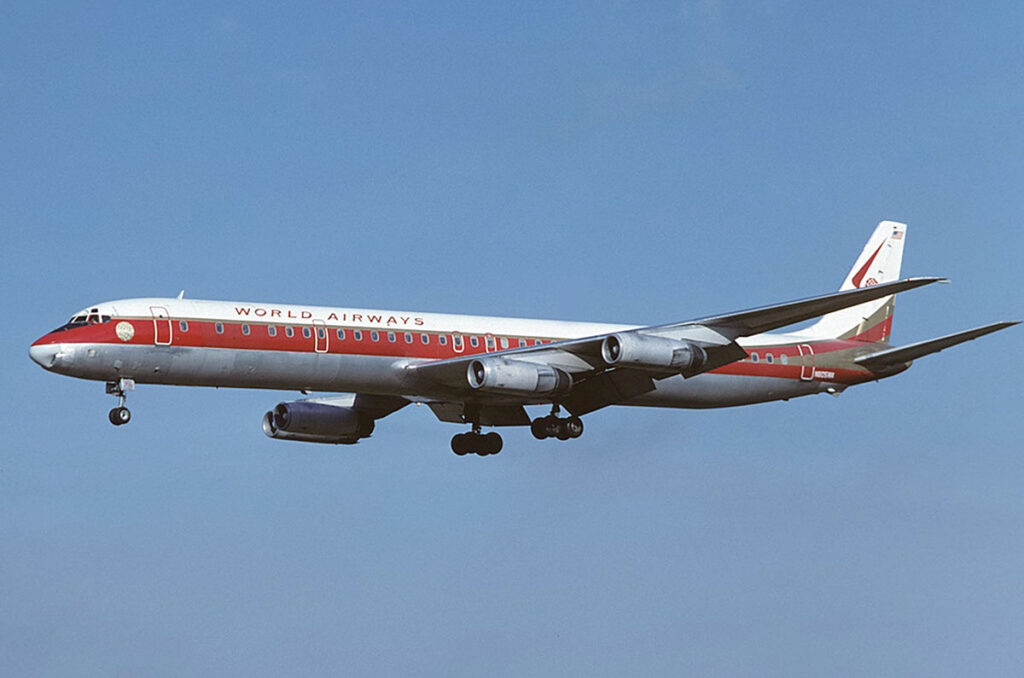
It subsequently decided to “go jet” when it became the first US charter carrier to do so, placing an order for three Boeing 707-320Cs in May of 1962. Combining the airframe and powerplant of the pure-passenger 707-320B, the version introduced a forward, left cargo door, a reinforced cabin floor, and appropriate shipment tie-downs, enabling it to offer passenger, freight, and combination services. It facilitated the operation of all, now re-designated Military Airlift Command (MAC) Pacific flights.
Charter Carrier
On August 10, 1964, World Airways was granted commercial passenger charter authorization from the CAB for operation between the US and Australasia, including stops in Polynesia, Micronesia, Indonesia, and India.
During this time, it operated several history-making flights. In its famous “Last Flight from Da Nang,” for example, one of its 727s evacuated 268 escapees who had stuffed themselves both in the passenger cabin and in the lower holds amid heavy gun fire from pro-government forces on March 29, 1975. Edward Daly himself was on board.
“Daly also directed a daring rescue of 57 Vietnamese orphans aboard a World DC-8 cargo aircraft, carrying them from Saigon to Oakland,” according to the Embry-Riddle Aeronautical University’s “World Airways” article. “The arrival was greeted with a sea of media, and President Gerald Ford immediately implemented ‘Operation Babylift’ in 1975, which utilized charter, scheduled-airline, and military aircraft to bring approximately 3,000 Vietnamese orphans to safety in the United States.”
World Airways entered the widebody era when it took delivery of one of only 13 Boeing 747-200C Convertibles ever built. Featuring an upward-opening nose to facilitate straight-in, main deck loading of very long and outsized cargo shipments, it expanded its capability.
Scheduled Carrier
World’s transition from a militarily-contracted carrier to a charter and, ultimately, scheduled one, was facilitated by the US Airline Deregulation Act (ADA) signed into law by President Jimmy Carter on October 24, 1978.
Cornerstone of its operations was the McDonnell-Douglas DC-10, the Super DC-8’s successor, and World acquired some 50 of its DC-10-10 domestic and DC-10-30 intercontinental versions, the latter with an increased wingspan, uprated General Electric CF6 turbofans, a dual-wheel, center-section undercarriage bogie, and increased weights. As its workhorse, it flew in pure-passenger, combi, and pure-freighter variants.
By the summer of 1980, at which time it served Boston, Honolulu, London, Los Angeles, New York/Newark, San Francisco/Oakland, and Washington/Baltimore, it offered up to three fare categories per flight. Those between Los Angeles and Newark included K-Class Economy without meal service for $139.99, Y-Class Coach with meal service at $142.99, and KN-Night Coach with meals only available for purchase at $119.99.
It subsequently introduced full-amenity Ultra Service, which entailed the following elements:
- Choice of three entrees with complimentary wine.
- Hot towel service.
- Special theme drinks.
- Comfortable foam-tipped headsets.
- Selected and modern full-length feature films.
- 8 stereo channels for your comfort.
- Silent video games.
- All fights are operated by wide-bodied DC-10s.
It advertised “World Airways; The fastest way to save you money” in its spring-summer 1984 timetable. But it failed to reveal that its scheduled service strategy was also the fastest way for it to lose it.

Return to Roots
Roots are always stronger than the individual branches which sprout from them and World thus shed its scheduled one and returned to its charter origins in 1987, unable to generate profitability in a battle with the majors, such as American and United. A single type, the DC-10-30, enabled it to once again concentrate on tour operator- and military lift, the latter in support of the Gulf War and the Iraqi and Afghanistan conflicts.
Short-lived strategies characterized its journey to sunset. World Air Holdings became the parent of both World Airways and North American Airlines in 2006 and a brief headquarters move to the West Coast preceded acquisition by Global Aero Logistics, which was subsequently renamed Global Aviation Holdings, and another transcontinental move to Peachtree, Georgia, next to Atlanta’s Hartsfield International Airport.
But ownership changes and tenuous roots proved its final grounding. A budgetary-forced cancellation of a World Airways Air Mobility Command contract in 2013 caused its parent company, which had already weathered two bankruptcy filings, to pull the plug on its operations on March 27, 2014, ending a multiple-role, almost seven-decade span of invaluable service.
Legacy
“In 2014, World Airways management closed the doors on one of the finest airlines in the aviation industry,” “Your Daily Bread: The Internet Home of the World Airways Alumni” website touchingly expresses. “Whether supporting the American public, American troops, or private contractors, the men and women of World Airways answered the call to serve our passengers with their personal dedication and professional performance. Wherever you are today, take time to pause and remember the impact you made upon the aviation industry…Most of all, remember the legacy you have left that others can only emulate.”
Considering its scope and reach, “World Airways,” as a name, could not have more appropriately captured its essence.