

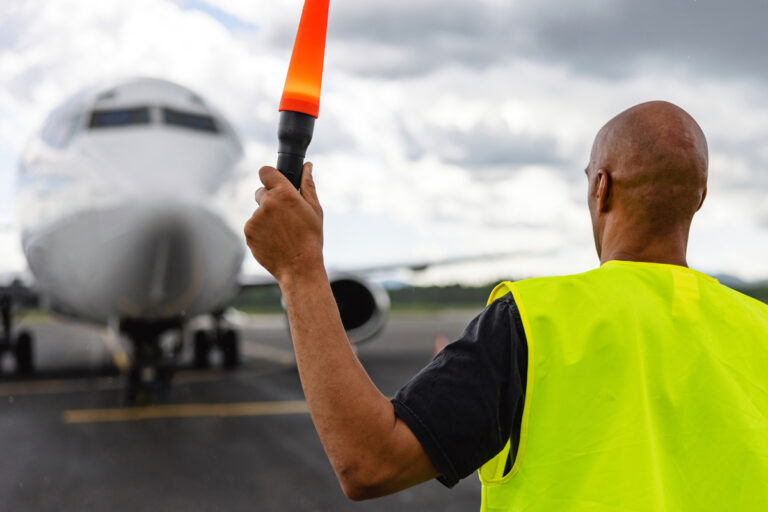
Airport ground operations are the pulse of any airport, covering all the essential roles needed to look after passengers, prepare aircraft, and get flights off the ground safely and on time. These careers offer a huge variety of paths, ranging from active, hands-on work out on the tarmac to tech-driven logistics behind a desk. Generally, the field is broken down into three main areas:
- Airside: working directly out on the ramp with the aircraft
- Landside: helping passengers inside the terminal
- Operational Control: managing logistics and overall safety.
Airports are marvels of complex logistics, where massive aircraft, specialized ground vehicles, and personnel move in tight spaces. In this high-stakes environment, electronic navigation systems guide planes through the sky and down to the runway, but the final, most precise movements on the ground rely on a human element: the aircraft marshaller.
Operating in the high-noise, fast-paced environment of the tarmac, aircraft marshallers serve as the vital link between the flight deck and the ground. Their presence is essential to airline safety, efficiency, and operational success for several critical reasons.
Navigating the Pilot’s Blind Spots: From the cockpit of a commercial airliner, a pilot’s visibility of the immediate surroundings is severely limited. Pilots cannot see their own wingtips, nor can they see objects directly beneath or immediately in front of the aircraft’s nose. Marshallers act as the pilot’s external eyes. By standing in a highly visible position and utilizing high-visibility paddles or glowing wands, they signal exactly how much space the pilot has, preventing devastating collisions with terminal buildings, service vehicles, or other aircraft.
Precision Parking and Gate Alignment: Stopping an aircraft at a gate is not a matter of approximation. Planes must park precisely on designated lines to ensure that passenger boarding bridges can align correctly with the cabin doors. Accurate parking also ensures that underground fueling systems, baggage conveyors, and catering trucks can safely service the aircraft without overextending or causing delays. Marshallers use a standardized language of hand signals to guide pilots down to the exact inch.
The Ultimate Safeguard: While many modern airports utilize automated Visual Docking Guidance Systems (VDGS) to park planes, technology is susceptible to mechanical failure, software glitches, and severe weather interference. Extreme glare, heavy snow, or torrential rain can blind automated sensors. In these scenarios, aircraft marshallers are the ultimate safeguard. Their manual training allows operations to continue smoothly, preventing airport gridlock and costly flight delays.
Ground Crew Coordination and Safety: The marshaller is often the leader of the immediate gate crew. While guiding the aircraft, they also monitor the surrounding ramp area to ensure that baggage handlers, fuelers, and mechanics remain clear of the dangerous hazard zones around running jet engines. They signal when it is safe to apply the aircraft brakes and when chocks can be placed under the wheels, officially transferring control of the plane from the flight deck to the ground station. Beyond signaling, marshallers are responsible for inspecting parking areas for hazardous debris, monitoring wingtips to prevent collisions with ground equipment, and coordinating with refueling and baggage crews for efficient turnarounds.
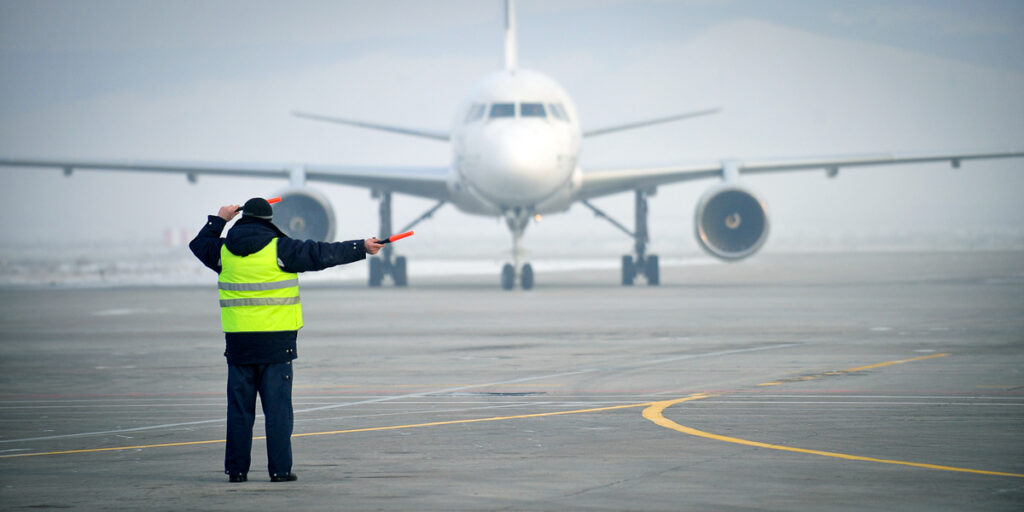
In an industry where safety margins are razor-thin, the aircraft marshaller remains an indispensable figure. Through clear communication, absolute precision, and unwavering vigilance, these professionals ensure that millions of passengers and billions of dollars in equipment reach their destinations without incident.
The Federal Aviation Administration (FAA) does not require or issue any official license or certificate for aircraft marshallers or signalmen. Instead, the FAA delegates the responsibility of qualification, training, and deployment to local airport authorities, airlines, and fixed-base operators (FBOs) based on specific safety standards.
According to the FAA’s guidance outlined in FAA Advisory Circular AC 00-34B and AC 00-65A, the fundamental expectations and requirements for a signalman include:
Training and Proficiency Requirements
- Local Procedures: The marshaller must be fully trained in the specific airport’s marshaling and safety guidelines.
- Standardized Hand Signals: Must demonstrate full command of standardized aviation hand signals (which align globally with International Civil Aviation Organization (ICAO) rules)
- Proficiency Testing: Expected to undergo periodic (typically annual) proficiency testing and remain fully qualified in towing procedures.
- Team Coordination: Must be trained to coordinate actively with wing walkers, tail walkers, and cockpit observers to ensure clearance.
No marshaller will guide an aircraft unless trained, qualified, and approved by the appropriate authority to carry out the functions of a signalman.
Equipment and Visibility Standards
- High-Visibility Garments: The signalman must wear a distinctive, daylight-fluorescent identification vest so the flight crew can immediately identify them.
- Daylight Signaling Tools: Must use daylight-fluorescent wands, reflective table-tennis bats, or high-visibility gloves.
- Night and Low-Visibility Tools: Must use illuminated or self-illuminating wands to remain visible during night operations, heavy rain, or thick fog.
- Personal Protective Equipment (PPE): Must utilize mandatory safety gear, including earplugs or muff-type ear defenders for noise mitigation, and protective goggles or helmets when working in rotor wash areas.
When a situation requires added pilot awareness, a flagman can be used to direct the aircraft to the marshaller in waiting.
Operational Guidance
- Strategic Positioning: For fixed-wing aircraft, the marshaller must stand on the left side of the aircraft (from the pilot’s perspective) to maintain optimal, unobstructed eye contact with the captain.
- Airport Discretion: The FAA notes that full-time marshallers are not mandatory at every airport; local authorities determine if a signalman is needed full-time, part-time, or occasionally based on the local risk of aircraft collisions with objects or people.
Training to become an aircraft marshaller at Port Authority of NY & NJ airports (John F. Kennedy International, LaGuardia, Newark Liberty International) involves completing ground operations instruction, acquiring security clearances, and working through specific airline or ground handling employers.
Key Steps & Basic Qualifications
Basic Education: A high school diploma or equivalent is required.
Complete an approved training program such as courses aligned with the International Air Transport Association (IATA) standards to learn nonverbal ramp communication, marshaling wand signals, and safety zones, or employer-provided programs based on global aviation manuals.
Employer-Led On-the-Job Training: Get hired by an airline or ramp service contractor operating at the specific airport, where practical field shadowing and supervised aircraft guidance take place.
Security Clearances (SIDA): Obtain a Security Identification Display Area (SIDA) badge by completing mandatory background checks and fingerprinting required for unescorted access to Port Authority airfield operations.
Background Clearance: Pass comprehensive federal background checks and fingerprinting to receive your official Airport Security ID badge.