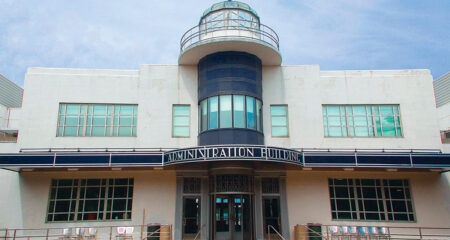




It would be memorable enough that the building was dedicated in May 1935 as the nation’s first air passenger terminal. Or that aviation legend Amelia Earhart was on hand for the festivities, given a hero’s welcome after a series of record-breaking flights over the preceding months. Or that in 2001, the building was picked up, moved, and reconstructed three-quarters of a mile away to accommodate runway expansion.
But as it approaches its 90th birthday, Building One is writing yet another chapter for the history books: it is now the first Port Authority building to receive a decarbonization retrofit.
Beneath its terrazzo floors and marble walls, the 110,000-square foot terminal has been retrofitted with electric boilers, heat pumps, and other clean-energy tools, eliminating any use of fossil fuels and prioritizing energy conservation at every turn. It’s given the Port Authority valuable lessons as the agency embarks on the same effort for all its other buildings enroute to fulfilling its ambitious pledge to reach net-zero carbon emissions agency-wide by 2050.
“We started with this building because we know it’s really a showcase building with a storied history,” said Rimma Krakhmalnikov, a program manager in the Port Authority’s sustainability office. “We knew if we could get this one right, it could be a blueprint for lots of other buildings down the line.”
Today, the building houses a diverse swath of Port Authority personnel, including law enforcement, airport operations and maintenance staff, and Airport Rescue and Firefighting crews, with staff in the building 24 hours a day, seven days a week. For the project’s managers, it became an exercise in collaboration just as much as sustainability.
“You need to create a lot of trust and confidence with everyone in the building since we’re going in and changing their work environment,” said Morys Guzman, a physical plant manager at Newark Airport. “Everyone put their two cents in on this project from IT, engineering, maintenance, security and operations. It was truly a team effort.”
The timing was right for the transformation as well, thanks to the building’s aging internal infrastructure.
“You don’t want to be spending money to replace equipment that’s still new or in good condition,” said Bhoomi Vala, a senior sustainability program manager in the Port Authority’s Aviation department who managed the project. “We did a full assessment of Building One and saw that a lot of it was nearing the end of its useful life and was ready to be replaced.”
Swapping gas-fired boilers for electric ones was just the beginning. Because electricity costs remain higher than natural gas, energy conservation was a significant element of the project as the agency looked to minimize the impact on its electric bills.
At Building One, that meant not just replacing fluorescent lights with LEDs, but installing customizable controls that automatically shut them off when the room is empty or dim them when the room is already filled with sunshine.
Windows were outfitted with a special low emissivity film to conserve heat, while plumbing fixtures were modernized to minimize hot water usage. The building’s IT room, which houses computer equipment generating significant heat, was outfitted with a system that allows that heat to be shared with nearby rooms, further reducing heating costs.
Building One’s parking lot also got in on the act, with electric vehicle chargers encouraging sustainable transportation to and from the site.
The work was completed in just a year and a half, all done while respecting the building’s history and landmark status. That meant structural changes, like tearing down walls, were off limits.
“There’s always an extra layer of consideration whenever we do anything in historic buildings to respect that history,” Krakhmalnikov said. “You’re limited in what you’re able to do, but it forces you to be more creative.”
Still, the lessons from Building One are already shaping the agency’s next steps. Around a dozen buildings are scheduled to be decarbonized over the next decade. Vala said starting with Building One was a valuable experience, bringing a litany of challenges they’re likely to see again.
“Each building is going to have its own unique design, but Building One certainly set the tone for us,” she said. “It had everything we could encounter in future projects like the number of stakeholders, the first responder presence, the historic status. It was a really instructive experience.”
It’s also a reminder of just how fast clean energy technology is evolving. The sector’s rapid innovation will force the team to continually reevaluate the best methods to achieve their goals.
“Something might work for one building, but then you’re doing another building six months later and you see that there’s better technology out there,” Krakhmalnikov said. “Our job is to never let up on that drive to push the envelope and try new things.”
It’s a pioneering sentiment Earhart might be proud of, 90 years after she helped open Building One’s doors.