



Airline Flight & Cabin Crew Couture
While uniforms may very well be the antithesis of high fashion, the relationship between the two uncovers a fascinating narrative and history. The focus of a uniform’s design is function, practicality, tradition, order, and durability. At the same time, fashion reflects continual change, imagination, originality, and often, defiance. But even within this contrast, style conveys an idea, a unique voice, and an individual identity.
Airlines liveries are graphic motifs applied to the exteriors of commercial aircraft. In a sense, they are an airplane’s distinctive ‘uniform’ that reflects an airline’s image or origin, a country’s national identity, and culture; TWA’s iconic Twin Globe and horizontal red ribbon along the airplane’s fuselage conveyed speed and worldwide exploration; American Airlines’ boldly reimagined livery reflecting the red, white, and blue of the flag and a timeless silver fuselage expressing American’s origins, innovation and the spirit of America.
Like an airline’s livery, the distinctive attire of its aircrew’s uniforms distinguishes one airline from another. Accessories, such as hats, badges, scarves, and wings, imply professionalism and add a distinctive flair, a pop of color, and a particular style.
Fashion often draws inspiration from uniforms, converting practical details into stylish elements. Over time, airline uniforms’ fashion and aesthetic significance have changed in silhouette, color, style, marketing, and design, often through societal change and the influence of pop culture.
1930s – 1940s
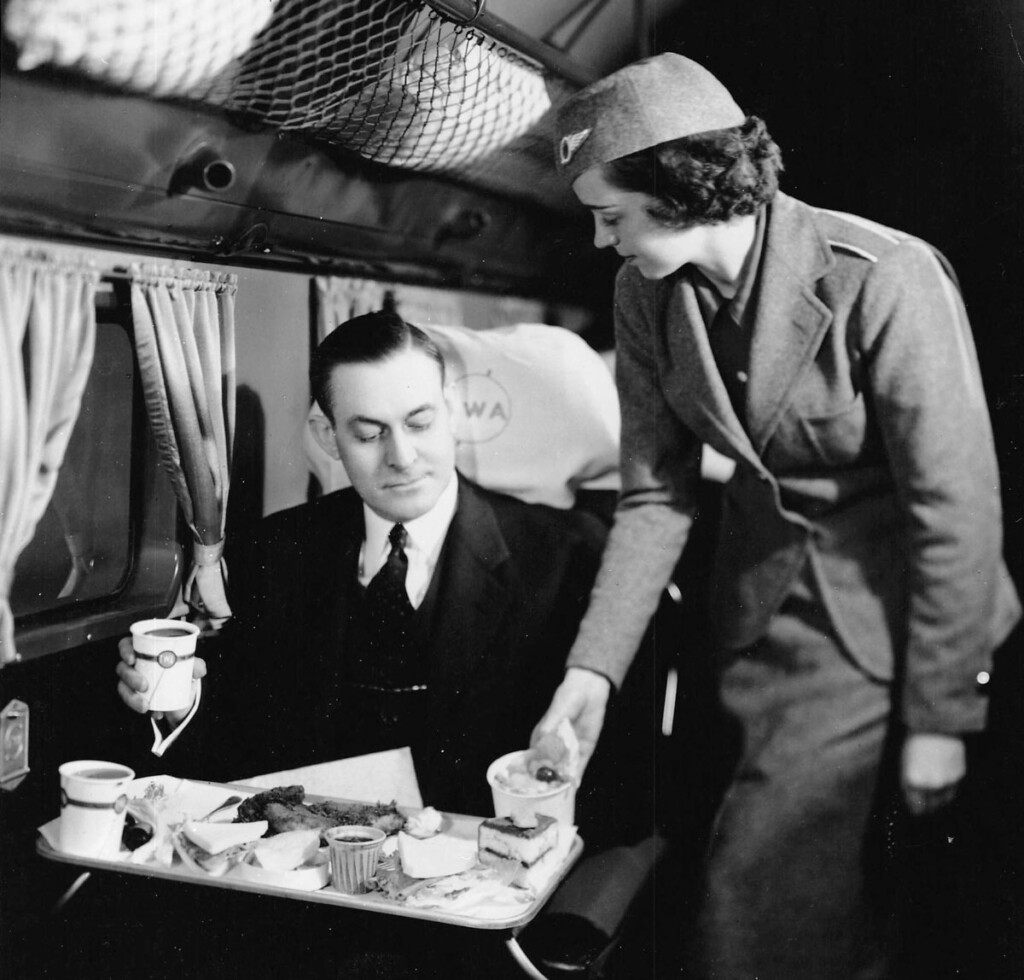
In the early 1930s, the features of an airline pilot’s (or captain’s) uniform were standardized when Pan American Airways outfitted flight crew members in naval-themed uniforms that featured black pants and jackets with braided cuffs that featured a crew member’s rank. Caps used by naval officers were adopted, as well as a pair of wings on the jacket and hat and the airline’s logo. Since then, this dark uniformed image has become an enduring staple of flight crew uniforms. On the other hand, the fashion of an airline’s cabin crew uniform has evolved significantly over the last nine decades, shifting from conservative and classic to trendy and outlandish to contemporary and classic couture.
In 1930, Ellen Church was a registered nurse and the very first female flight attendant, then known as a stewardess or hostess. As all early flight attendants were registered nurses, Ellen wore her nurses’ uniform while working for Boeing Air Transport. Made of heavy, durable material in military style, it included a large cap, a cape, and skirts that fell below the knee. The uniform lent an air of confidence, and its appearance helped to convince early passengers who were wary of air travel that flying was safe.
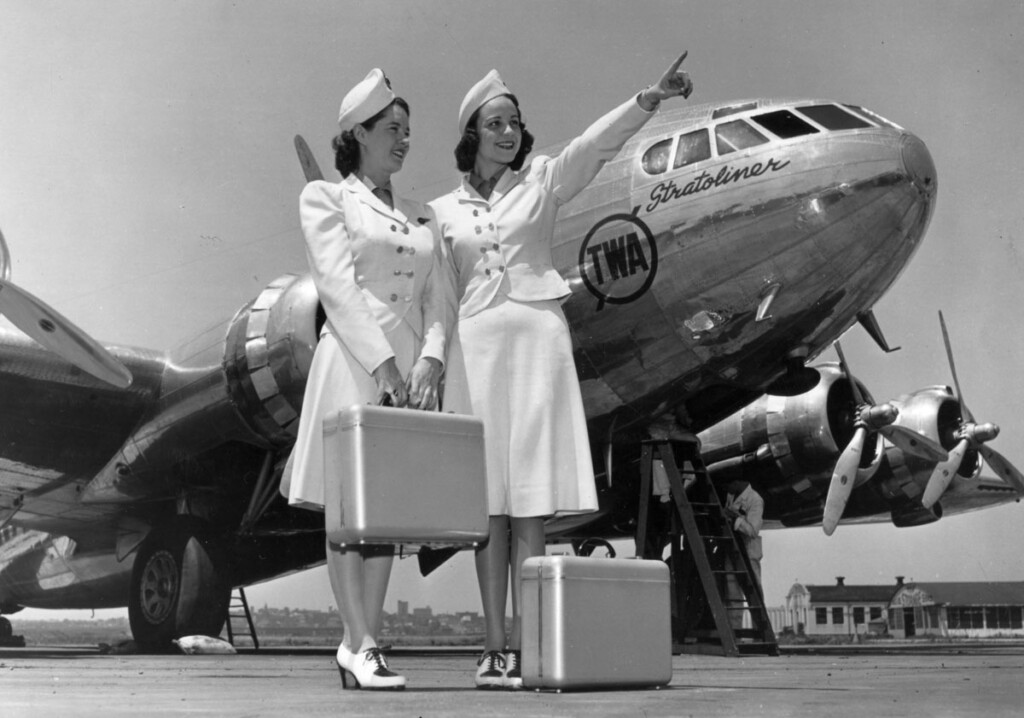
When women were first recruited as flight attendants in the 1930s, they had to be single, under 25, stand at about 5 feet 4 inches tall, and weigh less than 115 pounds. From the 1930s into the ‘40s, flight attendants were clad in petite, military-inspired skirt suits in subdued colors and white gloves. The subdued hues of 1930 slowly gravitated toward classic whites and matching caps. In the late 1940s, wide tapered waist dresses were a popular silhouette, and flight attendants at American Airlines wore light uniforms and spectator pumps, their designs inspired by vintage shoes.
1950s – 1970s
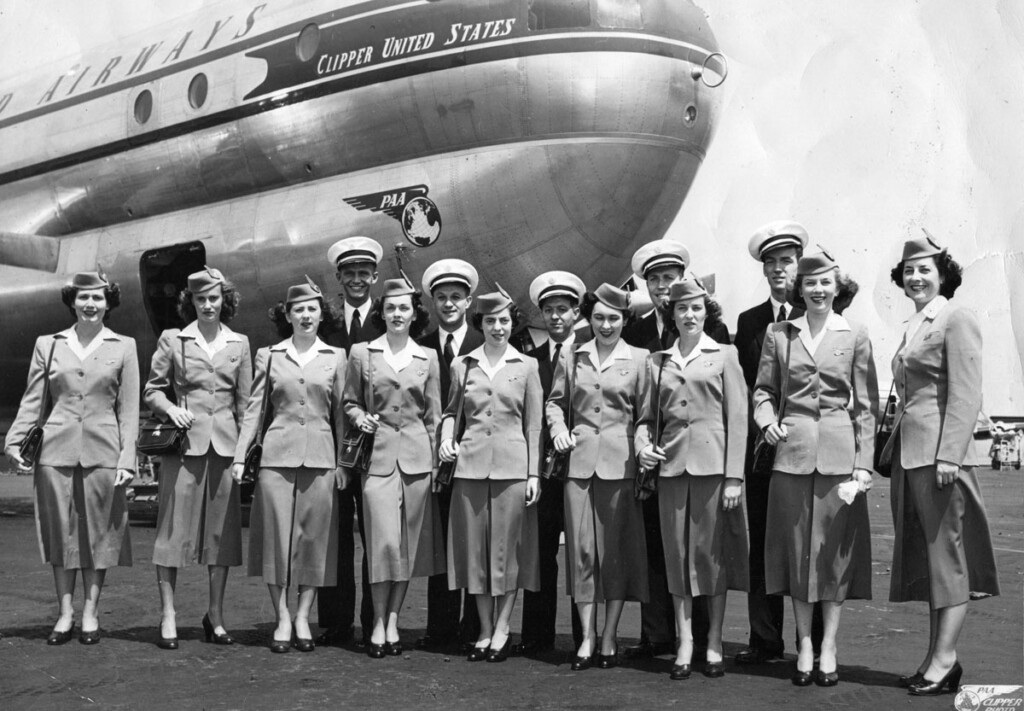
In the 1950s, traditional uniforms continued to be common at many airlines, and their style was still largely influenced by the military uniform. Flight attendants wore classic suits with overstated collars and pillbox hats to accommodate bouffant hairdos.
As the Jet Age in the United States ramped up in the mid-to-late 1950s, Delta’s first Jet Age uniform was designed by Paramount Studios chief designer Edith Head, with a hat designed by milliner Mae Hanauer. A “jet flame” ascot highlighted the honey-beige dress and jacket worn from 1959 to 1965. Coco Chanel-inspired jackets featured fabric-covered buttons, three-quarter length sleeves, a variation of a ‘40s garrison cap, gloves, stiletto heels, and a topcoat.
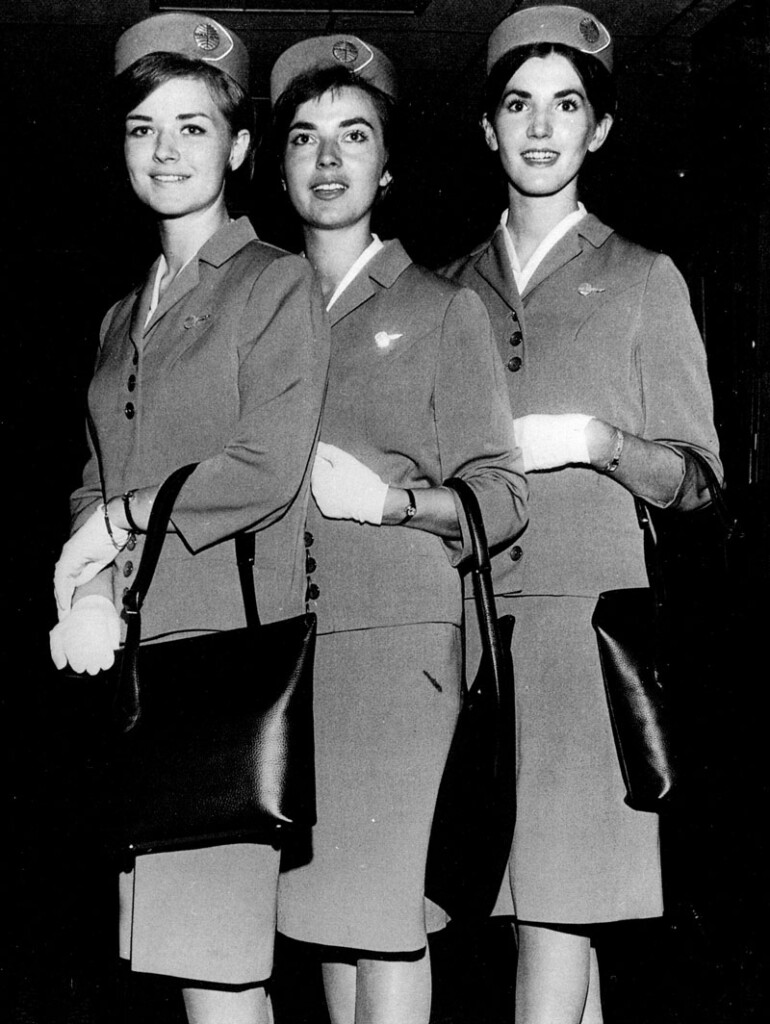
In the United States, as the country underwent social and cultural changes fostered by commercial jet travel, uniforms evolved into a more modern look. Changes in the ‘60s and ‘70s reflected social attitudes, and airlines marketed what the flight attendants wore with a clear intent to appeal to the male traveler. Female uniforms that once signified professionalism and order became highly sexualized through trendy fashion designs, and a more mod style grew prevalent.
Braniff Airways was one of the first airlines to opt for new, hip styles. Italian designer Emilio Pucci was hired to create a new line of flight attendant uniforms for the airline to accompany their brightly colored airliner liveries. He did so in an assortment of bright, fruity colors and bold patterns, accessorized with plastic space-age-inspired bubble helmets to protect a flight attendant’s carefully coiffed hairdos on windy tarmacs. As Pucci’s designs revolutionized airline fashion, a trend of brightly colored, psychedelic-patterned uniforms made the scene, along with mini-skirts and go-go boots.
But the boldly conspicuous trend was short-lived, and the reappearance of a more conservative look made a comeback, mainly stemming from new laws that prohibited hiring discrimination based on age, appearance, and gender.
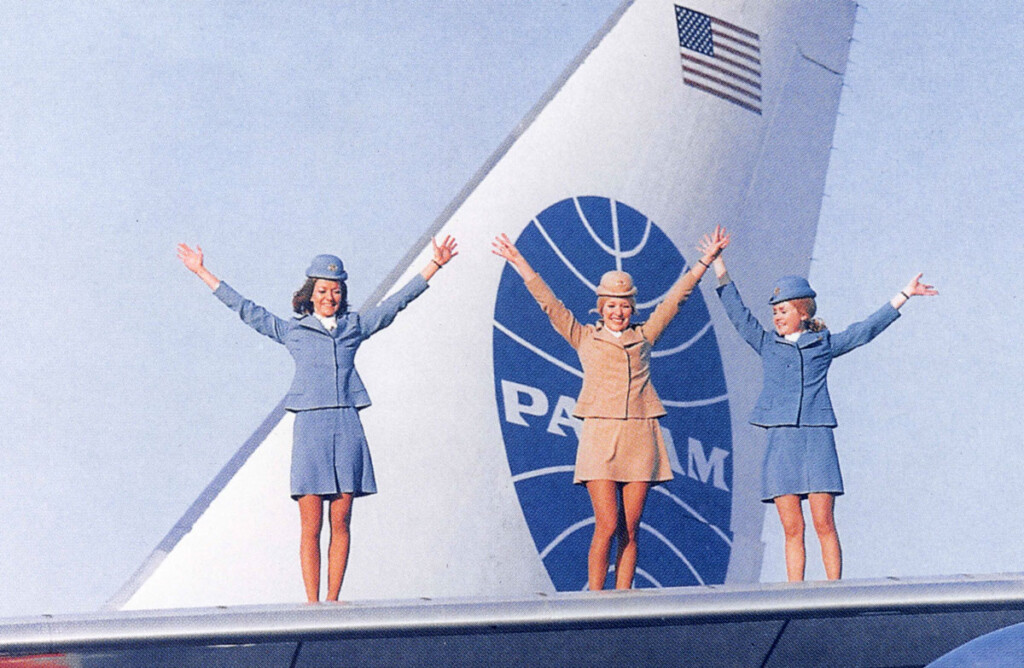
With the Airline Deregulation Act of 1978, airlines began to offer lower, competitive fares, more frequent service, and added routes. Airlines were no longer hiring largely based on appearance, nor were they permitted to. Business-styled uniforms returned, and they were designed for comfort and function. British Air was one of the first airlines to embrace a more elegant style, incorporating pinstripes, classic pumps, and trench coats.
1980s – 1990s
During the 1980s and ‘90s, uniforms saw oversized ties, scarves, and shoulder pads. In 1986 Yves St. Laurent designed uniforms for Australian airline, Quantas Airways, featuring stylish red-cuffed blue jackets, and a stylish scarf for female attendants that could be paired with a blue skirt, trousers, or white dress scattered with multi-colored ‘flying kangaroo’ symbols.

By the early 1990s, United Air Lines became the first to issue an official maternity uniform for female pilots since, by that time, the aviation industry had accepted that all qualified people, regardless of gender or race, could pilot an airliner.
Progressing into the 2000s, flight attendant uniforms arrived on the fashion scene in a fresh way, as major airlines (national and global) began to collaborate with top fashion designers on fashion-forward uniform collections tailored to their client’s specific requirements in comfortable, luxurious fabrics.
The 2000s and Beyond
In 2005, Air France commissioned Arles-born couturier Christian Lacroix to create a wardrobe of 100 combinable pieces for an all-new signature look for the airline’s flight and cabin crew that revisits French elegance and timeless, updated glamour in shades of navy blue, hints of red, and details that enhance a chic look that recalls the ‘Jetset’ era. As summarized on the Air France corporate ‘Creation’ page, the Lacroix collection is a subtle blend between the need for identity and the freedom of the imagination, as expressed by the designer himself, “You can recognize an Air France crew in any airport in the world. Not just by their ‘colors,’ of course, but by this inexpressible blend of allure and style.”
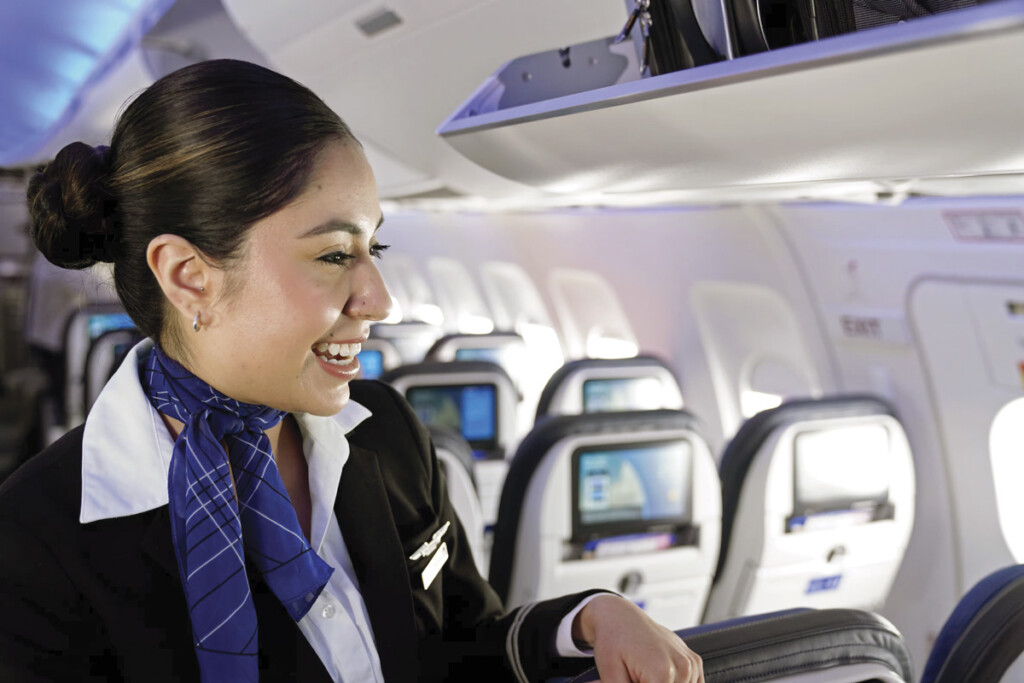
In 1998, the first of JetBlue’s crew uniforms reflected a casual image, which was updated in 2004 to a more modern and professional look that incorporated a blue palette in alignment with the airline’s brand identity. In 2010 JetBlue partnered with distinguished designer, Stan Herman, to create a refreshed uniform collection focusing on function and comfort. Dark blue silhouettes trimmed with bright orange features bring a sophisticated and contemporary accent to the airline’s ‘look,’ In 2014, the airline expanded its uniform options to accommodate a wider variety of sizes and diverse body types for its crew.
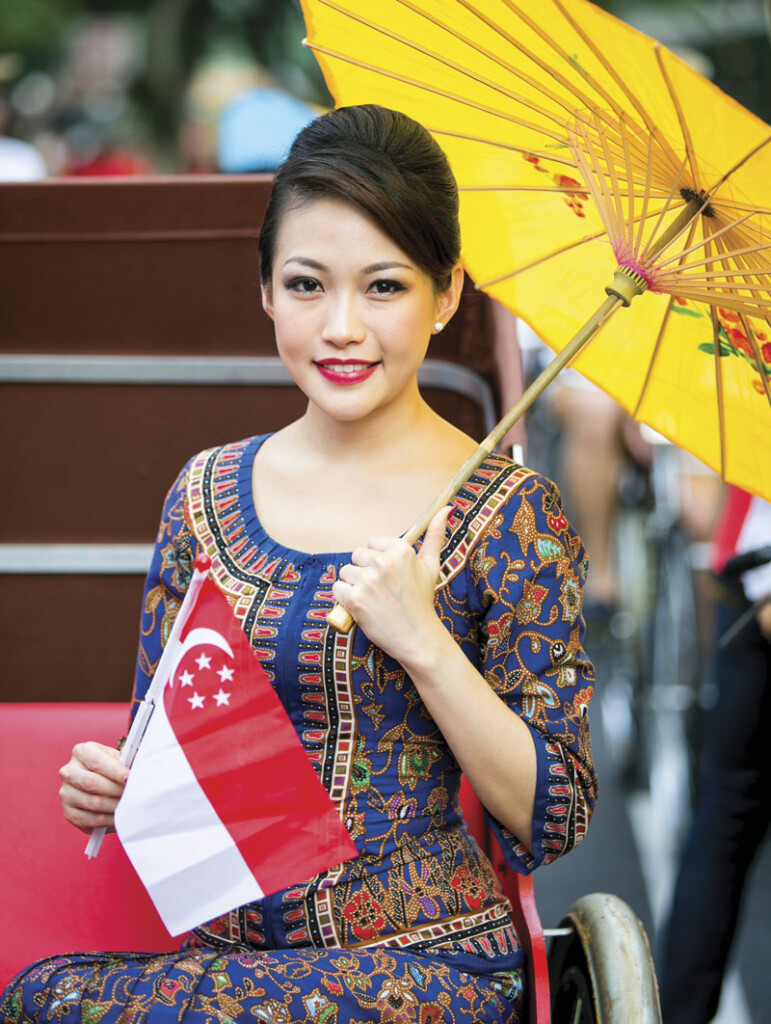
Still of note today is the enduring Singapore Airlines sarong kebaya uniform, designed in 1968 by French couturier Pierre Balmain for Malaysia-Singapore Airlines, later adapted by Balmain in 1974 for the then-newly named Singapore Airlines (SIA). The sarong kebaya designed for SIA’s female cabin crew (iconically coined as ‘Singapore Girls’) features a traditional Asian batik and a timeless silhouette that combines practicality and elegance that reflects the airline’s heritage. Four different kebab colors represent the ranks of each female crew. The male cabin crew uniform, updated in 2008, comprises a single-breasted navy blue suit, a sky-blue shirt, and a striped tie. Similarly, the ranks of the male crew are reflected in the color of their ties. Singapore Airline’s sarong kebaya is the longest-serving airline uniform today, and it has become a symbol of the high levels of service that the airline is renowned for.
In 2014, British fashion designer Vivienne Westwood unveiled a new line of redesigned uniforms for all staff members across the board (both flight crew and ground staff) employed by Virgin Atlantic. The airline’s cabin crew uniform features a vivid red jacket with a cinched waist and high collar paired with a pencil skirt, red shoes, and a red leather bag to accessorize the uniform. The male cabin crew’s uniform features a three-piece, dark burgundy suit worn over a white shirt with a red tie. Virgin Atlantic’s flight crew wear a dark charcoal tailored suit that includes a single-breasted jacket with a tie for men and a cravat for women. In September 2022, the airline announced an update to its gender identity policy, removing the requirement for its workforce to wear gendered uniform options.
Perhaps the best example of the antithesis between uniform and high fashion is Hainan Airlines’ elegant fifth-generation uniforms designed by renowned fashion designer Laurence Xu.
In 2017, Hainan Airlines, headquartered in Haikou, China, debuted its new haute couture collection for its cabin crew at the Fall/Winter Paris Couture Week. The collection combines traditional Chinese features and internationally popular elements that are more likely to be seen on a Paris runway rather than an airport runway.

Hainan Airlines’ describes Xu’s design as ‘Repurposing the alluring look of the Cheongsam, a stylish traditional Chinese dress for women usually worn on more formal occasions, the uniforms feature a collar overlaid with a pattern of auspicious clouds and a lower hem with a pattern alternating sea and mountains which contrasts with the collar’s clouds and sky, drawing a comparison between a Hainan aircraft that has just taken off, and a roc, a mythical bird denoting strength as it lifts into flight. Western-style draping incorporates popular fashion elements alongside a sense of high-quality professionalism.’ The men’s version of the uniform incorporates a more Western look with a smaller element of traditional Chinese culture. A double-sided cashmere coat and a detachable cape were added to the uniform, adding to the uniform’s practicality and aesthetics.
Plans for the uniform were strenuously tested to ensure its suitability in the cabin. During the design process, Hainan Airlines and Laurence Xu met and spoke frequently, going through more than 1,000 design blueprints and trying out more than 100 samples of garments and accessories. Said Xu, “The fabric was made of polyester, cotton, silk, and spandex, which made the whole uniform very light.” The aprons were processed to be waterproof, greaseproof, and dust-resistant. The design team also made the Cheongsam static-free and with radiation protection.
“When waiting at the boarding gate, stewardesses will be wearing Cheongsam, coats, hairpin, beret-style hats, and high heels to show their full respect to passengers.” Said Laurence Xu.
Eco-friendly Uniforms for Airline and Aviation Personnel
In recent years, many airlines have made considerable strides toward sustainability by creating uniforms that are eco-friendly not only for their personnel but for a more positive impact on the environment.
Dani Des Roches, a Design Consultant for Circular Fashion, recently spoke to Metropolitan Airport News about sustainability, “There is a lot of exciting movement in the fashion world right now toward considering the total lifespan of a garment from its conception stage. By designing garments around the principles of circularity – which means considering aspects of the design that could keep a garment in use for longer – we can not only slow the rate at which clothing ends in a landfill, but foster brand loyalty from the consumer. These circular principles are everything from comfort, functionality, and timelessness to longevity, repairability, and disassembly. With function and versatility being so integral to the dress of flight crew staff, it would only be natural to see these principles reflected in uniforms for airline employees.”

A few of the many airlines making strides in sustainability and the repurposing of airline staff uniforms include Air France, JetBlue, and Virgin Atlantic.
As part of its commitment to sustainable development and notably its policy of recycling end-of-life products, Air France has set up an innovative and original uniform recycling operation. Uniforms are recycled with the help of energy recovery in the form of textile pellets that are burned and used in the manufacturing of cement. In 2016, Air France reported that in an approximate three-month period, 8.56 tons of clothing were transformed into 1.28 tons of cement.
In 2018, JetBlue introduced uniforms made with enhanced fabric technology that supports the airline’s commitment to sustainability by implementing eco-friendly practices that include exploring the use of recycled materials and ways to reduce waste.
Virgin Atlantic reported that all 22 uniform pieces in the airline’s collection have been designed with the environment in mind, with many items produced using recycled materials – including a recycled polyester yarn made from used plastic bottles.