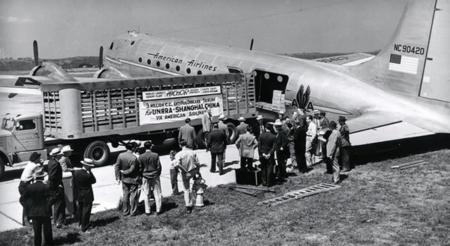





Despite appearances to the contrary today, Port Washington, Long Island, with its calm, sheltered waters and location 15 miles from Manhattan, was once conducive to aviation development, at least that using pontoons and floating hulls as opposed to that with wheels.
Wealthy Gold Coast mansion owners like the Vanderbilts, the Guggenheims, the Belmonts, and the Astors had the finances to invest in early “aerial yachts,” taking off from the very water that fronted their homes.
“Residents contributed mightily to the advance of flying, beginning as far back as 1910,” according to Daniel Pedesich in his article, “The Aeronautical Heritage of Port Washington” (Long Island Historical Journal, Volume 11, No. 1).
“From 1929 through 1956, aviation was the heart and soul of Port Washington.”
Although the private aircraft of the rich were all but closed out to the public, that situation changed when Pan American World Airways selected the North Shore town as its base for scheduled flying boat service across the Atlantic, first to Bermuda and then to Europe, during what became a brief but illustrious era.
Port Washington Base
Pan American’s choice can be traced, to a degree, to the American Aeronautical Corporation, the first company to establish a presence in Port Washington, NY, after it contracted with the Societa Idrovolanti Alta Italia, an Italian airplane manufacturer, to sell Savoia-Marchetti seaplanes on January 1, 1929.
Success, however, was intercepted by the Great Depression, at which time aircraft orders dried up, and the company was forced out of business.
But its hangar, then the United States’ largest privately owned one, became available for purchase at a fraction of its price, and Pan American, eager to establish a northeast hub, acquired it.

Along with the shelter of Manhasset Bay’s water and the expanse of Long Island Sound beyond it, it became the ideal aquatic airport for operations.
Despite this promise, however, the actual airport facilities were less than shining.
“While the (flying) boats, as they were floated into the landing docks, were impressive, and the spit and polish of the crew taking over their craft at the first bell, then boarding passengers at two bells, was dramatic, the reality of the Port Washington base was disappointing,” according to Denise Duffy Meehan in “How Port Washington Gave Birth to Pan Am” (Goodliving, June-July 1987).
“What would resemble a third-world airport today housed facilities such as Customs, Immigration, and Public Health, along with the operations division of the airline. The ‘terminal’ was modest with few amenities.”

Bermuda Service
Pan American’s first scheduled service was decidedly shorter than that to Europe, entailing, instead, a partial, 770-mile oceanic crossing to Bermuda, and was the result of British government-granted reciprocal route rights; its own Imperial Airways also linked the U.S. with the island.
The initial, but opposing-direction survey flight, occurring on May 25, 1937, entailed the eastbound departure of a Pan American Sikorsky S-42B quad-engine flying boat, the “Bermuda Clipper,” under the command of Captain Harold S. Gray from Port Washington, and that of the slower, reciprocal, westbound Imperial Airways’ Short C class “Cavalier” from Bermuda.
Three more such flights, along with an official service inauguration, followed in June by the two airlines. But the actual, regularly scheduled one took place on the 18th, each operating a single weekly round-trip.
“The Bermuda operation provided an excellent flying laboratory for the study of Atlantic weather and flight problems, and in particular for gaining experience with in-flight deicing conditions,” according to R. E. G. Davies in Airlines of the United States Since 1914 (Smithsonian Institution Press, 1998, p. 256).
“Deicing boots and deicing equipment for the propellers were fitted to the S-42, the largest aircraft of its day so-fitted.”
In the process, the North Shore Long Island community was placed “on the (airline) timetable of the world,” according to one local resident. But “world,” to Pan Am, meant Europe, and it set its sights on serving it.
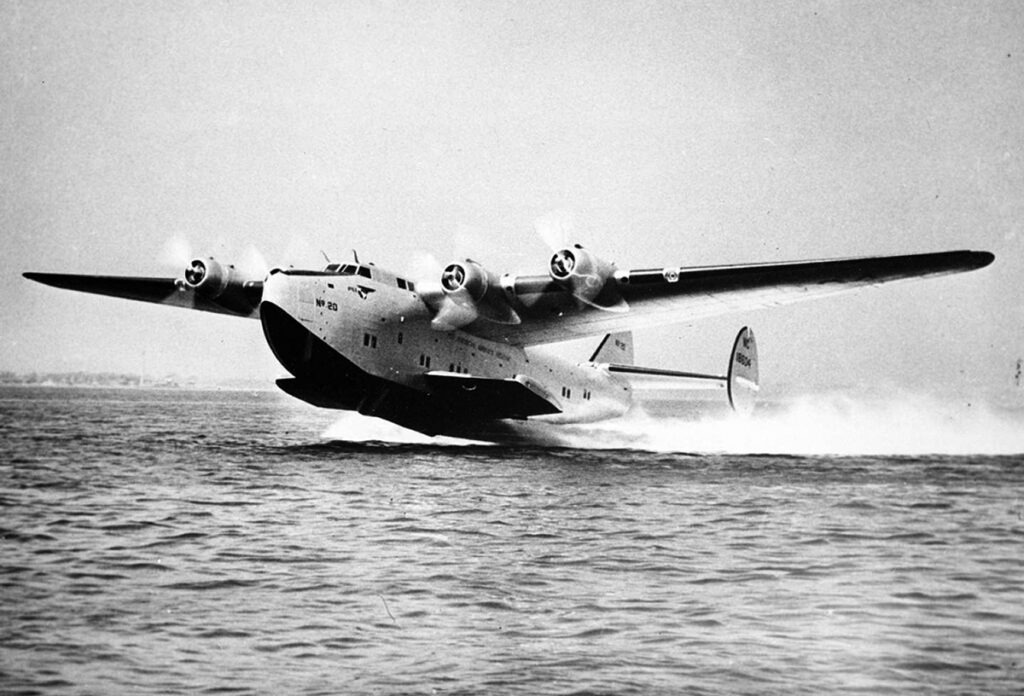
Boeing B-314 Flying Boat
Although the S-42 was considered a technological marvel for its time, its 750-mile range was hardly suitable for the full Atlantic crossing, and the carrier’s three existing – and significantly larger – Martin M-130 flying boats were needed for its comparable Pacific service.
That it would have been unable to operate the route with an acceptable payload against anticipated headwinds sealed its fate. What was needed was a type with both sufficient profitability and range.
Based upon the design requirements submitted by Juan Trippe of Pan American to Boeing, Consolidated, Douglas, and Sikorsky, in February of 1936, for a long-range, four-engine, transoceanic amphibious airliner capable of carrying a 10,000-pound payload on at least 2,400 statute mile routes against a 30-mph headwind and cruising at a 150-mph airspeed, Boeing itself proposed its B-314 and Pan Am signed a contract for a half-dozen on July 21, 1936.
It was nothing short of a behemoth, a true, aerial ocean liner, both efficient and elegant, and in a class of its own.
“The magnificent aircraft outstripped all rivals in size, load-carrying ability, and performance,” Davies wrote (ibid, p. 257).
“Efficient and elegant, it was in a class of its own, and the finest civil passenger-carrying flying boat ever built.”
European Service
Amid the blare of a brass band and the quay thronged with friends, relatives, messengers, reporters, and photographers, the 22 passengers, having had their tickets, passports, and baggage checked (the latter restricted to a 15-pound maximum), filed down the long dock to which the B-314, immersed in Manhasset Bay, was moored, on June 28, 1939, then the most mammoth and luxurious airliner, in- and externally reflecting the nautical heritage which had inspired it.
Piloted by Captain Rod Sullivan, who had previously operated the inaugural flight to Wake Island in the Pacific with the S-42, the transatlantic B-314 “Dixie Clipper” inched away from the dock at 15:00 local time with the 11 crew members, 22 passengers, and 408 pounds of mail. Lumbering through Manhasset Bay, it executed its acceleration run, cascading water by the drowning load behind it. Moving up on step, it disengaged itself from the surface which had provided its buoyancy, and the North American continent hovering above it at a 120-mph airspeed.
When a post-departure engine check revealed positive readings, the throttles were pulled back from the 1,550 to the 1,200-hp level, thresholding an initial climb to 750 feet, and then a secondary power reduction to 900 hp for a final ascent to altitude at 126 mph.
Reflecting the standard of ocean liner service, white-gloved stewards distributed the passenger list in a cabin that could easily have doubled as a nautical vessel.
Subdivided into two decks, the flying boat featured a carpeted and upholstered-chair upper level, which stretched more than six feet in height and extended 21 feet in length, and was provisioned with cockpit positions for the pilot, the copilot, the navigator, and the radio operator; a master’s desk; a meteorologist’s station; crew sleeping bunks; and a baggage compartment which was partially located in the wing. The cockpit and cabin crew consisted of between ten and 16 members.
A starboard-positioned stairway provided an inter-deck connection.
The soundproofed cabin, itself subdivided, featured five ten-passenger compartments; a single, special four-passenger section; a deluxe bridal suite; a dining room; a full-service galley; a men’s restroom; and a ladies’ powder room.
Passenger capacity included 74 by day and 34 by night, in convertible berths.
As befitting a destination directly served by scheduled, international airline service, Port Washington was eventually subjected to considerable development: paved roads now covered the agricultural foundation upon which it once rested; car and taxi service offered a surface link to New York City, to which most passengers were destined; and businesses expanded.

Brief, Glorious Era
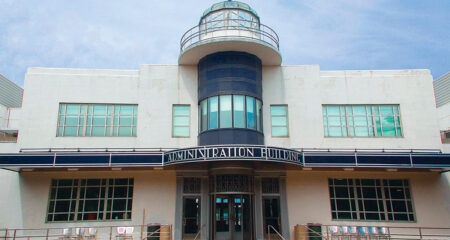
But Port Washington’s prosperous, scheduled-airline era lasted less than a year, with operations transferred to LaGuardia Airport and its Marine Air Terminal.
“From the late-1930s through the mid-1940s, Long islanders were uniquely located to view the brief, but glorious age of the commercial flying boat, operating from the two seaplane airports on the North Shore (Port Washington and New York Municipal Airport),” according to the Cradle of Aviation Museum in Garden City, Long Island.
“The few long-range aircraft of the day required extremely long take-off runs, and, as no existing airport could accommodate them, they were built as flying boats so they could take off and land in any sizable harbor. New long-range airliners built after World War II, however, were able to operate from new airports on land. Flying from airports on land, they were cheaper, easier, and safer to operate than flying boats; thus, the majestic seaplanes soon disappeared from American skies forever.”
Nevertheless, Port Washington temporarily became the center of international air transportation for the New York metropolitan area, once a small, relatively unknown North Shore community whose surrounding water became its greatest asset, transforming it into the gateway to the world.