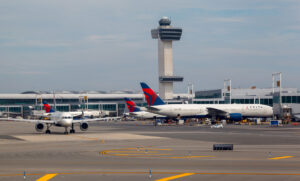




When a boarding announcement was recently made in the gate area at Los Angeles International Airport for a flight to JFK, most of the passengers rose from their seats, and a man instinctively took out his cell phone.
“They just called the flight,” he said to his wife. “We’re boarding now. I’ll be home in about five hours.”
A century ago, there were no cellphones, and those “five hours” would have constituted only a fraction of the transcontinental journey.
Early Airliners
Like a mountain to be climbed, the coast-to-coast crossing became an early, natural goal to be achieved, but lack of speed, technical sophistication, range, and appropriate navigational aids proved daunting obstacles, especially in the dark of night.
“One problem was a certain apprehension about flying by night,” advises R. E. G. Davies in Airlines of the United States Since 1914 (Smithsonian Institution Press, 1998, p. 111). “This was shared by operator and client, whether the Post Office (which sent mail by air) or the paying passenger. At this time, the science of navigation by instruments and the use of radio was in its infancy in the US, and the ability to fly during the hours of darkness rested entirely upon dependence of the lighted airway…”
In order to circumvent these restrictions, transcontinental air service assumed an intermodal nature. Daylight portions were made by air, while nighttime ones were conducted by trains in Pullman cars in which passengers slept. The most famous of these interchanges, and reflected by its very “Transcontinental Air Transport” (TAT) name, used a combination of Ford 5-AT Trimotors and surface transport provided by the Pennsylvania and Santa Fe railroads, with Columbus, St. Louis, Waynoka, and Clovis as their plane-to-train transfer points. Known as the “Lindbergh Line,” it began this service on July 7, 1929, requiring 48 hours to complete.
The Boeing 247, then considered the first modern airliner with its low, cantilever wing; two 525-hp Wasp radial engines; aerodynamic cowlings; and heated, sound-proofed, ten-passenger cabin, closed the transcontinental gap between Newark and San Francisco in less than half that time–in this case, 21 hours–requiring seven intermediate stops. It was operated by National Air Transport (NAT), one of United Airlines’ predecessors.
So competitive was it because of the aircraft that airlines tried to place orders of their own for it. Since production positions were sold out for years, however, Douglas responded with its similarly configured, 12-passenger DC-1. Succeeded by the slightly larger, 14-seat DC-2, and powered by two 875-hp Wright Cyclone engines, it became the wings with which Transcontinental and Western Air, forerunner to TWA, inaugurated Sky Chief service between Newark and Los Angeles on August 1, 1934, requiring 18 hours, with intermediate stops in Chicago, Kansas City and Albuquerque, to complete. The return journey, free from prevailing headwinds, was more than two and a half hours shorter.
Based upon design direction given by American Airlines, its wider, 21-passenger DC-3 counterpart became the most-produced aircraft of its time and the first that was able to generate a profit solely by carrying passengers.
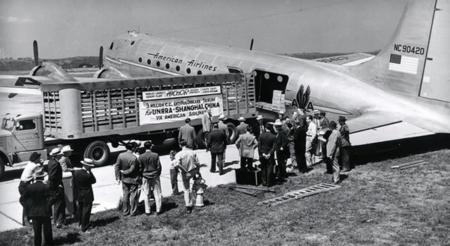
In 14-berth configuration as the Douglas Sleeper Transport (DST), the first of eight was delivered to American Airlines, which inaugurated transcontinental “American Mercury” service with “Flagship California” on September 18, 1936. It covered the eastbound route from Glendale to Newark in 15 hours, 50 minutes, stopping in Tucson, Dallas, and Memphis, although the westbound one, through the same cities, required 17 hours, 41 minutes to cover.
“The DC-3’s virtue was its greater range, which compressed flying time between far-apart cities and required fewer refueling stops,” according to Robert J. Serling in Eagle: The Story of American Airlines (St. Martin’s/Marek, 1985, p. 102).
Passengers enjoyed full-course meals and cocktails, and during night portions, retired to seat-converting, Pullman car-resembling, curtain-covered sleeping berths with their own upper sky windows through which they could view the stars.
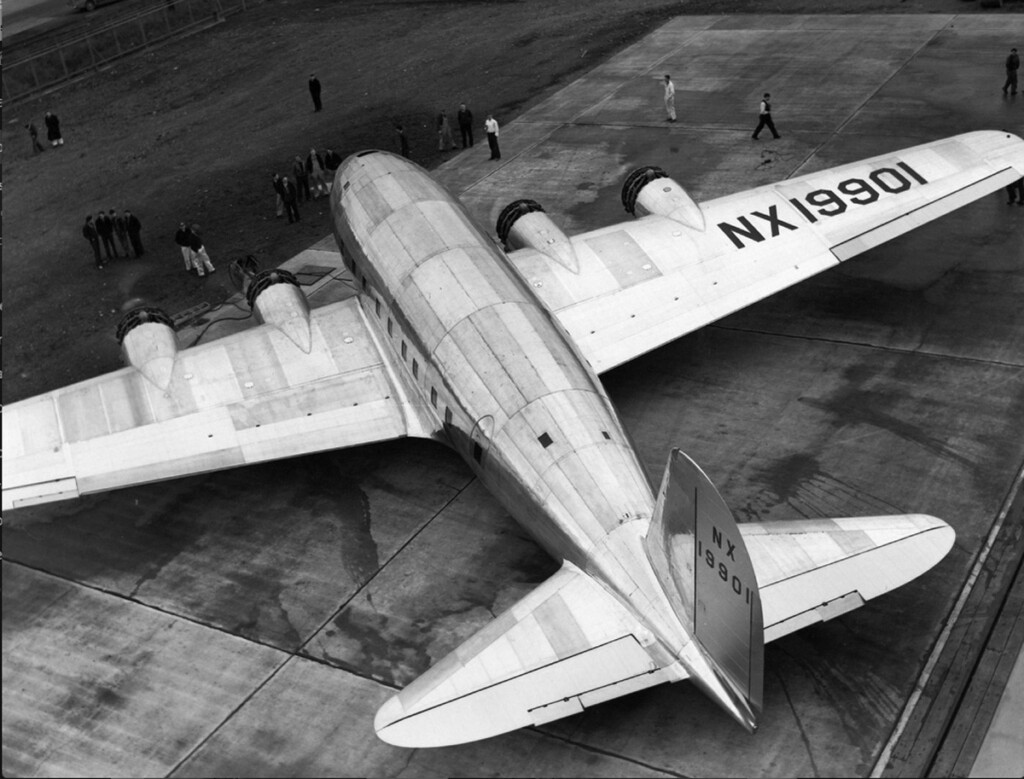
The pinnacle of pre-war piston airliners was the Boeing 307 Stratoliner. Powered by four 1,200-hp Wright Cyclone engines, it was heated, lighted, soundproofed, and pressurized, facilitating high-altitude, above-the-weather cruising and the accommodation of 32-day or 16-night passengers, who enjoyed fully-stocked galleys, razor-equipped lavatories, ladies’ lounges, and curtained sleeping compartments.
TWA placed the “wide body” type into transcontinental service between New York and Burbank with stops in Chicago, Kansas City, and Albuquerque on July 8, 1940, completing the westbound trip in just over 14 hours and the eastbound one in just over 12, and setting several speed and time records in the process.
Although it offered great promise, the eight built for TWA and Pan American were requisitioned by the US Army Air Force for World War II transatlantic military service operated by its Air Transport Command at the end of the following year.
Post-War Airliners
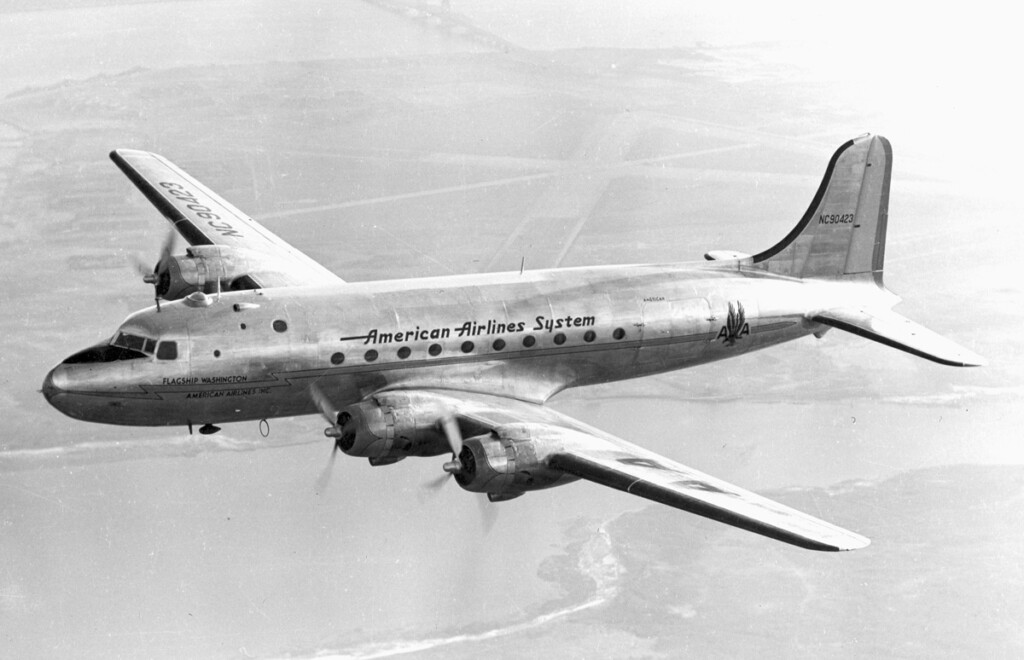
The Douglas DC-4, with its four, 1,450-hp Pratt and Whitney R-2000 engines, higher gross weight, greater capacity, and tricycle undercarriage, served as Douglas’s transition from the smaller, tailwheel DC-3 and enabled United to inaugurate single-class, 66-pasenger, coast-to-coast service with it on September 30, 1951.
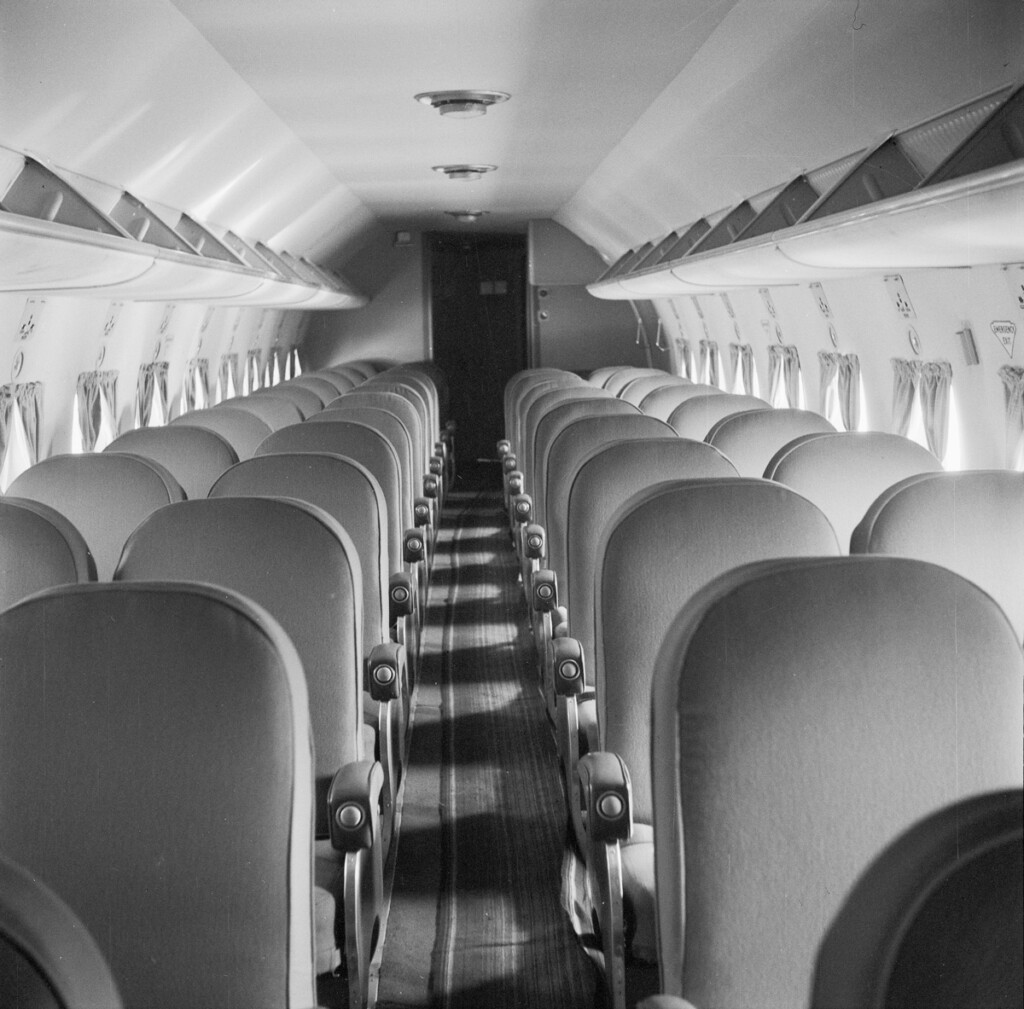
But it proved no competition for Lockheed’s post-war, piston-liner, the L-49 Constellation, whose design was largely dictated by Howard Hughes, who always strove for superlatives. Sporting an almost airfoil-shaped fuselage and a triple vertical tail, and featuring internal pressurization, it demonstrated its “superlative” transcontinental crossing capability by completing it in six hours, 58 minutes.
TWA, which varied its configuration by route, served the New York-Los Angeles sector in 11 hours with a single stop, and the reverse one in 9.45 hours.
The speed and comfort of it attracted passengers, profits, and ire from competing Douglas, which was forced to design a DC-4 successor, the DC-6, with its own pressurized cabin. Powered by 2,400-hp Pratt and Whitney Double Wasp engines, it incorporated a 6.9-foot fuselage stretch, rectangular passenger windows, and enabled Untied to reduce its east- and westbound, single-stop transcontinental flying times to, respectively, 10 and 11 hours. It was succeeded by improved higher-altitude versions, the DC-6A freighter and the DC-6B.
“The DC-6…incorporated many firsts for an airliner, and learned lessons form the first Constellations, thus refining the air travel product even further,” according to John Proctor, Mike Machat, and Craig Kodera in their book, From Props to Jets: Commercial Aviation’s Transition to the Jet Age, 1952-1962 (Specialty Press, 2010).
Lockheed, naturally, responded with its own L-1049 Super Constellation and L-1649A Starliner versions.


TWA, operating the L-1049C, exploited the aircraft’s 18-foot fuselage length increase, which provided both a 35-percent higher capacity and a 40-pecent higher payload, on its premier transcontinental Ambassador route, inaugurating the first sustained, nonstop, eastbound service between Los Angeles and New York on October 19, 1953. It was covered in just under eight hours.
Douglas’s competitive response was the DC-7. Its speed advantage, achieved by, 3,250-hp Wright R-3350 Turbo-Compound engines, and greater capacity, attained with a 3.4-foot longer fuselage, collectively offered advantages over TWA’s Constellations, enabling launch customer American to offer nonstop transcontinental service in either direction on November 29, 1953 between Los Angeles and New York-Idlewild for the first time. Four months later, on March 29, its “Flagship Illinois,” achieved the official speed record of six hours, 10 minutes.
The Jet Age
Powerplant type, combined with the optimum aerodynamic design features, produced speed. In the case of the pure-jet engine, whose four-stroke air intake, compression, combustion, and exhaust sequence, operated on the reaction principle, it facilitated significant speed increases and eliminated propeller-associated drag and vibration.
The Boeing 707, the first US commercial jetliner, evolved from the 367-80 prototype and exuded speed with its sleek lines. Powered by four Pratt and Whitney JT3C turbojets and sporting 35-degree swept wings, it was placed into service on October 28, 1958 with Pan American, but first crossed the continent with American three months later, enabling passengers to fly from the west coast to the east in that five-hour internal.
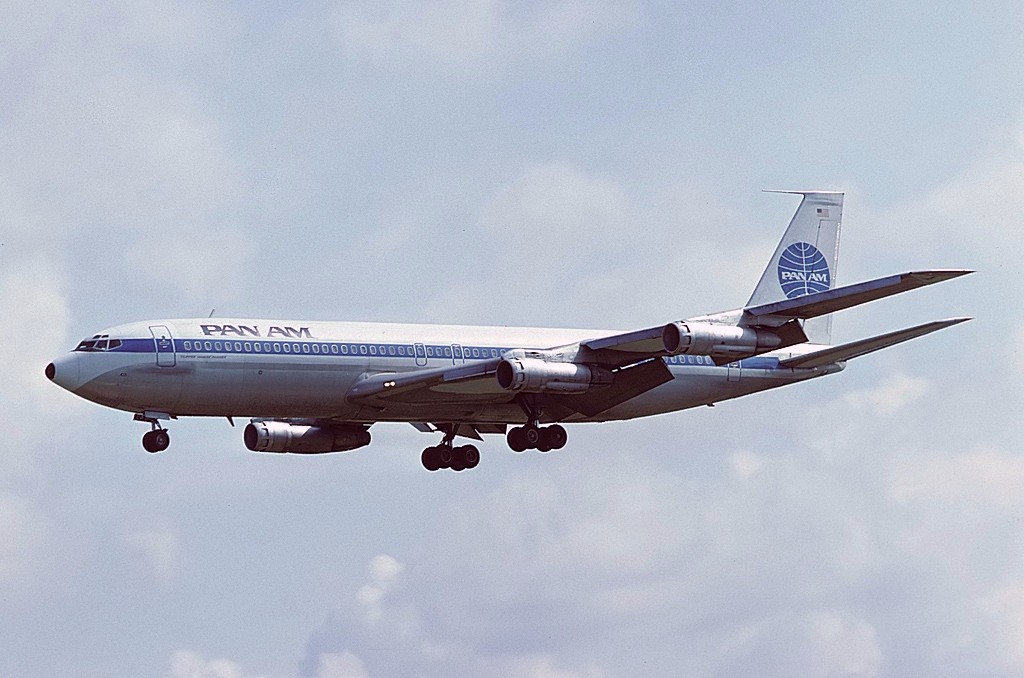
“The eagle (American Airlines) and the jet rendezvoused January 25, 1959,” according to Serling (op. cit., p. 306). “On that day, American pioneered transcontinental jet service between New York and Los Angeles.”
Its inaugural Flight 2, piloted by Captain Charles Macatee, carried seven other crew members and 112 passengers on its record-setting continental crossing, completing it in four hours, three minutes.
All these flights, spanning three decades, demonstrated that air travel resulted in new ratios. Speed progressively shank the continent and distance could now be measured in terms of the flying time it took to cover it—initially from 48 hours to a final five.