



Accessible Services at New York Airports


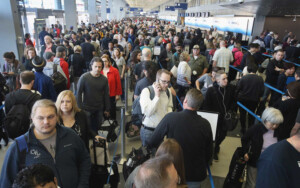
For people with hidden disabilities, entering an airport can often raise stress levels, as they are inherently unfamiliar, noisy environments with long lines and crowds. While accommodations for disabilities that are visible can be made for people impacted by mobility, hearing loss, and vision impairment, those with hidden disabilities may struggle with anxiety, change, transitional situations, social skills, and communication. Portable sensory kits with plush play equipment, texture, and color can help to alleviate these challenges, creating a sense of calm for passengers who are overstimulated. It is typical that someone with a disability travels with at least one adult or family member, meaning that at least one other person is affected by the stress of traveling with a disability.
Passengers with hidden disabilities who are traveling through the JFK International Arrivals Terminal 4, and those who are traveling with them, who need more information about sensory kits and lanyards, or who are unsure about amenities for the disabled are advised to e-mail: [email protected] for further assistance, and somebody will respond to assist them to the best of their capabilities.

“At JFKIAT, fostering a safe, accessible, and welcoming environment for all travelers within Terminal 4 is of the highest priority,” said Roel Huinink, CEO of JFKIAT, the operator of Terminal 4 at John F. Kennedy International Airport. “From leveraging artificial intelligence to assist individuals who are blind or visually impaired, to holding training classes for guide dogs, and bridging the gap for those with hidden disabilities who may need additional space or time, and more, our initiatives are working to provide essential resources, care, and assistance that help to ensure all individuals feel supported throughout their entire journey, from curb to gate.”
JFKIAT Terminal 4 maintains a fleet of equipment to assist in the boarding and deplaning all passengers whose flight departs/arrives at a remote parking area instead of a Gate at the terminal. All buses utilized for remote parking operations are equipped with wheelchair ramps to allow for quick and seamless bus boarding for disabled passengers requiring wheelchairs. Regarding transit from the bus to the aircraft (or vice versa), T4 utilized its Mobile Jetbridge Units or Ambulift units to assist. The Mobile Jetbridge is a product designed by ‘Aviramp’ that allows all passengers (disabled or not) to ascend/descend a ramp from the main aircraft door. The Ambulift is a vehicle that has the ability to raise the passenger compartment from ground level to meet the door of an aircraft which would allow for a passenger to be safely lowered down to ground level.

Guided Vision Assistance via AIRA Access; Artificial Intelligence Remote Assistance (AIRA) is a mobile app designed for blind or low vision customers to navigate independently with the assistance of a Live Remote ‘Agent’. This complimentary service is available at all access points, terminals, and AirTrain stations; however, it is not available at TSA/CBP checkpoint screening areas. All you need to do is download the complementary app on a smartphone. The ‘agent’ on the phone will assist you and know what is in front or near you with the use of the camera, GPS, and other web data on your phone to provide visual descriptions on demand. To download the AIRA app, go to www.aira.io

Travelers Aid is an internationally recognized non-profit organization contracted by the Port Authority of NY & NJ to provide various services to passengers at JFK International and Newark Liberty International Airports. Travelers Aid assists passengers who experience problems such as missed airline connections, flight delays, and lost luggage. Their information desks are staffed by a group of dedicated volunteers (in blue vests/blazers) who can guide travelers with answers to questions about the airport or the New York metro area. In addition, the Travelers Aid professional staff manages the volunteer program and offers social service support to passengers encountering challenges at the airport. Services include customer service and airport information; guidance for travelers with unexpected challenges; meet and assist; social service and referrals.
Jane Mrosko, the program manager at Travelers Aid, JFK International Airport, said, “The Port Authority really values these types of programs, and they show their care for passenger’s well-being and safety.”
John Morris – Founder, WheelchairTravel.org

John Morris is the Founder of WheelchairTravel.org, the world’s largest accessible travel resource that covers a vast amount of information that involves every aspect of inclusive travel for disabled people.
In 2012 a car accident laid claim to three of Morris’ limbs. Before his disability, Morris was a world traveler, and travel was his first true love. More than a year after his accident, he took his first trip to Los Angeles to see his alma mater, Florida State University, win the college football national championship. But planning the trip was difficult, and Morris found that the internet was filled with unreliable information about traveling with a disability, and nothing that he read prepared him for what traveling with a wheelchair is like. After traveling for more than a year, he launched WheelchairTravel.org.
Morris only writes about the places he has visited and the experiences he has had from the seat of his wheelchair. He is committed to providing his readers with the tools to access the world independently or with family, friends, or caregivers. He is also deeply interested in disability advocacy, diversity, inclusion, and visibility. He works each day to engage with business and government leaders to create a world that is more accessible to everyone, as well as to educate readers about what to expect when traveling with a mobility impairment.
In a recent interview with Metropolitan Airport News, John Morris shared his personal experiences of his travels through New York metropolitan airports and the mobility challenges faced by disabled passengers.
“One of the foremost challenges,” said Morris, “is that each carrier is responsible for delivering the accessibility services, particularly services that mobility impaired travelers rely on…wheelchairs, boarding assistance, handling of personal mobility equipment. All of this is the responsibility of the airline, particularly in airport assistance and getting to the gate, which is handled by contractors. There isn’t a consistency of experience. But there are things that travelers can do to head off the challenges, and chief among them is to inform the airline in advance of your travels and specific needs.” While Morris said this doesn’t always work, it helps the airlines better plan for the customers they are going to be servicing on a particular day.
With close to 1,000 flights to his credit, Morris believes each airport brings about different challenges and benefits for travelers with disabilities. “The biggest challenge in the entire travel industry is the lack of information,” said Morris, “if this information was provided, my website would no longer exist.” He added that there needs to be a balance between the challenges and the benefits that are now becoming more accessible. “I respect the challenges that air carriers face, as there is great variability in the number of passengers that need assistance daily, and that is hard to plan for and staff. It’s a hard problem to solve. But there’s a lot more data now on usage that can be utilized to plan better with.”
Airport Resources
Each PANYNJ airport has its own webpage of accessibility services that include information on wheelchairs, oxygen requirements; drinking fountains; restroom accommodations; pet relief areas; hearing impaired accommodations; Planemates, or ‘mobile lounges’ used to transport passengers between arriving/departing aircraft and the gate area; Autolink Service (for connections to other flights); transportation to and from the airport, and car rental options.


- Accessibility Services at John F. Kennedy International Airport (JFK)
- Accessibility Services at Newark Liberty International Airport (EWR)
- Accessibility Services at LaGuardia (LGA)
- Mobility-Friendly Travel Guide
Proper planning is the cornerstone of any successful trip, and it’s even more crucial when you’re traveling with mobility aids. About 30% of Americans over the age of 65 living outside of institutions use assistive devices for mobility purposes, both inside and outside the home. Many use a wheelchair or scooter, while the greatest number use canes, crutches, and walkers.