



Today’s airline passengers search the internet for the lowest possible fare, pay for their ticket with a credit card, have an electronic boarding pass sent to their cellphones, and ultimately board the aircraft after a gate agent scans their QR code. Depending upon the route, they settle into their seats, have access to the latest inflight entertainment, and may be wined and dined, depending, of course, upon their chosen class.
Aircraft a century ago seated relatively few and were initially unpressurized. Long-range international and intercontinental journeys were measured in days, not hours, and entailed multiple city and country stops. They required nighttime accommodation in either cabin-converted sleeping berths or in hotels, and were sometimes multiple-mode in nature, involving both surface and air means.
A review of some of these long-forgotten types operated by European carriers sheds light on the flying experience some 100 years ago.
Fokker F.XII
As an early high-wing, wooden, trimotor, the Fokker F.XII, produced in Holland, ushered in the 1930s-decade. It represented a streamlined monoplane and enabled KLM Royal Dutch Airlines to establish both its European and intercontinental route systems with it, carrying between 10 and 18 passengers.
Receiving an eight-strong launch order from the carrier, it first flew on December 5, 1930, but operated its first passenger flight three months later, on March 5, with its president, Albert Plesman, on board, spanning the continents from Europe to Asia.
It advertised the adventurous nature of its Dutch East Indies route to Java, as follows.
“Fly by KLM – the world’s oldest air travel company, on the world’s longest air route – 9,000 miles in ten days,” it enticed. “The voyage of your dreams by ‘Flying Dutchmen,’ the latest American-engine Fokker monoplane to Holland, the Acropolis, the Pyramids, the Holy Land, Baghdad, Mysterious India, the Ganges from aloft, the Golden Domes of Rangoon, Java, and Bali. A complete world panorama in ten glorious, pleasure-packed days.”
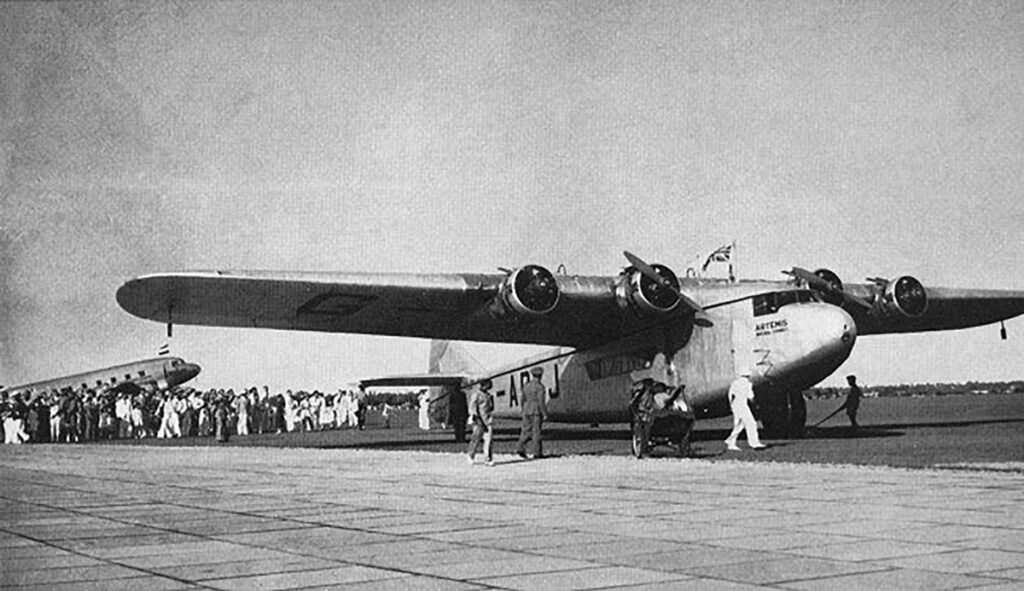
Armstrong Whitworth AW.15 Atalanta
The Armstrong Whitworth Atalanta, built across the channel in England, represented an evolutionary step in aeronautical design with its low-drag, streamlined configuration, high wing, and four engines.
“Extremely careful streamlining is the main feature that impresses one when first confronted by the Atalanta,” according to the Armstrong-Whitworth AW.15 Atalanta (British): A Commercial Multi-Place Cantilever Monoplane description (National Advisory Committee for Aeronautics, Aircraft Circular No. 167, Wash., August 1932, p. 1).
Powered by four 340-hp Armstrong Siddeley Serval III radial engines, it accommodated nine, three-abreast passengers in reclining, head- and shoulder-supporting seats, and featured both a galley and a lavatory on African routes, as operated by Imperial Airways, predecessor of both British Overseas Airways Corporation (BOAC), and today’s British Airways.
A multiple-mode, ten-day, 7,963-mile routing from England to South Africa and entailing two rail journeys and seven nights in hotels, left Croydon Aerodrome and passed through Paris and Brindisi, Italy, but by rail, and then continued by air to Athens, Alexandria, Cairo, Assiut, Aswan, Wadi Haifa, Khartoum, Kosti, Malakal, Juba, Entebbe, Kisumu, Nairobi, Moshi, Dodoma, Mbeya, Mpika, Broken Hill, Salisbury, Bulawayo, Pietersburg, Johannesburg, Kimberley, Victoria West, and Cape Town, according to its April 10, 1934 timetable.
“On all Empire services operated by Imperial Airways, meals taken on board the airliner, as well as hotel accommodation and tips, are included in the fare,” it noted.

Dewoitine D.338
France designed its own early airliners, one of which was the Dewoitine D.338.
Powered by three nine-cylinder, air-cooled, 650-hp Hispano-Suiza engines, which turned constant-speed propellers, it featured a 72.7-foot overall length, a 96.4-foot wingspan, and a corresponding 1,066-square-foot wing area.
Air France emphasized the aircraft’s comfort by stating that it offered twelve reclining armchairs, a bridge table between facing seat pairs, and a cabin bar.
It operated the type on numerous routes, such as the one to West Africa, which required an aircraft interchange.
“Air France service to the West African Coast is operated in conjunction with the Aeromaritime Company,” according to its 1938-1939 Winter Timetable. “The service, which leaves London on Saturdays, reaches Dakar in Senegal on Sunday night by the first section of the Air France line to South America. The main part of this journey is flown in large Dewoitine 338 three-engine liners, cruising at 185 mph.
Air France also described the exotic nature of its intercontinental routes, particularly the far-flung, 9,209-mile, London-Hong Kong journey that required 22 en route stops to complete.
“Each week, in both directions, Air France airliners connect France to Indo-China and China, by way of the Mediterranean and India,” it stated in its Far East Timetable (March 30, 1938). “From Marseilles to Tripoli in Syria, by way of Athens; from Damascus to Baghdad; from Jodhpur to Bangkok and beyond; as far as Saigon, Hanoi, and Canton, the history of western and eastern civilization is spread beneath Air France wings, and brought to memory by names which revive classic recollections, “Tales of Arabian Nights, and the mysteries of secret Asia and the Asiatic Temples. Phocaeon Marseilles, Naples, and its famous boy, in which is reflected Vesuvius, Corfu with its carpets of flowers and dusky maidens evoking carriers of amphora. The Ionian Sea is scattered with islands of bewitching names, Leucade, Cephalonia, and Ulysses’ Ithaca. Further, between Patras and Corinth, Lepanto, where Ottoman galleys were defeated. Athens. Above the Cyclades, the flying boat scuds along towards Rhodes and Castelrossa.
“And then on the threshold of a legendary world, is Tripoli in Asia; Damascus with its gardens; Baghdad, capital of Haroun-al-Raschid, the cruel, but literate caliph, friend of Charlemagne. From the coast of Iran, a fantastic view of the desert, the cliffs, and the sandstone citadels. At Karachi, the Arabian Sea is followed by yet another ocean, one with coagulated waves, the Sindh desert, a scorching land of mirages and thirst. At Jodhpur, another civilization—that of India, and then onwards to Allahabad, Calcutta, and Akyab. Finally, he arrived at Rangoon, Siam, with its cool pagodas and French Indo-China with artistic treasures hidden away in the shaded forests.”
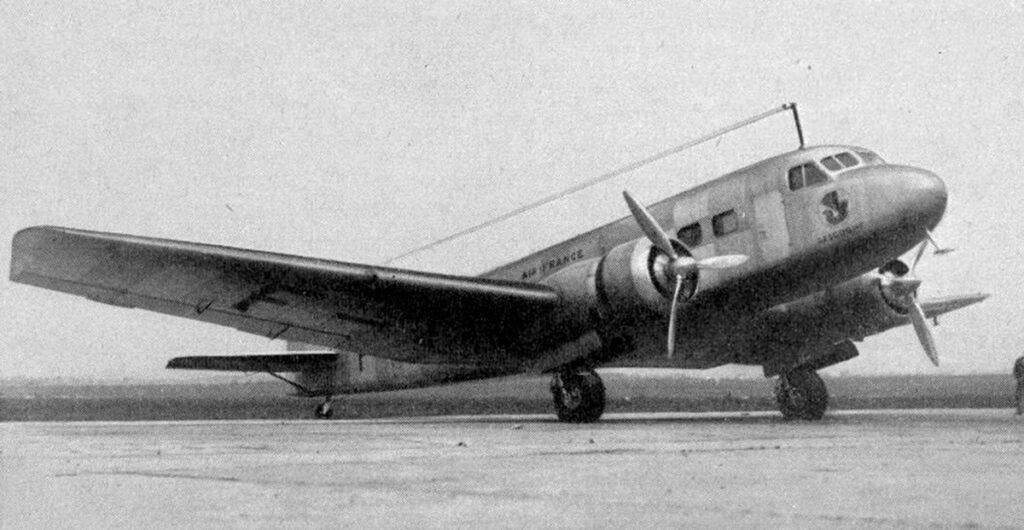
Bloch MB.220
Another French airliner was the Bloch MB.220, a low-wing, all-metal, cantilever monoplane that could be considered the equivalent of the Boeing 247 and the Douglas DC-2 built in the US. Its cabin, subdivided into six- and ten-passenger sections in a two-abreast configuration with a central aisle, sported tray table-provisioned Pullman seats. A bar and a lavatory were respectively installed on the aft left and right sides.
“The steward serves light refreshments from a well-stocked bar, where most drinks from champagne to iced draught Lager may be obtained,” it described its service. “On some routes, a full-course luncheon is served (on linen and china).” One of them, between Paris-Le Bourget and London’s Croydon Aerodrome, departed in the afternoon, but required a surcharge. “Luncheon, price 25 francs, is served on the 13:30 service from Le Bourget,” it noted. “Please order in advance.”
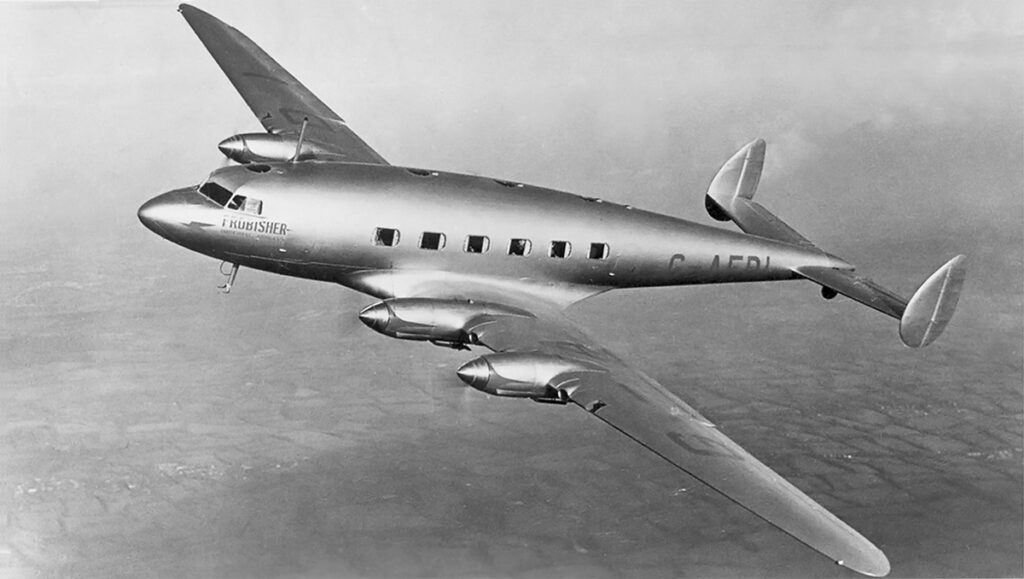
De Havilland DH.91 Albatross
Once again across the channel, England produced the de Havilland DH.91 Albatross, often considered the most elegant design.
“Aerodynamic refinement was the driving consideration in the design of this elegant aircraft, and the result was a fantastically clean fuselage,” according to BAE Systems, the company that de Havilland ultimately became. “This was enhanced further by featuring a retractable undercarriage and an engine installation with minimal frontal area.”
Standard crew consisted of the two pilots, a radio operator, and a flight attendant, and up to 22 passengers could be accommodated in the cabin.
Imperial Airways, which placed the launch order for five Albatrosses, took delivery of the first in October 1938 and inaugurated it into service two months later on the 52-minute London (Croydon Aerodrome) – Paris and 48-minute London-Brussels sectors.
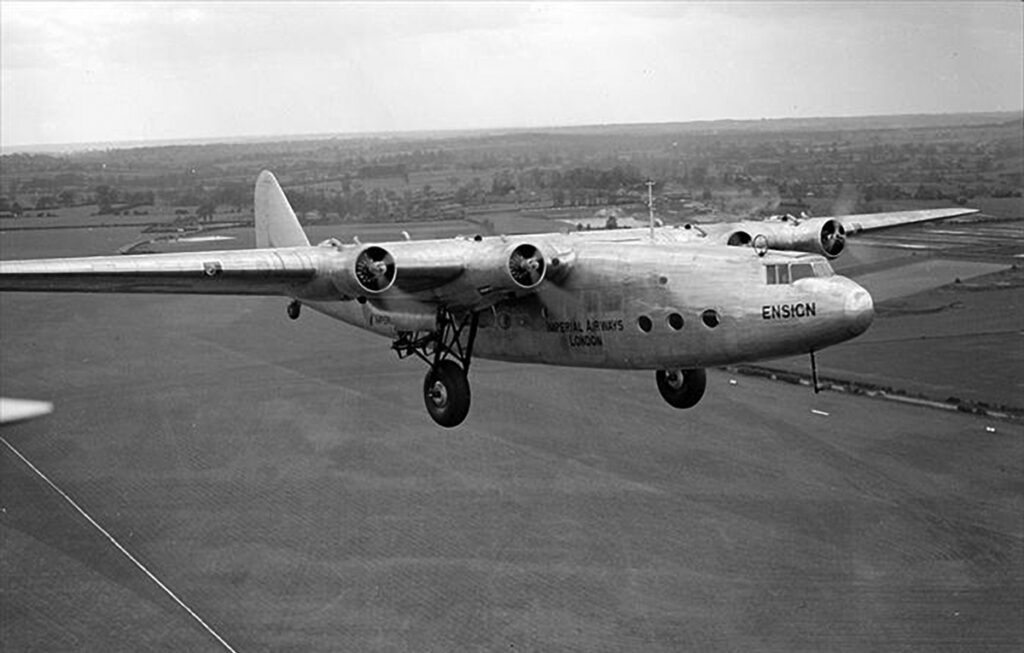
Armstrong Whitworth AW.27 Ensign
The Armstrong Whitworth AW.27 Ensign, Britain’s largest interwar transport landplane, represented the manufacturer’s aeronautical bridge between the bi- and monoplane configuration and was designed to fulfill Imperial Airways’ requirements for a continental-European and long-range Empire route airliner.
One configuration, with winged seats and curtained porthole windows through which views were completely wing-unobstructed, featured a forward, 12-passenger smoking cabin; an aft, equally 12-seat, but nonsmoking one; and a final four-passenger one, all in a three-abreast, one-two, arrangement. The single seats were convertible into sleeping berths on the Empire routes.
Journey times included coach transportation to the airport of departure and from the airport of arrival, as well as the actual flight. In the case of the London-Paris sector, passengers departed the Airways Terminal in Britain, took off from Croydon Aerodrome, landed at Le Bourget after a one-hour, 20-minute flight, and completed the surface portion to the Paris Airway Terminal in France.
Breguet Deux Ponts
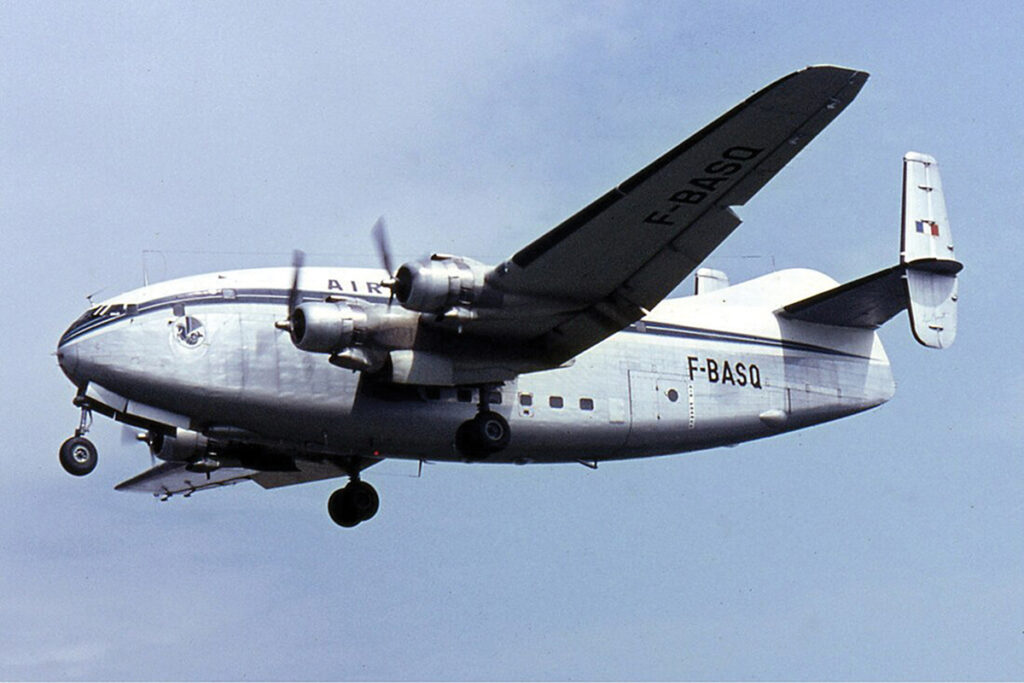
Despite Boeing’s progressive 747 upper deck stretches and McDonnell-Douglas’s proposed, but never-built, dual-deck MD-12, Airbus finally fulfilled that long-envisioned goal when it first rolled out the A380 from the factory in Toulouse, France, on January 18, 2005. Ironically, and most likely little-known, is the fact that a full double-decker airliner was designed in the same country more than three-quarters of a century before it, and at a time when technology had hardly reached a level of maturity.
The aircraft was often referred to as the “Breguet Deux Ponts,” which was not its official name, but an acknowledgment of its “double-decker” design.
“The idea behind the design of the ‘Deux Ponts’ was to offer operators a freighter to carry the largest payload as far as possible at the lowest cost,” according to Jean-Christophe Carbonel in his article, Aeroplane Database: Breguet ‘Deux Ponts’ (Key.Aero, June 12, 2023).
One hundred seven passengers could be accommodated in a five-abreast upper and a four-abreast lower arrangement. As a combi, it carried 59 passengers and 22,000 pounds of cargo, and as a pure-freighter, it accepted a 33,000-pound payload, which could consist of outsize shipments, vehicles, tanks, and even helicopters, all of which were loadable through four wide, laterally-opening, rear doors.
Air France operated the type on its Provence routes from Paris-Orly to Marseilles, France; Ajaccio, Corsica; and Algiers, Algeria.