

Airports are dynamic, fast-moving, and complex environments that can be stressful for even the most seasoned, stalwart traveler. They are gateways that serve as immersive centers for diverse people of varying ages, cultures, languages, and backgrounds, including people with visible or non-visible physical and cognitive disabilities.
Each traveler’s journey may present a unique set of hardships. For people with intellectual or developmental disabilities, for those with physical disabilities who may struggle with mobility, and those with medical challenges who scramble to find their bearings in a large, crowded, over-stimulating complex, the airport experience can be overwhelming to the point where air travel is seen as an unimaginable option.
There is a heightening awareness that every traveler along their journey deserves an airport experience that is hospitable, accessible, and accommodating, be it seniors who may be frail or affected by dementia, an anxious traveler looking for a comfortable space to decompress in, people in need of sensory features that will improve their airport experience, a person traveling with a service animal, or a family traveling with small children or those with special needs.
As awareness around accessibility and inclusivity has evolved, airports are some of the most adaptable, well-suited spaces for the implementation of universally accessible provisions and inclusive design for all people.
Acknowledging the needs of all air travelers, inclusive and functional spaces furnished with accessible provisions and user-friendly resources create a sustainable and resilient environment that prioritizes the needs of both people with disabilities and people without disabilities.

In creating an inclusive environment, airports are required to comply with the Americans with Disabilities Act (ADA), which prohibits discrimination towards people with disabilities and implementing accessibility measures in public accommodations.
The Port Authority of New York & New Jersey (PANYNJ) is committed to creating inclusive and supportive environments in their airport facilities and workplace for people with disabilities or who identify as neurodivergent, including those with autism. The agency is dedicated to ensuring these spaces are accessible, accommodating, and supportive, and it has launched several programs aimed at raising awareness and empowering both patrons and employees. For employees, the Port Authority Abilities Network (PAAN) acts as a resource for disability-related matters and aims to build awareness, maximize potential, and empower employees with and without disabilities.
“Accessibility is a critical part of the Port Authority’s mission to create world-class airports, where state-of-the-art technology and thoughtful design will make travel easier and less stressful for passengers of all ability levels,” said Port Authority Executive Director, Rick Cotton.
On the Port Authority’s website is a ReciteMe Accessibility toolbar, accessed by clicking an ‘Accessibility Tools’ button at the top of each page. Each respective airport page has a list of information regarding accessibility services tailored to the specific airport. This enables users to customize their interaction with the site, such as by providing a screen reader, reading assistance, changing text by size, color, or font, or translating more than 100 languages, including 35 languages for text-to-speech.
The Port Authority also plans to test an AI-driven automatic sign language translator with a photo-realistic synthetic signer to provide online accessibility information for all of its airports. It maintains an accessibility guide where passengers can find airport-specific information and the agency’s supplemental accessibility requirements.

Externally, programs like The Sunflower Lanyard are available across all PANYNJ airports and obtainable at their welcome centers. The Sunflower Lanyard allows passengers with hidden disabilities (such as Autism, PTSD, ADHD) to discreetly alert airport staff that they might need help navigating through the airport. This initiative is part of a broader effort that includes sensory rooms at Newark Liberty and LaGuardia airports and plans for enhanced sensory spaces at JFK, ensuring their facilities exceed accessibility requirements.
From tranquil sensory and wellness rooms to wheelchair assistance, specialized security lanes, and assistance for people who are deaf or blind, many accessible provisions are presently in place at Port Authority of NY & NJ airports, and more are to come, including:
- Artificial Intelligence Remote Assistance (AIRA) is a mobile app designed for travelers with low vision or people who are blind to navigate the airport independently with the assistance of a Live Remote ‘Agent’. Once the app is downloaded, the ‘Agent’ will assist passengers in knowing what is in front or near them using the camera on their smartphone. The mobile app can be downloaded at www.aira.io
- Family suites and all-gender and accessible restrooms are available at all Port Authority airports.
- Sensory rooms that provide a refuge for travelers, particularly people with autism and sensory processing complications.
- Service Animal Relief Areas (SARA) – low maintenance, ADA accessible areas with cleanable turf, specialized exhaust ventilation, a hand wash sink, waste bag supply and disposal.
- John F. Kennedy International, Newark Liberty International, LaGuardia, and New York Stewart International airports accommodate passengers traveling with service animals by offering outdoor and indoor service animal relief areas.
- TSA Cares Program – This Transportation Security Administration’s dedicated helpline allows passengers to request assistance traveling through the TSA screening checkpoint at Port Authority airports. Passenger Support Specialists are TSA officers who have received advanced training in assisting passengers with disabilities, medical, or other circumstances through the screening checkpoint. To request support, passengers can submit an online form via www.tsa.gov at least 72-hours in advance of travel or by calling TSA Cares at (855) 787-2227
- Transportation navigation software allows individuals to share appropriate information with a third party to enhance efficiency and safety.
- Wellness rooms are acoustically sound spaces designed with co-efficient-rated ceilings, noise reduction, and sound insulation. They are furnished with softly blended tones, natural elements, and aesthetics that provide a quiet, comfortable space with ambient lighting for travelers who need a place to relax away from the noise and congestion of an airport.
- The Seeing Eye – This philanthropic organization’s mission is to enhance the independence, dignity, and self-confidence of blind people through the use of Seeing Eye® dogs. Collaborating closely with the Port Authority (PANYNJ), the TSA, and United Airlines, The Seeing Eye has been training guide dogs annually at Newark Liberty Airport for over two decades.
- Wings for Autism/Wings for All – Special needs accommodations extend to the overall airport experience. Wings for Autism/Wings for All events, sponsored by The Arc of the United States, give families and aviation professionals the confidence to take to the skies by providing airport rehearsals and a presentation on aircraft features and in-flight safety protocols. Chapters of The Arc throughout the country, local partners, airports, airlines, and TSA personnel work collaboratively to design and carry out each Wings event. During a Wings rehearsal, participants check in to receive boarding passes, proceed through the TSA security checkpoint, wait in the boarding area, and board an aircraft (that does not take off). This helps to alleviate some of the stress that people with autism and other Intellectual and developmental disabilities (IDD) and their families experience and learn about how their loved ones will react to different stimuli in an airport.

Newark Liberty International Airport
The Pre-Security Sensory Room located in Newark’s Terminal A provides a refuge from the stress of air travel. Created for neurodivergent travelers and people on the autism spectrum, the PANYNJ designed the room with the architecture and design firm PGAL and in consultation with leading experts from the Anderson Center for Autism, which certified the space and provided training to terminal staff. Echoing a New Jersey sense of place, colorful carpeting and soft textures suggest flowing water, a grassy shore, a sandy beach, and bright saltwater fish swimming in a large tank. Soft, warm light radiates from slabs of pink Himalayan salt. The pre-security sensory room can help prepare travelers in Terminal A for the next steps in their journey, and through the TSA Cares program, they can wait for a TSA passenger support specialist in the sensory room and can exit through the room’s back door for a separate TSA screening line for a calmer experience.
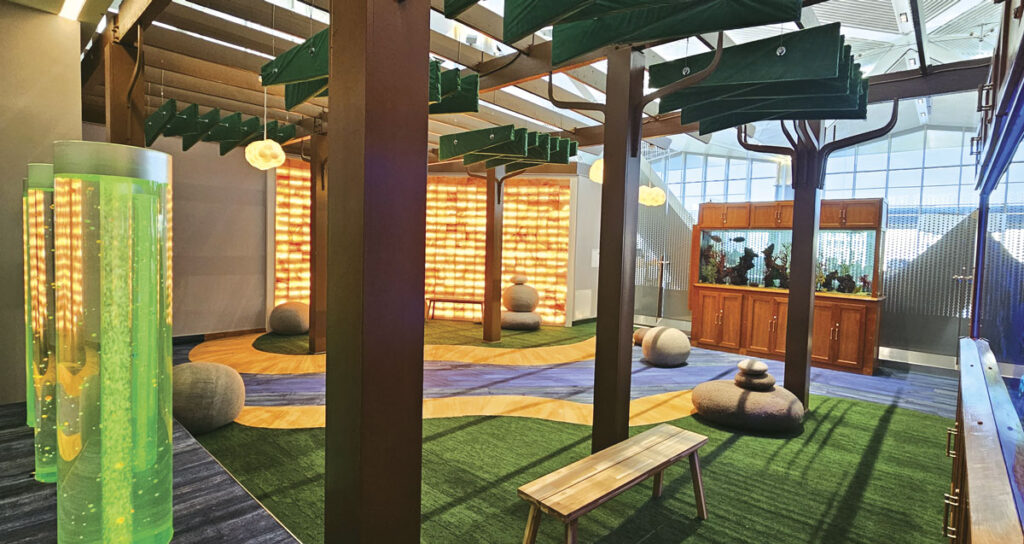
The PANYNJ is also working on a second complementary sensory room in the same terminal, located past security, that will serve as a bookend for a smooth and stress-free airport journey for individuals and families who may need a grounding space and room to help overstimulated travelers a place to decompress. The Post-Security Sensory Room is expected to be completed later in the year at Newark Liberty Airport. It will replicate the on-board airplane experience with furnished seats, seatbelts, and faux windows, as well as typical entertainment monitors and cabin lighting that create a calming pre-flight rehearsal experience, especially for first-time travelers and those who rarely fly.
Additional features at Newark include:
- Terminal A – Pre-security Sensory Room, Indoor pet relief areas.
- Terminal B – Family restrooms with adult changing tables, a dog run & indoor pet relief areas.
- Terminal C – Partnership with The Seeing Eye
- Terminal A & C – Family restrooms with adult changing tables are underway
- Hearing loops are available at Terminal A guest experience desks and the Terminal B & C Welcome Centers at Arrivals Level 1.
- Newark Liberty International staff receive regular training in assisting those with vision disabilities through a 30-year partnership with The Seeing Eye, Inc. The organization trains puppies for future roles as guide dogs and trains airport staff to aid travelers. The Port Authority and representatives from the U.S. Transportation Security Administration and United Airlines teamed with volunteers from The Seeing Eye and Newark Liberty and recently welcomed 220 dogs and 265 volunteers over two training sessions in Terminal C. The sessions were part of a special program to train the next generation of puppies to be guide dogs, assisting people with low vision or blindness in navigating airports.

LaGuardia Airport
- Terminal A – Family restrooms with adult changing tables.
- Terminal B – Accessibility features for guests with hearing, vision, and mobility disabilities, such as hearing loops at all guest desks, intuitive departure board displays, accessible assistance at drop-off and check-in points, color-coded wayfinding across the terminal, a calming seating area with plants and foliage.
These features helped Terminal B become the first airport terminal in the U.S. to receive a gold rating, the highest, in the Rick Hansen Foundation Accessibility Certification (RHFAC) program.
Following this certification, Port Authority Executive Director, Rick Cotton said, “Among all the accolades received by Terminal B, we are particularly proud that the new terminal is the first in the nation to be awarded Gold certification by the Rick Hansen Foundation.” - Terminal C Sensory rooms help overstimulated travelers find a place to decompress.
Just beyond security, Delta Air Lines’ sensory room includes soft lighting, bean bag chairs, and a small aircraft mock-up to help passengers familiarize themselves with air travel before their flight.
John F. Kennedy International Airport
Each terminal has curbside unloading areas for baggage and passengers, usually near the airline entrance door, with wheelchair-accessible entrances. Wheelchair services are available, and arrangements may be made with airlines at least 24 hours in advance of travel to confirm assistance with baggage check-in, ticketing, and movement to the gate area. Skycaps are available to assist with luggage.
The terminals and parking lots at JFK are divided into five areas, each specified by a separate color. Parking spaces for customers with restricted mobility are located in each parking lot near the terminal entrance, subject to availability. To utilize a discount, drivers must enter the lot through the “Ticket” lane, pull a ticket, and request the courtesy discount by pressing the “Help” button and speaking with an attendant at the exit. Official license plates issued by a municipality or state of residence must be prominently displayed to park in the ADA Restricted Mobility spaces.
At JFK, the AirTrain is fully ADA-compliant and has elevators, escalators, and wheelchair locations on each vehicle. Braille signs, tactile platform warning surfaces, and destination announcements are available for passengers with low vision or who are blind. Visual paging is also available for passengers who are unable to hear announcements.
Airport Customer Experience Specialists (in red uniforms) are available upon arrival and at the Welcome Centers to assist passengers. If additional assistance is needed, call (718) 244-3563 Monday through Friday from 9 AM to 5 PM EST or visit us.qrideo.me/jfk/assist#0 for virtual assistance Monday through Friday from 8 AM to 12 AM EST.
Accessibility at T4 (JFK International Air Terminal) includes:
- ADA-compliant restrooms, water fountains, and relief areas for service animals.
- Jetweels Wheelchairs – JFKIAT is the first airport terminal in the nation to offer Jetweels wheelchairs, non-metallic, lightweight, and ergonomic wheelchairs designed to improve the travel experience for passengers who need wheelchair assistance. This initiative was launched through the Terminal 4 Airlines Consortium (TFAC) partnership.
- Arrivals Accessibility Meet & Greet – Together with airlines at JFK and U.S. Customs and Border Protection (CBP), passengers are provided meet and greet services at the gate for people with hidden disabilities. Requests for this service may be made at least 72 hours in advance of arrival at www.jfkt4.nyc.
A Vision for the Future: Accessibility and Inclusion at JFK through Redevelopment
As JFK International Airport transforms into a unified, world-class international gateway, the 2.4 million sq. foot state-of-the-art New Terminal One (NTO) will anchor the south side of the airport and is being built on the sites of Terminal 1, 2, and the former Terminal 3.
In advance of the New Terminal One (NTO) completion, with its first phase expected to open in 2026, Jennifer Aument, Chief Executive Officer of The New Terminal One, said, “We all have family and friends who have left the world of travel and adventure because navigating airport terminals became too overwhelming. Our team at the New Terminal One is creating a world-class experience that is also inclusive of all travelers’ needs, so customers who need additional support will feel cared for on every step of their journey.”
The New Terminal One (NTO) amenities and features for Passengers Requiring Assistance (PRA) will include the following:
- Dedicated PRA drop-off and pick-up areas at curbside
- PRA lounges, available at landside before security, airside after security, and at arrivals;
- lounges offer check-in kiosks (landside)
- Assisted changing rooms with hoists and restrooms
- Wheelchair storage
- Seating areas
- Quiet room
- Sensory room for neurodivergent travelers
- Tactile flooring for visually impaired customers
- Nursing rooms
- Pet relief areas
- Gender-neutral/family restrooms
- Dedicated security lanes
On the airport’s north side, the $4.2 billion development of the new Terminal 6, built by JFK Millennium Partners, will seamlessly connect to JetBlue’s existing Terminal 5. With the new Terminal 6, scheduled to open in phases, beginning with the completion of the arrivals and departures hall and the first five gates in 2026, Karen Ali, Chief Operating Officer, JFK Millennium Partners (JMP), said, “JFK Terminal 6 will cater to the needs of a variety of different travelers. This includes business travelers, for example, who may want to zip through the terminal as quickly as possible using their smartphone, to families with small children who require extra time and a more hands-on approach. There’s also travelers with pets, senior citizens, as well as travelers with reduced mobility or disabilities — both visible and invisible.
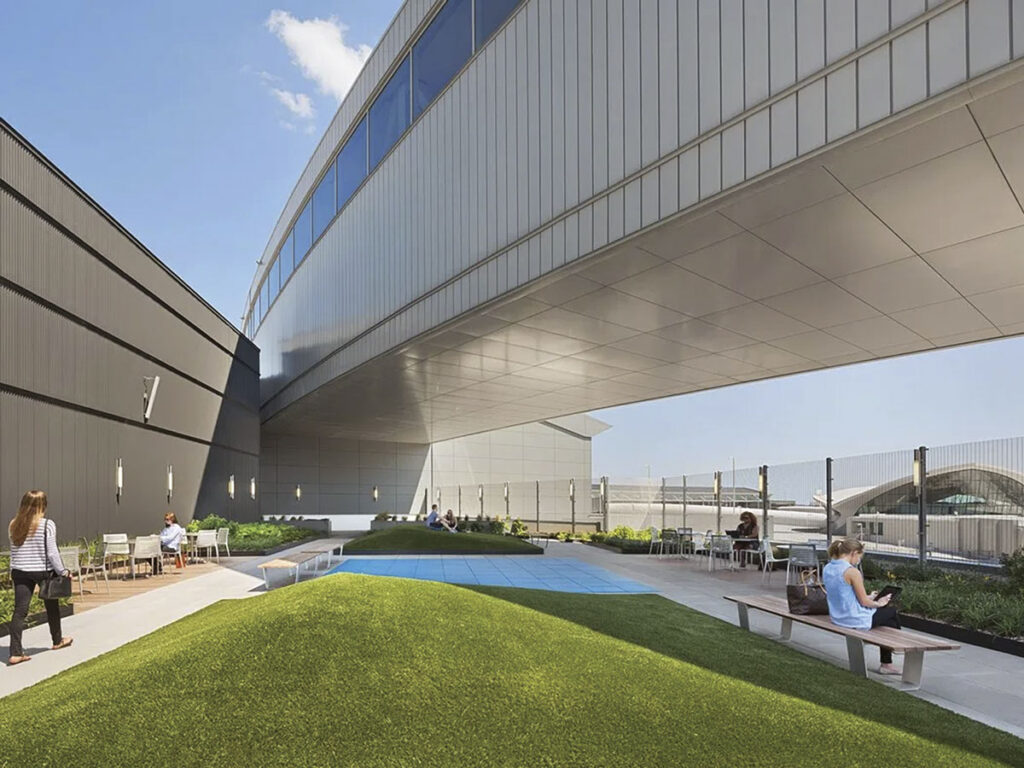
In each of these cases, and as we continue to prepare for T6’s opening in 2026 — we remain focused on providing the right infrastructure and the best technologies to meet each of our travelers’ needs. In addition, our JMP philosophy is that our people are our greatest asset, and so our goal will be to open a state-of-the-art terminal that is guest experience and ADA-oriented in its design but staffed with the right people who will go that extra mile to make all T6 travelers feel welcome and supported.”
Amenities for An Enriched Passenger and Family Experience
JFK International Airport
Rooftop & Wooftop Lounge – Located in Terminal 5, across from Gate 28, this outdoor space is open to all travelers and their pets. It features tables, benches, and a garden with planter boxes where potatoes, herbs, and other produce are grown, making the T5 Rooftop Lounge the first functioning farm in the world at an airport.
Also located in Terminal 5 is the JetBlue Junior Children’s Play Area, which includes an immersive cockpit simulator that allows young travelers to pilot an airplane in an aviation-themed play space. Here, they can also learn about aviation history events and landmarks from many of JetBlue’s destinations and a kid’s reading nook.
Located in Terminal 4 and Terminal 8 are Escape Pods that offer a quiet space for families who need to private place to retreat to, away from the activity of a busy airport. Designed to shut out the noise of the terminals, the pods include Wifi, temperature and light controls, and desks for work, food, or children’s activities. This amenity can be booked in advance at the Escape Pods website.
LaGuardia Airport
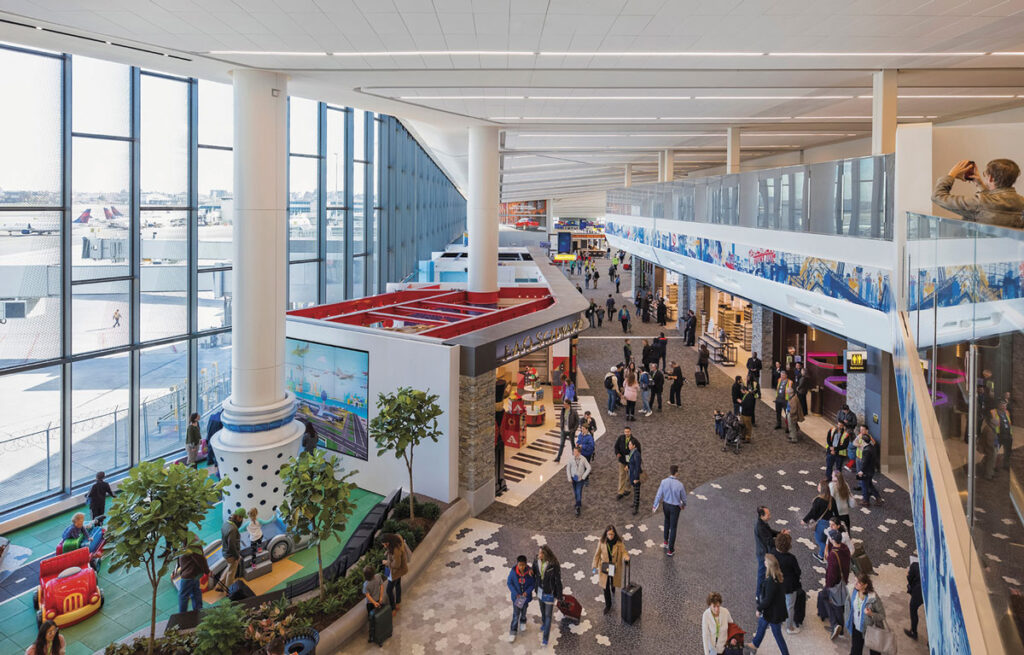
The Water Feature in Terminal B, located post-security on Level 4 of the Arrivals and Departures Hall, provides a mesmerizing display. Its 4,000 gallons of recirculated water falls from more than 450 individually controlled solenoid valves, while combined with choreographed lighting, video projection, and music, creating a spectacular show for all guests traveling through the terminal.
Play Areas are located in Terminal B’s two concourses. They include a play structure and space where kids can run and get their energy out before a flight. They can also design their own aircraft on a table and watch it come to life on a big, interactive screen.
The Sensory Room at LaGuardia is located just beyond security in Terminal C. It features soft lighting, soothing music, bean bag chairs, and gently swaying egg-shaped seats hanging from the ceiling. This space gives travelers with cognitive and developmental disabilities and their families a place to relax and prepare for their trip.
Located in Terminal B, LaGuardia’s dual pedestrian skybridges connect passengers to the terminals east gates and gives a bird’s-eye view of airplanes taxiing beneath, to and from their gates, as well as marvelous views of the NYC skyline.
Newark Liberty Airport
At the Children’s Lending Library in Terminal A, children can leave a book and borrow a different one, providing them with something new and interesting to read during their travels. The library was created through the efforts of Sia Malhotra, a local fifth grader and avid reader who approached the Port Authority in 2021 with her idea to have a children’s library at the airport.
Play Areas are located throughout Newark’s four terminals. One is located near the East Pier in Terminal A and includes a track, a rope course, and junior-sized bicycles so that children can run, climb, and get some exercise before boarding their flight.
The New Jersey Forest of Firsts, located in Terminal A, is an art installation with a digital forest that provides an immersive experience filled with music and facts about New Jersey’s history. Here, families can learn about literature, science and technology, movies, and literature, all with roots in the Garden State.
The Sensory Room, located pre-security in Terminal A, provides neurodivergent travelers and their families with a tranquil moment of respite in a space filled with soft lighting, fish tanks, and water features designed to evoke a verdant forest.