



Located in the mid-Hudson Valley, Newburgh’s Stewart International Airport (SWF), south of Kingston and some 65 miles north of Manhattan, is one of three secondary airports, along with White Plains’ Westchester County and Islip’s Long Island MacArthur. Having transitioned from a military to a commercial facility and relying on a regional market base that usually avails itself of greater destination choice in Albany and the three major New York airports, it grappled with sustained airline service in the midst of limited notoriety, a recession, and the pandemic.
Origin and Military Application
Seeds grow from farmland and, in this case, so, too, did an airport when Thomas Archibald Stewart, an aviation enthusiast and descendent of prominent local dairy farmer Lachlan Stewart, convinced his uncle, Samuel L. Stewart, to donate 220 acres of family farmland to the city of Newburgh for the purpose of establishing an airfield.
“Archie thought that a city in the twentieth century would need an airport to prosper, just as a city in the nineteenth century needed a railroad,” according to the historical marker in front of the current-day terminal. “He did something about it. In 1930, his family donated the original tract of land for this airport.”
Because the area, like the rest of the country, had sunk into the depths of the Great Depression at the time, the dirt expanses remained untouched until 1934 when Douglas MacArthur, then superintendent of the US Military Academy at West Point, proposed using the field for cadet training. The Academy itself acquired the field for a token of $1.00, but it was not for another five years that it was transformed into something usable—in this case, an equally dirt landing strip.
World War II, giving it even greater purpose, was the catalyst to more significant development, and it soon sprouted barracks and other facilities. Although the Army airfield was re-designated Stewart Air Force Base after that service branch was created, cadet training continued.
Deactivated in 1970 and subsequently acquired by New York State, it remained dormant for 13 years, at which time the 105th Airlift Wing and the 213 EIS of the New York Air National Guard established the Stewart Air National Guard Base for its Lockheed C-5A Galaxy fleet. However, within the sprawling field, there was potential waiting to be released.

Commercial Application
Despite its remote location, that very aspect, combined with 6,006- and 11,818-foot runways 16/24 and 09/27 equipped with instrument landing systems (ILS), gave then-Governor Nelson Rockefeller pause to consider it a possible commercial airport able to handle the Boeing 2707 supersonic transport currently under development.
Although cost overruns resulted in its ultimate cancellation, Concorde pilots conducted touch-and-goes on its runway, which was also designated a Space Shuttle alternate landing site in the event of an emergency diversion.
Nevertheless, the idea sowed the seed for scheduled airline subsonic service to the area, and he proposed a $30 million bond to transform the underused facility into a revenue-generating, passenger-using commercial one.
The first attempt to transition the mid-Hudson Valley facility was made by the Metropolitan Airport Authority (MTA), which used eminent domain to triple its size with the addition of 7,500 acres, envisioning it as the New York metropolitan area’s fourth airport after JFK, La Guardia, and Newark. But the 1973 oil crisis and escalating fuel prices hardly spurred airline expansion at this time and it relinquished its ambitious plan three years later.
It was not until the next decade, specifically in 1982, that control was passed from the MTA to the US Department of Transportation (DOT) with the mandate that the airport be improved and developed.
Under a pilot program, whose legislation was passed by US Congress, Stewart became one of five airports to be privatized, and a 99-year contract for its operation was awarded to UK-based National Express Group, which had concluded a similar agreement for the running of East Midland Airport in Leicestershire.
However, National Express Group’s interest quickly waned, and it relinquished its operation, as it also did with East Midlands Airport, leaving the Port Authority of New York and New Jersey to acquire the facility and assume the 93 remaining years of its lease. If officially took control on November 1, 2007.
Earmarking $500 million for its ten-year capital improvement and joining the JFK, La Guardia, and Newark fold, it had, to a degree, become the long-envisioned fourth New York airport.
After discussions between the Port Authority and the Stewart family to rebrand the facility in order to market it outside of the Hudson Valley, yet continue to honor its heritage, it re-designated it “New York Stewart International Airport,” which was part of a $37 million upgrade program.
Airport Expansion and Modernization
The transformation of New York Stewart International Airport from a military base to a passenger-carrying venue required facility and infrastructural changes.
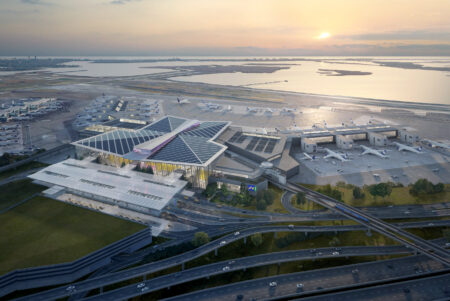
The passenger terminal, which has been subjected to renovation, now features check-in counters, a food service area and gift shop, a security checkpoint, jetbridge gates, two arrivals baggage belts, and rental car counters.
Unlike the two other comparable New York secondary airports of Westchester County and Long Island MacArthur, Stewart fields international flights. To facilitate such operations, a 19,850-square-foot, single-story Federal Inspection Service (FIS) facility housing US Customs and Border Protection attached to the original terminal building and completed on October 28, 2020, replaced the makeshift moveable wall that had temporarily separated domestic and international passengers, although pandemic-caused flight reductions left it unused until 2022. It both expanded the airport’s capability by enabling up to 400 passengers per hour to be processed and confirmed its “international” status, attracting foreign carriers and transforming it into a viable JFK and Newark alternative.
“Economic development is one of the Port Authority’s fundamental missions, and expanding Stewart International Airport to handle more international customers does exactly that,” Board Chairman Kevin O’Toole commented. “Since taking over the airport in 2007, this agency has now invested more than $200 million in the airport’s infrastructure.”
Airline Service
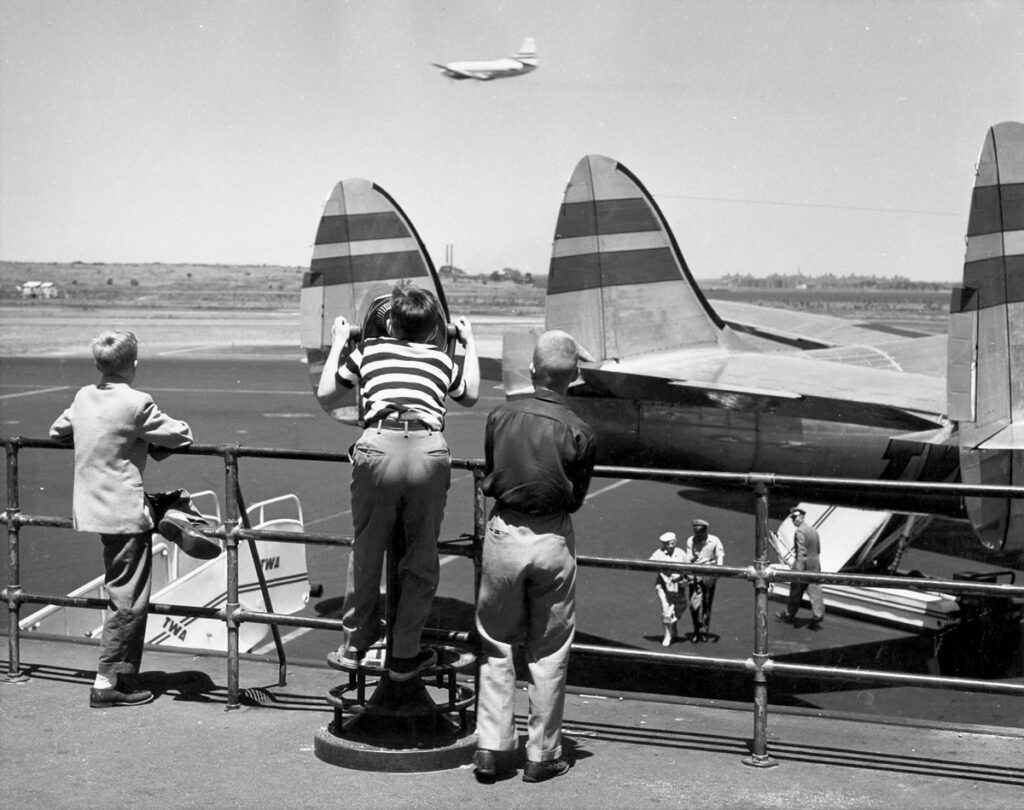
Like the two other reliever airports, Stewart International’s history has been characterized by main, regional, low-fare, and –uniquely in its case –foreign airline entrance and exodus, which varied because of load factor, fuel cost, competition, the pandemic, and pilot shortage.
American Airlines inaugurated service to Newburgh in 1990 with three daily round trips to its Chicago-O’Hare and Raleigh/Durham hubs. Although it discontinued its operation there in 2017, it briefly re-introduced a link to Philadelphia with an American Eagle Embraer ERJ-135 four years later, on January 5, 2021, only to later discontinue it because of a pilot shortage.
Before it had acquired US Airways, the airline, through its Air Wisconsin, Chautauqua, and Piedmont regional subsidiaries, had served the airport from Philadelphia.
Delta Airlines equally connected the mid-Hudson Valley with Detroit and Atlanta with, respectively, its own Pinnacle Airlines and Atlantic Southeast Airlines (ASA) subsidiaries branded as the Delta Connection, operating twin-engine Bombardier CRJ Regional Jets. Low-fare carriers, seeking to take advantage of Stewart’s lower landing fees and creating a win-win situation by offering air service to the airport, became the lifeblood of it.
JetBlue, which inaugurated Stewart service to Ft. Lauderdale on December 19, 2006 with 156-passenger Airbus A320-200s and charged $79.00 introductory fares, implemented a second daily roundtrip, as well as new service to West Palm Beach, on January 5 of the following year. It also touched down in Orlando.
Already serving Buffalo, JFK, La Guardia, Rochester, and Syracuse, it counted Newburgh as its sixth New York destination and became its largest carrier at the time.
Other low-fare, sunspot-serving carriers included AirTran, which discontinued its flights there in 2008 and was later acquired by Southwest Airlines, and Allegiant Air, which had served Myrtle Beach, South Carolina; Savannah, Georgia; and Orlando-Sanford, Punta Gorda on the Gulf Coast, and St. Petersburg, Florida, with A320 equipment.
Operating both A320s and A321s, Frontier Airlines linked the mid-Hudson Valley with Ft. Lauderdale, Orlando, and Tampa but expanded its service to Atlanta and Raleigh/Durham on May 26, 2022, with $39.00 introductory fares.
The catalyst of the $37 million Federal Inspection Facility was Norwegian Air Shuttle’s transatlantic service inauguration from Dublin, Ireland, in July of 2017, which saw traffic increase by 62 percent. A second daily frequency was added on April 26 of the following year, sparking a more than double passenger total increase.
“It is a demonstration of the airport’s unique international capability, market positioning, and proven viability as a low-cost alternative to the New York and New Jersey metropolitan regions,” according to O’Toole.
Because of the March 2019 grounding of the Boeing 737 MAX-8 aircraft it had used after two fatal accidents involving Lion Air and Ethiopian Airlines, it had to discontinue its service.
Stewart’s clipped transatlantic wings were regained on June 9, 2022, however, when Play Airlines, whose foundation had been laid by low-cost but now-defunct Wow Air, inaugurated service to Reykjavik, Iceland, with Airbus A321neos (new engine option). It facilitated connections to some 20 European destinations, such as London, Copenhagen, Paris, and Berlin, and it was the first carrier to use the new FIS facility.
New York Stewart International Airport, which is classified as a non-hub primary commercial service facility and generates some $145 million in annual economic activity for the region, saw an average 433,000-passenger throughput during the 20-year period from 2000 to 2019, offering mid-Hudson Valley air service to major cities, Florida sunspots, and European destinations.