



If aviation had an equivalent to Mecca, it would most likely be Dayton, Ohio, and its Aviation Trail enables the visitor to trace the lives of the Wright Brothers and their invention of the world’s first successful aircraft.
The Wright Brothers and Dayton
Considered the “birthplace of aviation,” Dayton itself is inextricably tied to the Wright Brothers.
“In a sense, the Wright Brothers and Dayton came of age together,” according to the National Park Service’s “Dayton Aviation Heritage” brochure. “It was a nurturing environment for the curious and creative pair. From childhood, they tinkered, built, and showed an entrepreneurial bent-tendencies that found an outlet in the print shops they ran from 1887 to 1899.”
Although the foundation of some of their work was laid by earlier aviation predecessors, such as Sir George Cayley, Clement Ader, Otto Lilienthal, Octave Chanute, and Samuel Pierpont Langley, they themselves were the first to successfully fly a controlled, powered, heavier-than-air aircraft on December 17, 1903 at Kill Devil Hills, North Carolina, in the form of the Wright Flyer because they had applied a systematic approach to solving the technological and aerodynamic problems associated with flight, focusing on the three main parameters of lift, propulsion, and balance and control.
“Theoretical work in Dayton lay behind the revolutionary control system employed at Kitty Hawk, North Carolina,” the “Dayton Aviation Heritage” brochure continues (ibid). “The aircraft they assembled there was made from components fabricated in their hometown bicycle shop.”
The Aviation Trail
As part of the larger National Aviation Heritage Area, the Aviation Trail provides insight into the Wright Brothers’ early lives, influences, and their later perfection of the airplane.
“The Dayton Aviation Trail was established in 1981 by Aviation Trail, Inc., whose mission is to preserve and promote Dayton’s unique aviation heritage, starting with the invention of the airplane by Wilbur and Orville Wright,” according to the Dayton Aviation and Convention Bureau.
Its interpretive attractions are many.
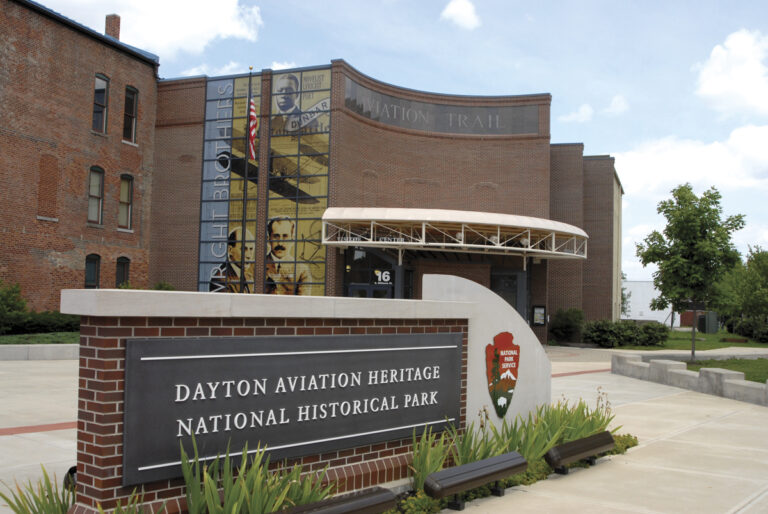
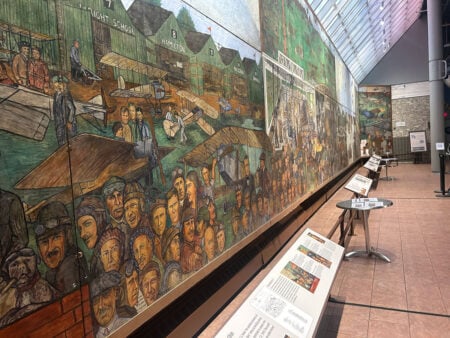
Starting point, perhaps, is the Wright-Dunbar Interpretive Center, located in the Hoover Block Building section of the complex, where the famous brothers established their printing business between 1890 and 1895. Adjacent to it is the Aviation Trail Visitor Center, which features exhibits on all aspects of their lives, from childhood to their aeronautical experiments.
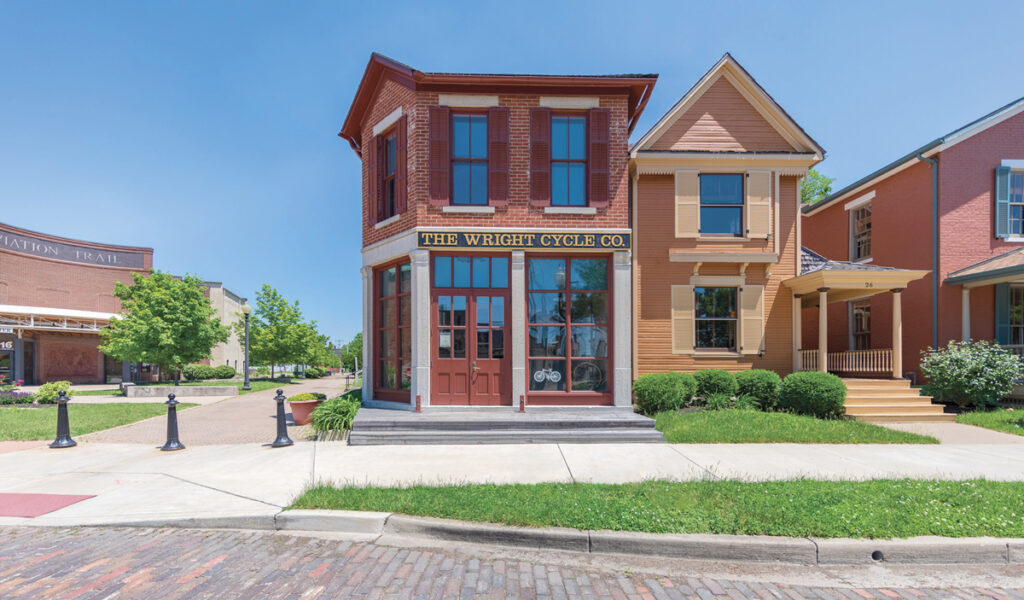
Printing led to bicycles, as can be gleaned in the Wright Cycle Company, another Aviation Trail sight. By late 1892, the joint Wilbur-and-Orville printing venture, already highly successful, had begun to diminish in importance, and interest turned to personal transportation. Both brothers had, after all, been mechanics and excellent riders and, with sufficient funding, opened a sales shop on West Third Street in Dayton. With increasing demand, and the emerging need for repairs and servicing, they moved to several successively larger shops, ultimately designing their own bicycle brand, the Van Cleve, thus forming the Wright Cycle Company.
The bicycle, however, only proved to be the first step to the airplane. Both were mechanically based, prompting the inseparable pair to create a so-called “technology transfer” from it to the airplane by analyzing the commonalities between their control methods. It was, in fact, in the back of just such a bicycle shop where the world’s first aircraft took shape.
The brick Wright Cycle Shop located at 22 South William Street next to the Hoover Block, one of only two original Wright Brothers buildings still standing in their original locations in the Wrights’ West Side neighborhood and a National Historic Landmark, was occupied between 1895 and 1897. Today, the building features its original wood plank floors, a workshop, several Wright Van Cleve bicycles, and interactive displays demonstrating the application of bicycle technology to aerial design.
Another significant Aviation Trail site is Huffman Prairie Flying Field. Although initial flight experimentations occurred in North Carolina, it had quickly become difficult to continue flying from there for three primary reasons:
The distance between North Carolina and Ohio to repair one of many parts in the more fully-equipped Dayton workshop had become prohibitive.
The sand on Kill Devil Hill would ultimately damage the engine.
Correct wind direction, tantamount to flight, often failed to materialize, resulting in countless days of inactivity.
In order to remedy the deficiencies, the Wrights received permission to use an 84-acre cow pasture located nine miles northeast of Dayton called “˙.” Its layer of clay and frost heaves hindered tree growth yet provided a surface soft enough to cushion hard landings.
It was from this field that they tested the successor to the original Wright Flyer, the Wright Flyer II. Powered by a larger, 15-16 hp engine with increased propeller width, the modified, more ambitious design featured white pine wing spars with spruce; a longer, 40-foot wingspan; reduced wing camber; a larger, aft-relocated fuel tank; and an almost 300-pound gross weight. Take-offs were achieved with a 250-foot-long wooden launch rail, considered the world’s second runway after that used in Kill Devil Hills.

Because projected winds often failed to produce sufficient airspeed in which to become airborne, however, a 1,200- to 1,600-pound catapult, erected on September 4, 1904, generated the required 28-mph aerial speed.
Of the 105 mostly-short flights conducted in 1904, the longest covered three miles, and the airplane remained aloft for five minutes, eight seconds. Between 1910 and 1916, the Wright Company operated a flying school there, training more than 100 of the world’s first pilots for the Wright Exhibition Team and the military. In 1917, the US Army Signal Corps purchased the field, along with 2,000 adjacent acres, and renamed it Wilbur Wright Field, subsequently establishing Wright-Patterson Air Force Base on it in 1948.
Today, Huffman Prairie Flying Field, the world’s first “airport,” remains exactly the way it was during the Wright Brothers’ test flights, with a replica of their 1905 hangar (again the world’s first), a reproduction of their catapult system, and National Park Service interpretive signs.
The nearby Huffman Prairie Flying Field Interpretive Center offers exhibits that focus on the 1904-1905 experimental flights, the 1910-1916 flying school, and the history of Wright-Patterson Air Force Base.
The Wright Flyer III, yet another important Aviation Trail sight, is located in Carillon Historical Park, a 65-acre outdoor museum opened in 1950 consisting of 24 attractions which deal with invention, settlement, industry, and transportation. The aircraft, seven feet longer than the Wright Flyer II and the third design evolution after the original Wright Flyer, featured decoupled wing-warping and rudder controls for the first time, the former the initial method of banking along the lateral axis. With its three axes of flight—pitch, roll, and yaw—thus independently controllable by September of 1905, the design, with larger horizontal and vertical stabilizers and upward-curving skids, eliminated turn-induced stall tendencies and was able to perform a wide range of aerial maneuvers, including banks, circles, and figure-eights. With an endurance exceeding 30 minutes, it provided the training aircraft in which countless others learned to fly.
A 1908 modification entailed the installation of a more powerful engine, reconfigured controls, and, for the first time, passenger provision on the lower wing surface.
The Wright Flyer III, housed in Carillon Historical Park’s Wright Hall, was restored under the personal supervision of Orville Wright himself.
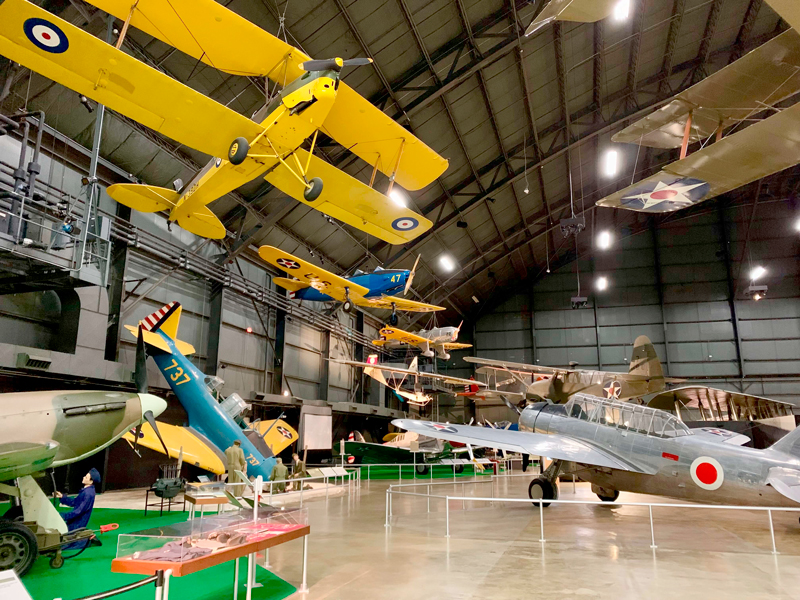
National Museum of the United States Air Force
The National Museum of the United States Air Force, adjacent to Wright-Patterson Air Force Base and part of the Aviation Trail, is the world’s largest and oldest military aviation facility and features more than 360 aircraft and missiles and some 6,000 historical artifacts housed in 19 acres of indoor display hangars spanning the history of aviation from the Wright Brothers to current stealth aircraft technology. It contains an atrium entrance, an IMAX theater, a gift shop, a bookstore, a café, the National Aviation Hall of Fame, an outdoor Air Park and Memorial Park, and seven galleries: Early Years, Air Power, Modern Flight, Cold War, Missile/Space, Presidential Aircraft, and Research and Development/Flight Test Aircraft.
Significant exhibits, to name only a few, include the North American XB-70 Valkyrie, the Wright 1909 Military Flyer, the Bleriot Monoplane, the Curtiss JN-4D Jenny, the Nieuport 28, the Sopwith Camel, the Fokker D.VII, the de Havilland DH.4, the North American B-25B Mitchell, the Consolidated B-24D Liberator, the Boeing B-17G Flying Fortress, the Boeing B-52D Stratofortress, the Convair B-36J Peacemaker, the Boeing WB-50D Superfortress, the Boeing RB-47H Stratojet, and the Lockheed SR-71A Blackbird.
Also on display is a rich collection of former presidential transports, like the Douglas VC-54C Skymaster “Sacred Cow,” Franklin D. Roosevelt’s purposefully-built airplane; the Douglas VC-118 “The Independence” used by Harry S. Truman between 1947 and 1953; and the Boeing VC-137C SAM 26000, the 707-320B-modified and first specifically-designed jet aircraft for presidential use designated “Air Force One.” During its 36-year flying career, it carried eight sitting presidents and countless dignitaries on historic journeys known as Special Air Missions or “SAMs.”
“The William E. Boeing Presidential Gallery gives visitors the opportunity to view an historic collection of presidential aircraft, and walk through four of them, including aircraft used by Presidents Roosevelt, Truman, and Eisenhower, as well as the Boeing VC-137C which was used by eight presidents–Kennedy, Johnson, Nixon, Ford, Carter, Reagan, George H.W. Bush, and Clinton–in addition to carrying heads-of-state, diplomats, and other dignitaries and officials, on many historic journeys,” according to the museum.
For an aeronautical professional or just bonafide buff, a visit to Dayton, the “Birthplace of Aviation,” is an immersive and enhancing experience.
1 Comment
Hi,
This is a great tribute to Aviation. I have been in Aviation for 50 years and recently was awarded the Charles Taylor award form the FAA. I was thinking that having a plaque with the recipients names of those awarded the Charles Taylor award would add more insight into this wonderful industry.