

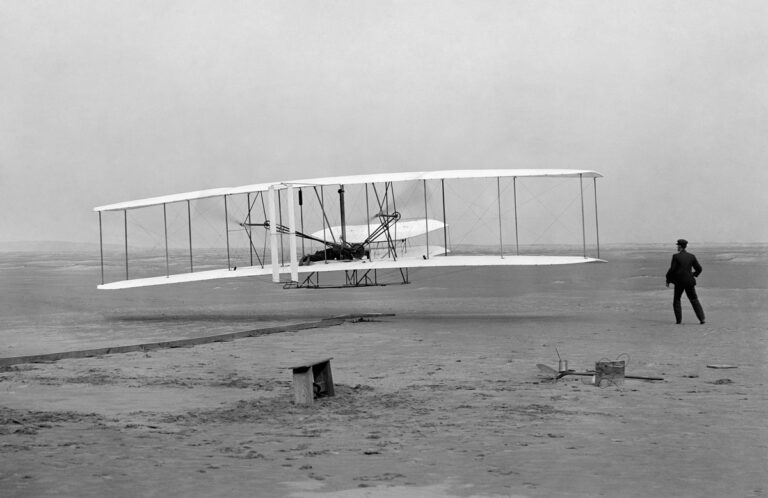
One of the most famous ‘aviation firsts’ photographs of all time was taken by John Daniels of the Kill Devil Hill Lifesaving Station and made from a 5 x 7-inch glass-plate negative deposited in the Library of Congress in 1949.
A camera was set up on a tripod by Orville Wright, and it clearly captured the world’s first powered, manned, and sustained airplane flight at the exact moment of liftoff after Orville instructed Daniels how and when to snap the shutter.
With Orville Wright at the controls, lying on the lower wing of the Wright Flyer with his hips in a movable cradle that operated the wing-warping mechanism, brother Wilbur ran alongside the machine to steady it just seconds after releasing his hold on the upright wing strut before stepping back to watch it fly.
Orville and Wilbur faced freezing temperatures, ice-covered rain puddles, and winds up to 27 mph. The first flight lasted 12 seconds and stayed aloft for a total of 120 feet. This flight was followed by three more on that day, with the brothers taking turns flying. Each flight was longer than the previous flight, and the fourth and last flight of the day covered 852 feet in 59 seconds, with Wilbur at the controls. After its impressive fourth flight, the Wright Flyer was caught by a gust of wind, rolled over, and was damaged beyond repair.
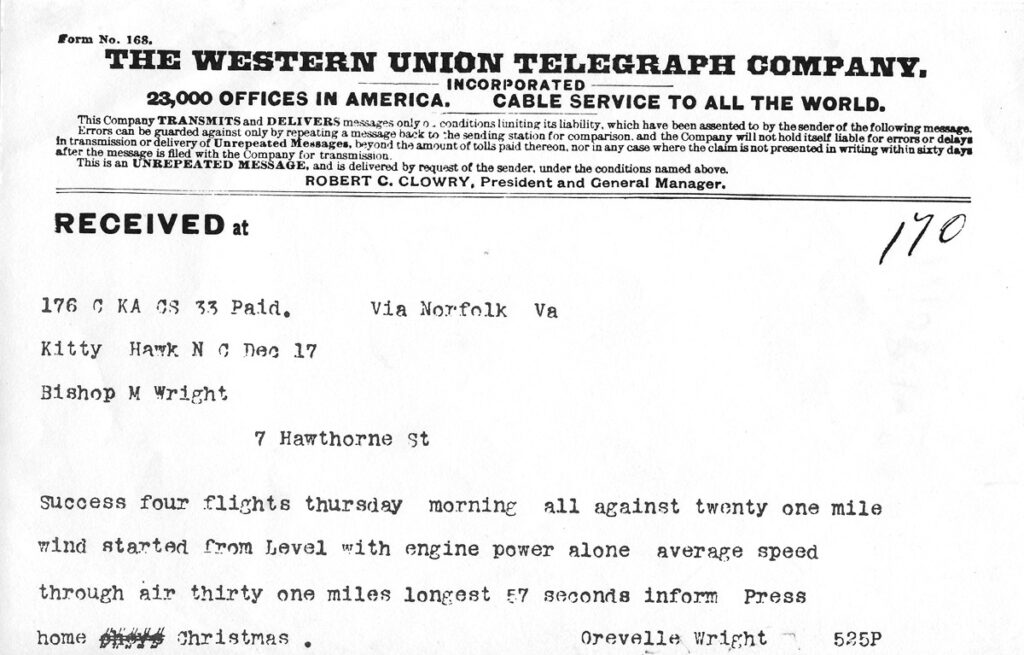
Following their momentous morning and successful flight, the Wright Brothers walked to the town of Kitty Hawk to send a telegram to their father, Bishop Milton Wright. The only telegraph operator in Kitty Hawk was a government wire at the weather bureau office, which passed the message on to Western Union. Two errors in transmission were made – Orville’s name was misspelled as ‘Orevelle’ Wright and the time of their longest flight was 57 seconds instead of 59 seconds.
The Wright brothers famous flights on the Outer Banks of North Carolina defied the 19th Century’s idea that taking to the air was a far-fetched, impossible dream — and in 12 seconds, their first flight changed the world and proved that powered flight was indeed a reality — inaugurating the aerial age.
Today, the Wright Brother Memorial at Kill Devil Hills in North Carolina is a towering, 60-foot-tall granite structure that sits atop the hill where the Wrights achieved their first momentous flight. The original Wright Flyer is permanently displayed at the Smithsonian National Air and Space Museum in Washington, D.C., an everlasting reminder of the Wright Brother’s incredible feat 121 years ago on that December day in 1903.