



Airline Origins and Service Inauguration
Chicago-based Midway Airlines, which plied the skies for a dozen years, was the first deregulation-spawned start-up to enter service, paving the way for the multitude of similar-strategy carriers that followed. In a way, it represented all of them, sparking a resurgence of vacated, underutilized airports, which they claimed as their operational bases, and it taught important lessons about such airlines. Ultimately, it demonstrated the underlying forces of U.S. deregulation. Its history may have been brief, but it was characterized by aircraft, destination, and strategy changes as it sought to determine its niche and profitably fill it.
Founded on August 6, 1976, by Irving Tague, a former Hughes Airwest executive, to offer low-fare, high-frequency, no-frills, single-class service with a fleet of used McDonnell-Douglas DC-9s and to re-establish its virtually dormant but city-vicinity Chicago South Side namesake airport, thus avoiding congestion and competition from incumbent carriers using O’Hare International and taking advantage of lower landing fees and terminal facility prices in the process.
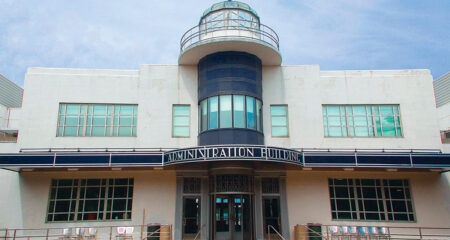
Its story was, to a degree, almost as much about an airport as it was about an airline. Once “the” area airfield, it lost all of its tenants at the end of the 1950s when O’Hare was completed, leaving Northwest Orient as the only remaining thread to its piston-liner past.
Tague, resultantly, saw Midway Airport as an opportunity and an uncongested alternative, re-injecting it with passenger purpose the same way that Southwest Airlines had re-established Dallas-Love Field. Harnessing deregulation’s freedoms, he endeavored to link the airline and airfield with a common name and cause.
Wings would be provided by five former TWA DC-9-15s, featuring a five-abreast, single-class, 86-seat interior—only one row short of its 90-passenger maximum—and most of their previous owner’s color scheme. But externally, they reflected their “Rainbow Jet” designation by displaying a vibrant livery.
Inaugurating scheduled service from Midway Airport on November 1, 1979, Midway, the airline, offered multiple daily frequencies to Cleveland, Detroit, and Kansas City and treated its passengers to complimentary soft drinks, juices, coffee, tea, peanuts, and snack trays of breadsticks and cheddar cheese spread. An attempt to subsequently touch down in Minneapolis was unsuccessful, resulting in its discontinuation after a short period.
As would repeatedly play out in deregulation skies, Midway soon adopted a fight-for-survival strategy since long-established Chicago hub carriers American and United—albeit at O’Hare—temporarily lowered their fares to retain and, in some cases, regain market share, leaving Midway’s load factors and profitability to slip away.
The Multiple Strategies
Its decline, it was determined, was the result of its no-frills, low-fare structure, so prevalent within the deregulation airline arena. It was not always the most apocopate one in all markets, especially those involving higher-yield business passengers whose expense accounts covered higher fares with the expectation of superior comfort and service. It was this strategy with which Midway tried to compete, admittedly with “O’Hare operators that offered size, route structure, and brand loyalty fostering frequent flyer programs. It was little more than a shadow to them.
In order to more effectively compete, if not altogether survive, it needed to embark upon a systematic analysis of its makeup, discarding those aspects that were ineffective in such a specialized environment and replace them with those that were.
The result was Midway Metrolink, a concept that expressed its ability to “link” the major “metro”-politan centers with the more convenient, hassle-free Midway Airport. Its advertisements depicted the toss of cabin seats through its aircraft doors and their replacement with business-attracting elements.
Internally, comforts included four-abreast leather seats, eliminating the dreaded middle one, increased legroom, larger carry-on luggage space, and garment closets, and externally its new image was expressed by a conservative, cream-colored livery.
Annual passenger figures clearly reflected Midway’s growth—from 56,000 in 1979 to 464,521 in 1980 and 885,739 in 1981. In 1982 it topped one million.
By 1984, operating a 19-strong fleet comprised of 60-passenger DC-9-15s, 84-passenger DC-9-30s, and 120-passenger MD-80s, it served Cleveland, Dallas, Detroit, Kansas City, Minneapolis, Newark, New York-LaGuardia, Philadelphia, Topeka, and Washington-National with 125 daily departures from Chicago Midway Airport.
Assets of failing and bankrupt carriers, including aircraft, airport facilities, and routes, at bargain basement prices provided opportunities for healthy ones to expand, and Midway did not hesitate to avail itself of this opportunity after Air Florida filed for Chapter 11 on July 3, 1984, enabling it to balance its business-oriented midwestern and northeastern routes with leisure ones to Florida and the U.S. Virgin Islands.
The move, sparking its third strategy after its Rainbow Jet and Metrolink ones, entailed operation of its first non-McDonnell Douglas aircraft—in this case, the Boeing 737-200—which accommodated 128 passengers in a six-abreast configuration. Although they were painted in the same cream livery and retained the light meal service, they operated under the “Midway Express” banner alongside the pure Midway Metrolink one.
The Metrolink strategy, in the meantime, was itself only partially successful. While load factors were high on morning and evening flights as businessmen traveled to and from their companies’ corporate offices for the day, the period in between attracted fewer passengers, leaving Midway to counteract the revenue loss with a reversion to five-abreast seating, its fourth strategy. The improved Metrolink service was retained, but, as occurred during the Rainbow Jet period, higher-yield travelers lost their coveted comfort and legroom.
A sixth strategy, implemented in early 1987, once again saw it come full cycle. Because the single and dual-class cabins of its nine DC-9-15s, 11 DC-9-30s, and ten 737-200s limited their route type and destination utilization, they were reconfigured yet again, the single-class concept now re-introduced, which provided ultimate network flexibility. Capacity increased to 83 and 115 in its short- and long-fuselage DC-9s, yet decreased to 122 in its 737s. But service differentiation in its two classes had only been reduced to seating and this lack had failed to attract sufficient front cabin load factors.
The brand, simply designated “Midway” and identified by a new red and white livery, eliminated class, seating, and name differentiation, but it served a few new destinations, such as Denver, Indianapolis, and Las Vegas.
Expansion, by means of undervalued assets of a failing carrier, occurred once again when it took advantage of Eastern’s $213 million package that consisted of its passenger, cargo, and maintenance facilities in Philadelphia, 16 Midway compatible DC-9-30s, engines, and spare parts, two transborder routes to Montreal and Toronto, and two lucrative slots at both New York-La Guardia and Washington-National airports.
The strategy, its seventh, gave it a second hub, an east coast route concentration, and Canadian reach, all without the otherwise protracted expansion period required if it had attempted to do so from scratch. It also avoided any aircraft, facility, frequency, service, or employee reductions at his existing Chicago hub in the process.
Demise and Deregulation Lessons
All of these aspects were superlative and promising, except one—Midway’s financial ones. It was losing almost $1 million a day.
Its acquisition of the Philadelphia hub at a time when fuel prices increased because of the Iraqi invasion of Kuwait, and competition from USAir there prompted its October 1990 sale of it to them for $67.5 million. The following year’s recession and declining load factors forced it into Chapter 11 bankruptcy protection in March. Its overexpansion, the Gulf War’s effects, and competition from the established, more financially sound airlines all sealed its fate.
Ironically, the airline that rescued an airport could not be rescued itself. Its meteoric, multiple-strategy rise-and-fall was brief, spanning only a dozen years, but it left a legacy by teaching several lessons.
Although it employed the low-fare, no-frills, used-aircraft model subsequently adopted by numerous other deregulation-spawned carriers, that strategy, first and foremost, was not always successful in markets that competed with major, established, well-financed ones that offered frequent flyer programs and improved comfort and service to high-yield business travelers on expense accounts.
Secondly, its continual strategy changes attempted to achieve profitability in a very competitive environment, but only dual cabin classes could satisfy high- and low-yield executive and leisure passengers—and not necessarily on all routes, such as those to the Florida sunspots, which themselves were subjected to seasonality.
As had occurred with Southwest at Dallas-Love Field, PEOPLExpress at Newark International, and Northeastern at Islip’s Long Island MacArthur Airport, Midway was able to resurrect an uncongested, underutilized, almost-dormant airfield by taking advantage of its lower landing fees and ground facility costs, attracting passengers and, ultimately, other operators with its low-fare service. Its common goal of both airline and airport growth was briefly successful in the first case and ultimately so in the second one.
It often expanded with the acquisition of bargain basement assets obtained from failing airlines, such as those of Air Florida and Eastern, until it itself became fodder to surviving entities.
Finally, it demonstrated deregulation’s David and Goliath theme, whose opportunities, if adequately financed, enabled a long list of upstart airlines with numerous structures to expand until the majors, now threatened by them, either defeated them or absorbed them, once again proving the fundamental Darwinian truth of the survival of the fittest.
Midway, the first deregulation carrier, wrote a story that was repeated and replayed until the last one lost its wings.