



Over the course of nearly 25 years, much of my work has been about aviation history and how both aviation and, unfortunately, war brought about previously unheard-of opportunities for American women during the Second World War. In researching the history of the over 350,000 women who served our country in uniform and the six million women who took jobs in factories and other civilian capacities on the U.S. Homefront, any serious researcher can tell you of the unlimited variety of rabbit holes that you will be led down to get to the heart of a story, and the branches that often lead you in different directions.
Away from the topic of aviation, this occurred as I was delving deeply into the story of women who served in the Red Cross in Europe during World War II. This led me to a book that I read about the more than 120 American women who were accredited as war correspondents; women who documented wartime experiences and informed American citizens at home of the human devastation of the conflict. In addition to the accredited women war correspondents, female journalists remained on the home front, documenting how the country changed dramatically under wartime conditions. And they did it through the lens of their cameras and the tapping of their typewriter keys.
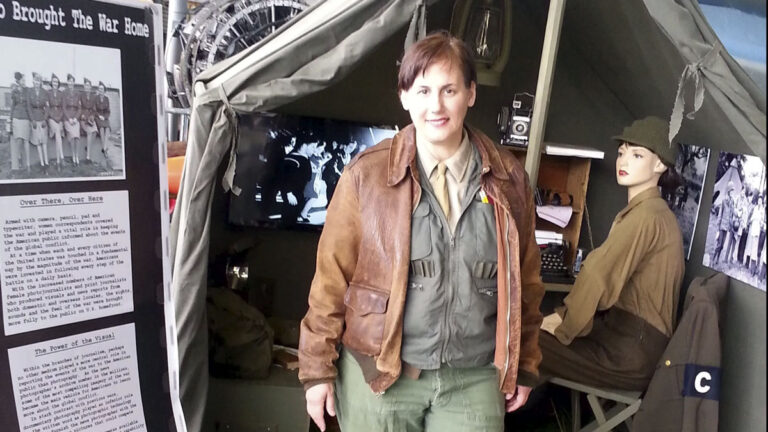
In May 2014, I curated a permanent exhibit at the American Airpower Museum entitled “Women Who Brought the War Home.” The exhibit tells the story of these women and the legacy they left behind as documentarians of war, whose implications are still felt today.
The exhibit is set up in a canvassed field tent and includes a mannequin depicting a female war correspondent in an authentic encampment surrounded by period memorabilia, such as a vintage typewriter and a Rolleiflex camera, on loan from the late WWII photojournalist Nestor Epstein. Adjacent to the encampment are the pictures and biographies of nine featured war correspondents and photojournalists, with five of the nine being New Yorkers, including Margaret Bourke White and Lee Miller, who both documented the liberation of Buchenwald and Dachau.
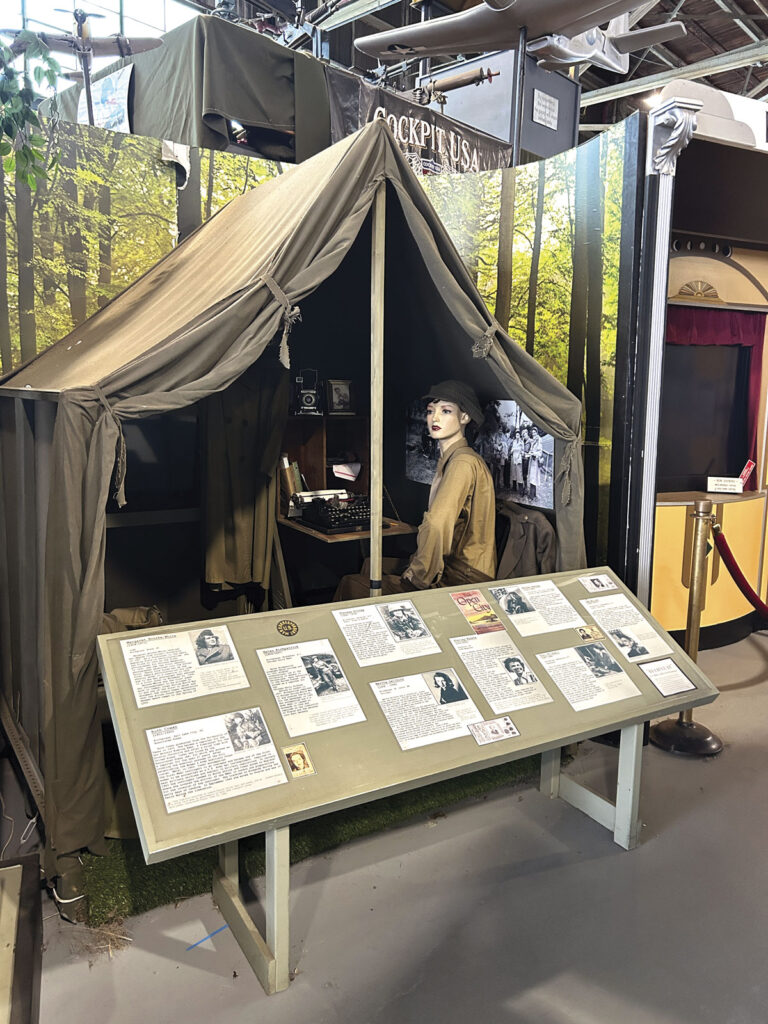
Inside the encampment are panels with photographs obtained from the National Archives, and beside them, a monitor with a streaming presentation showcasing images of their riveting reports and compelling photography.
Yesterday, I went to see the movie ‘Lee’ at the Cinema Arts Center in Huntington, in which war correspondent and photographer Lee Miller is portrayed exceptionally by actress Kate Winslet. Winslet spent eight years working to bring Lee’s untold and compelling story and her wartime photography to life. It was powerful, emotional, and unforgettable, and a story that should be told, seen and always remembered.
The movie brought tears to my eyes, and as difficult as much of the subject and imagery was to view, once again, from a curator’s point of view, I was grateful to have gone down that rabbit hole ten years ago and to play a small part in sharing the untold story of the women whose imagery and text will remain imprinted in my mind, and hopefully always in the minds of the American people.